AI Endurance TrainerDay Integration

Hi all,

AI Endurance is now integrated with TrainerDay. If you enable the integration

  1. your TrainerDay completed workouts will be imported into AI Endurance upon completion
  2. your AI Endurance training plan will be imported into TrainerDay

How AI Endurance is different from the other AI training apps:

  • we’re not just a wrapper around LLM calls: we model your physiological response with a digital twin that is trained on your historical numerical workout power, heart rate etc data + model your recovery with HRV, sleep, soreness etc data
  • LLMs help with adaptability, analysis, explainability, nutrition and fine-tuning of training plans

You can create an account at https://aiendurance.com 14 day free trial, then $20 USD/month.

Thank you @Alex for helping us getting this integration up and running!

3 Likes

I love to see my favorite apps join forces :partying_face:

2 Likes

Thanks Markus. It was great working and discussing with you. Although I have not had time to try your product based on our discussions and discussions with others it seems like it is likely a great product/solution.

1 Like

Hi @markusrummel this looks very intersting to me and i started to dive deeper.

I connected TrainerDay but it seems, nothing was tranferred. I downloaded my most recent trainings and uploded manually.

My question would be, is it worth/does it makes sense to uplaod all my TrainingDay rides? We talk about Data starting last year march with in average i think 4 rides per week.

My Wearable is Whoop. Here i got plenty of thoughts and background infos, which might be intersting for you, regarding the data input. Let me know, when you want to have them.

I also linked my Whoop i saw the last 14 days was imported but only the over night data.

I created a plan already and stenght training is included but how it will be reflected? i track my strength training in whoop.

Best regards

Hi @Abrams , thanks for connecting!

Re import: it can take a while/few hours but since this integration is new I’d like to double-check your TrainerDay historic import works as intended. Should be the last 2 years of data. Could you please email me the email address you used for AI Endurance to markus@aiendurance.com so I can check your account?

For Whoop we’re only using overnight HR/HRV data indeed. It’s a deliberate choice because those metrics have the most backing in research and also mirror a lot of other metrics we could use (for example lack of sleep will lead to tanking of rmssd in most scenarios). But curious to hear your thoughts what other data we could consider.

Re strength: we’re currently not importing activities from whoop (generally speaking we import only if we get the full data of a workout, i.e. fit file) and I don’t think Whoop API makes that available. You can manually track Whoop activities by adding manual activities in AI Endurance calendar or also through intermediary like Strava or Intervals.icu

Hi Makrus,

mail is sent.

Regarding Whoop: i agree that its nice backed with research. I don’t think that there should other data be used i just wanted to highlight, that i end up with relatively high RHR. Lately i could lower it but it still hovers around 65 bpm. I do like 90-120 mins of strength training per week and 3-4h cardio, HR based 142 bpm (MAF).

Whoops RHR and HRV is taken, to my knowledge, at the last deep sleep segment of the night. Wrist worn Wearables, are well known struggling in sleep stage detection. For some its better for others worse but overall, we only get an idea about the time asleep not so much about light, deep and REM. With this source of errors, the measurements for RHR + HRV for the last block of deep sleep is already questionable from my point of view and could be wrong already. But it will be the base for the calculations, righ t?

Last night for example: my RHR reported by Whoop: 68 bpm.

If I go to the data of the night, shortly after falling asleep first deep sleep block reported by whoop with RHR of 57 bpm.

I think that’s a huge discrepancy and potentially a big impact on the calculat ions?

To be honest, I did not feel nice after getting up this morning, sleep amount fine but else, headache etc. far away from feeling reaching new grounds.

Don’t get me wrong, I don’t want to question Whoops way of doing things, actually I have 1300 Days of Data so this data is somehow my truth.

These thoughts came up, when I saw my todays Dashboard and my Aerobic Recovery showing 3% only whilst my RHR is only 4 bpm above average and HRV 2 ms below average. That 3% was bit shocking and would make skip any cardio that day but potentially this number is right. Just sharing thoughts and feelings of my experience so far.

This is potentially result of my HRV and RHR in the last month reached a plateau. Not moving a lot and hovering around their averages.

My question towards strength training was more related how the stress/strain or training load will be calculated/considered or reflected. Actually, it’s good, that whoop workouts are not synced into AI Endurance to avoid duplicates and, sadly, Whoop does not consider Watts and Cadence, HR only.

Best regards

Hi Markus,

before you spending too much work looking into this for me: I figgured out it does not (yet) meet my needs or expecations.

The workouts, which are sent to TD are too basic in terms of i need to read the description and manual set things up.

For example: Today was planned 60 mins with max 134 Watts. The workout send to TD: 60 mins fixed ERG 133,5 Watts. Text says stay below this. Ok fair enough but whats the point?

I talked to the implemented AI and it confirmed its nonsense and it agreed (like AI likely do everywhere) that my HR Target would make more sense. So i updated my prompt in the Plan Builder making very clear what setup i use and that i prefer HR based training. The plan updates take super long btw, however it ended up giving me exact same training. 60 mins 133,5 Watts ERG. Only the text was updated: stay below 134 Watts and 142 BPM.

I am in the free Version ofc but at this stage i cannot justify 20$ per month for a workout recommandation where i end up having more work rather then less.

I think your work and idea is a great basement but yet i think mainly focussing on people which doing mainly sports not free time hobby athlets (like me) which want to use their time to train not to do “research”.

I will follow up our work and changes in the future and most probaly will test it again at some point.

Keep going and best of luck!

Cheers

Thanks for the feedback.

Re Whoop: they only make one RMSSD and resting HR available through the API. Even if we wanted to, we couldn’t use different values (e.g. whole night) since Whoop only exposes this one pair of values. The most important thing with HR/HRV based recovery modelling is to take consistent values (e.g. always the whole night, always after you first wake up, …). As long as Whoop takes a consistent measuring time frame/method, it should be fine.

Re 3%: although it sounds like a small deviation lead to a big drop in recovery, in our model it’s your resting HR value relative to your resting HR variation. So it sounds like your resting HR is pretty stable. For someone with big fluctuations in resting HR, this wouldn’t have led to such a big drop in overall recovery score.

Re workouts: that sounds like a standard endurance ride. You’ll find that in most plans of most platforms and point is to simply accumulate time at/below Z2. If you do intervals 100% of the time that obviously won’t be ideal. We deliberately keep it simple (it really isn’t more complicated than that) but if you want some small variations because otherwise it’s too boring on the trainer you could simply add something to the Plan system prompt like “I want my Endurance workouts to have structure because I’m doing them on the trainer”. You only have to do that once.

No pressure to sign up obviously, totally respect it isn’t for you, just wanted to clarify some points and that it’s not ‘nonsense’ :slight_smile:

1 Like

Could an AI that is integrated with TD schedule a HR+ workout when an athlete expresses a preference for HR training?

Should be possible.

1 Like

@markusrummel excuse my wording calling it nonsense, i was actually mad at the AI telling me that it makes so much sense what i am suggesting. If so, why the AI does not suggest it in the first place. :smile:

regarding whoop: i agree totally with you, even when something is „wrong“ if its consistently wrong we still can work with the trends. Trends are anyway the only thing i use to interpret my data.

Regarding the Workout output towards TD its not about being boring. I basically doing 90% of the time Zone2 training steady HR, i am used to „boringness“.

My problem i have is, that the kind of workout provided need me to adapt it and does not give too much of a guidance. If i start it it will directly jump to the fixed ERG Watts, 133,5 in this case. It will remain there and i meet the goal stay below 134 Watts. Thats for endurance rides, i saw also other rides for VO2 Max which had changing ERG of course, thats not my point.

However, i follow the 80/20 rule. 80% Aerobic, rest higher intensity. So i will end up majority if the time in the simple fixed ERG workouts.

Whats not clear for me, how i am supposed to improve overtime, when the training is so squishy. I can do 133,5 Watts for 60 mins but also i could do 80 Watts for 60 mins and in both cases i meet the requirements of stay below 134 watts.

The model predicted an increase of my Critical Cycling Power from 205 to 254 watts, which i find a lot within a few months.

So possibly its lack of my imagination to make such big steps with still 80% aerobic work. But this fact that for 80% of my training time i don’t get a clear guidance rather than: stay below this, i would expect a minimum at least. Stay above this. Most probably i got some mindset issues here so its me, not the AI model.

@Ivegotabike i updated my promts for the AI plan generator that i use HR+ in TD for my Workouts and the plans only updated with the text telling me now stay below 134 Watts and 142 bpm.

This can also be an input issue from my side. Here the circle closes, for a subscription based model/offer, i as an hobby Athlet expect things for me to be done rather than put my time to figure it out on my own with a lot of try and error while plan generation taking ages. Its about convenience.

To summarize i see my self here being the problem rather than the tool.

Best regards

1 Like

Markus would have to build HR+ support. Also 80/20 is 20% of days, not 20% of time. It’s more like 10% of time according to Seiler. Just to be clear. Andrea also suggests going from 0 or 5% of time ramping up to about 15% of time for a short period. But partially that depends on total time. A person doing 2 or 3 hours a week total might be able to do 30% of time or more.

1 Like

This brings an interesting discussion that there is a wide disagreement on. Should I do the highest intensity possible to achieve stated objective or should I do the lowest given intensity to achieve a given objective.

  1. The TSS/CTL crowd would typically say do the highest you can following the (mostly wrong) idea that CTL = Personal Fitness

  2. Another crowd which Andrea and I are a bit closer to would be that for many people recovery is the primary limiter and so doing the lowest possible effort to achieve the desired objective is likely to produce the best results. At the minimum I would suggested this approach healthier and safer for most.

But in both cases it results in “it depends.” Another question “Is todays objective even what it should be? :slight_smile:”

These are all difficult questions to answer and if expert humans strongly disagree on what is the best approach then AI is not going to do any better job and arguably worse and making such a decision.

People that recover well from more intensity frequently do well with more intensity. Even one rider here with a 400w FTP said he was unbreakable, until he broke…

Generally for elites, train hard/get fast but slowly over time elites also lower intensity durations considerably relative to FTP, except in races. More volume beats more intensity up to a point. Back in the day when TR suggested crazy high volume sweet spot, the people that survived would get faster. The problem is you are on the edge and the chances of crashing are high.

1 Like

This is partly why I now prefer HR+ for endurance (and tempo and sweetspot) workouts, rather than power.

If an athlete rides endurance rides at a low HR* with HR+ controlling the power then, as aerobic fitness improves, the power sustainable at that HR will, over time, increase.

*Let’s say derived from the MAF formula, or just below the lower end of Z2 HR zone, or whatever formula takes your fancy.

2 Likes

@Alex Can definitely look into building HR target support for the TrainerDay integration. I agree for Endurance Ride staying below certain HR is arguably more sensible than power.

Re chasing TSS: totally agree that that’s not ideal and the whole point of our digital twin approach is that it is a personalized model to find what training gives you the biggest gains. Gains not measured in TSS/CTL but measured thresholds/performances. Recovery, in particular scheduling in enough time to be ready for the next effort is key too, I agree.

I don’t want an LLM to make those decisions (like you say it was trained on a mix of opinions of human coaches found on the web) but a personalized numerical model, i.e. digital twin: training X leads to performance Y

1 Like

Thanks for the comments, makes sense. The less than X Watts instructions is almost always slower than people ‘want to go’. They’re not really gonna ride at 50 W if they’re to stay below 200 W but your point is fair. Technically we’re aiming for ~80% for the lower range.

Need to look into how ERG mode works with our TD integration. Usually we recommend the Endurance Rides as ‘Free Rides’ so you’re not locked into that one power value (which I agree is a horrible experience) but you simply keep an eye that your power doesn’t exceed the upper bound for power and/or HR.

1 Like

You can also send slope segments which are free-ride equivalent but since slope are highly personal based on gearing and watts it’s harder to pick a one size fits all. I guess sending 1% slope for lower efforts and 2-3% for harder should usually be ok and the person can adjust. But i think for TD HR+ and ERG are likely safer but up to you.

1 Like

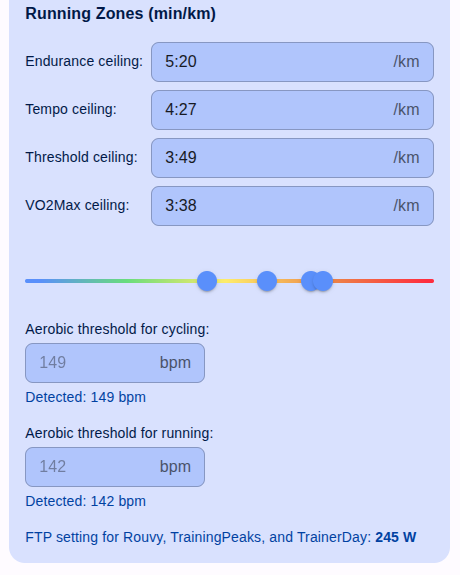
Ok for pure Endurance Rides (only one segment with target ‘stay below X W’) AI Endurance is now exporting as HR+ to TrainerDay IF your aerobic threshold ceiling is set in Account page:

1 Like