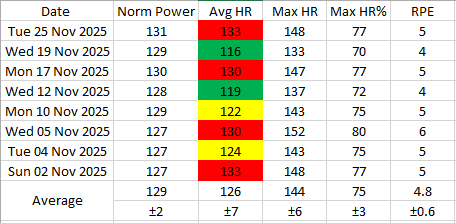
Let’s say you execute the same exact workout or workout type over and over, what would you expect the Avg or Max HR / RPE variation to be between the workouts?
I’ve done a family of workouts 8 times now and the compare activities in Intervals.icu says Avg HR is ±7 BPM and Max HR is ± 6 BPM. That seems like a lot of variation.
I wonder if this is trainable, would a very fit athlete would have less day-to-day variation than a very unfit athlete?
For me the biggest impact is time of day and prior training load. My diet and sleep is generally a constant.
5:30am workouts are generally 5 - 10 beats and higher rpe than when I do them at 12 noon. Tue after a 4 hour endurance ride on sat/sun is higher than the equivalent ride on a thur.
This is where I get slightly confused. Ignore HR/RPE and push through adhering to wattage targets or adjust for how you actually feel. Still not figured it out🤷
Yes, I feel HR and RPE are very sensitive. I think push through vs adjust is personal but my advice would be more health first than performance first so that would mean adjust based on RPE unless long term you see it not aligning with your goals.
Some people like HR+ for this reason as lots of time HR aligns closer to RPE then power does so you can still feel you did what you were supposed to but have it more controlled by your current metabolic state.
But my experience is more like yours. High variability in RPE/HR to power.
Here is Andrew Coggan, posting on a thread elsewhere,
" HR is a measure of cardiovascular strain during exercise, but won’t really tell you anything about metabolic responses, which are more important in determining endurance exercise capacity, and hence whether you’ve done too little, too much, or just enough in the context of your overall training plan. The only way to find that out is to try different things and see what is sustainable and what is not.
Now if all you have is a HR monitor, and you know from experience that if you do more than X duration at Y intensity you’re going to have difficulty recovering adequately for your next important workout, then yeah, you could use HR to help hold yourself back. But if you’ve got power (and perceived exertion, which is always freely available, and tuned by millions of years of evolution), why bother? Your HR, for example, might be elevated above normal due a poor night’s sleep, despite which you may very well be able to carry on training as usual."
He seems to love to answer stuff very scientifically but that sounds like a bad reference to metabolic response… meaning HR is a metabolic response but power is not. Overall I agree with the sentiment I believe you are trying to convey, its just I don’t think that is a great quote from an accuracy stand point.
Think about this below, the following is the definition of what metabolic means, but maybe he has his own nuanced definitions…
Heart rate rises to deliver oxygen to working muscles so they can produce ATP (energy). The harder your metabolism is working to meet energy demands, the faster your heart needs to pump. HR reflects the metabolic cost of the effort, not the effort itself.
I don’t see any of this as relevant. What we are talking about is, does 85% of FTP produce better results than 80% of FTP for half of your intervals on a day you are feeling off? Another one of those “it depends.”
Some people will be able to use HR as a proxy for or support for RPE but some will use it as an excuse
As one other person pointed out on another thread they feel way better training with HR intervals. So if you are the type that wants to complete your intervals and you find HR aligns with RPE then it might be smarter (healthier) to do HR intervals as their is no conclusive evidence that slowly decreasing power over an interval is worse metabolically or produces worse results. Using scientific terms to back up beliefs “sounds good,” but wheres the proof.
As we know durability is critical from a race strategy which has a strong mental aspect so backing off intensity is not an optimum strategy for peak period race training… the suffering becomes an important aspect.
So if being good at suffering and really digging deep is important to your cycling then its likely a good idea to stick to power and if you get the right amount of suffering from power than by all means stick to it. If you are just trying to get faster then a health first approach has a lot of merit, and as I have repeated many times, Andrea believes many pros could even do better putting heath at a higher priority…
It’s interesting, usually at about 15 minutes I am frequently pretty sure it’s going to be a bad day and some time before 25, I feel it will be a great day… I think it’s very easy to let HR amplify that bad day belief… I think this is what @Ivegotabike is alluding to in his quote. So you need to be sensitive to this and hide HR from yourself to make sure it is not wrongly influencing your beliefs.
Sorry “good” day and “bad” day weren’t reflective of what I was trying to say, I mean good legs or bad legs. Every day is a good day!
I have to say you’re very giving with your time. There aren’t that many sites where the top executive is that involved with the users. I appreciate your banter with us.
Yes, that is what I meant by good day bad day too… Meaning will these power based intervals feel like I want them to or at the right amount of suffering…
As you can see, I would much rather do this than dumb marketing stuff
I am trying to work on a new youtube content series… I have a good idea but I need the right drivers to put it together… At the minimum I need to update some of our feature videos that have changed.
You may not know it, but I do feel self-conscious about posting sometimes.
The forum is very welcoming, I’d say more welcoming than just about all of them I’ve visited, but within myself I do feel an obligation like there needs to be a certain level of achievement to “earn your stripes” so to speak when posting on a training forum.
I don’t think at my performance level I’ve earned the stripes, but I genuinely appreciate the effort you’ve put in to discussing training with me over the past few years.
You’ll work to help anyone no matter what their performance level is.
I seriously appreciate you as well. Because of discussions with you, people feel more welcome. For me it’s all just series of very fun problems. Meaning helping people achieve their goals that have a health element to it. It’s a dream come true.
I sometimes get to the end of the warmup thinking that I might not make it to the end of the rest of the workout.
Sometimes that turns out to be true.
But not always. There have been plenty of times when I have gone through a workout thinking “OK, I will just try the next interval before I decide whether to quit.” But then going on to actually complete the whole thing, with pretty decent form and no ill effect on the next scheduled workout.
Yes exactly, if you don’t mind these evaluations and feel success even if you backed off, it’s a perfect approach and I like, lets just see how the next one feels. Friel said something like you should typically leave one more in the tank.