Building and Measuring aerobic fitness

Hi all,
I’m a 46yo MTBiker and, after reading several books about training, I’m currently reading “Endurance Training and Racing” by Phil Maffetone.

I’m convinced to follow his principles for this winter (3-4 months) and see what are the results.

To train in MAF zone I should train at 180-46 = 134 bpm (or 134 +5 bpm max as I’m training 4 times per week without problems for some time). Let’s say my MAF HR target is 135bpm.

I’ve started training 3.5 years ago, and I’m currently training on bike on Tuesday, Thursday, Saturday and Sunday. On Monday and Friday I do weights training at gym, Wednesday is a complete day off from all sport activities.

On bike I normally train harder on a day and lighter on the next day to try to recover properly, expecially from anaerobic workouts (which I’m stopping for now).

Starting this week I’ve planned to reduce a lot all anaerobic efforts, included weights (I’ll basically halve the weights for all exercises), trying to avoid anaerobic stress (cortisol) that might negatively impact aerobic growth.

On Tuesday I’ll train with this workout on my Home Trainer Trainer Day - Workout: Z2 2.5h

On Thursday I’ll train with this workout on my Home Trainer Trainer Day - Workout: AeT / MAF Test 60 min @ 135 bpm + 30 min @ 120 bpm + 30 min @ 125 bpm (which is also the AeT / MAF test)

Over the weekend I do long easy rides (outdoor if weather permits) trying to reduce at the minimum hard efforts on steep uphills (but some are unavoidable with MTB).

What do you think about this program?

Regarding the AeT test I’m taking notes of the results in a Google Sheet, also about Trainer Day - Workout: Z2 2.5h (which is my z2 training - but also the AeT test in the end is high z2 / low z3 training in my case)

For Trainer Day - Workout: Z2 2.5h these are the last 2 executions:

The goal/hope is to see the avg HR go down over time.
For this workout I kindly need an advice from you :slight_smile:

Between a nice warm-up and cool down, it consists of 4 x 30 min blocks with 30 seconds recovery at 35% ftp between them (otherwise it’s very mentally taxing to ride on Home Trainer for 2.5 hours):
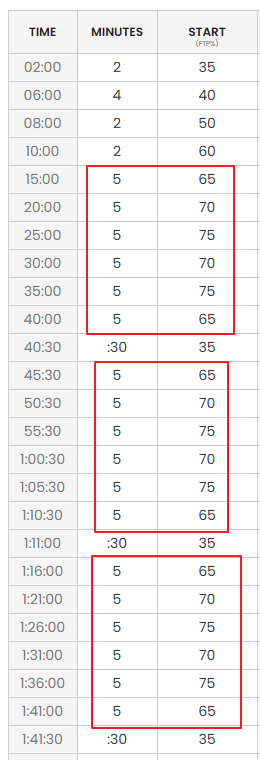
At the moment I execute each block at an average HR of 117-125:
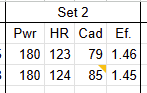
image

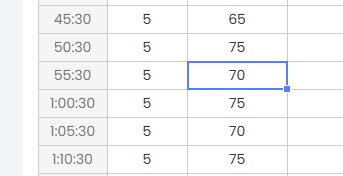
Do you think I should increase the intensity of each block in order to work with an higher bpm and be closer (at the moment) at the MAF threshold of 135 bpm? For me this workout now is long, creates some fatigue but is doable/enjoiable. Of course increasing the intensity will make it harder and less “nice”. In any case I want to keep it a Z2 workout and do not go in Z3. What do you suggest? would you keep it like this with several ups and downs (aiming at touching different phisiologic responses) or keep it stronger more or less like this?
image

And / or eventually changing the highlighted interval from 70% to 75% or even 80% (z3)? Doing an interval at 80% after the previous ones near 75% might also cause the HR to go a bit above target (I can reduce this chance by doing a rest of 1min at 35% instead of 30 seconds).

Perhaps are details, but as I’ll execute it for some months I want to squeeze something also from the details if the end result can be better.

From this week I’ll start to consistently measure RHR and HRH (today I should received a wrist strap)

I would be happy to see your opinions. Thank you!

Have you considered HR+ mode?

It reduces the need to think about the details and just get on with pedalling.

Hi @Ivegotabike
sure, I execute Trainer Day - Workout: AeT / MAF Test 60 min @ 135 bpm + 30 min @ 120 bpm + 30 min @ 125 bpm in HR mode.

But I also like to variate - HR mode for long time at steady HR peace is also very mentally taxing (effort without rests and without variations)

1 Like

If the long time purely under HR+ control very mentally taxing for you, then I understand why you are looking for variation.

That said, looking at your “ActiveCollab” data table, the HR averages on there (123 and 119) are a long way from your 135 target.

Even digging down into the HR averages in sets 1, 2, 3 and 4, the highest average seen is 129 in week 1 and 124 in week 2.

Whilst a lower HR is not inherently a bad thing for this type of training, do you wonder if it is possible get those averages a bit closer to your target, without hitting higher peak HRs during the workout?

tnx @Ivegotabike
I’ve fixed the wrong ActiveCollab link (ops…)

So you also think like me that I should increase the intensity a bit.

Isn’t there any upside in touching different high/low zones of the wide Z2 zone? (55%-75%)? if not it’s probably better to change the block to
5 75
5 70
5 75
5 70
5 75
5 70

and eventually rest for 1 minute at 35% instead of 30 seconds.

Maffetone says that the maximum aerobic effects are closer to the MAF zone (around 135 bpm for me)

tnx for your feeback.

ps, on the long run, if the Maf method works for me (read: I implement it properly), those avg HR should go down while keeping the avg power steady (this is my goal).

On Thursday I do HR training, on Tuesday I would only maximize my Z2 training (starting not far from optimal and hoping that HR goes down)

I think about low HR / MAF / Zone 2 training from a different perspective.

Rather than looking for average HR to go down while keeping the average power steady…

I look for the average power to go up while keeping the average HR steady

That’s why I control these workouts with HR, not power.

I agree, but it’s also true that while training, if the average power goes up (and I/we do FTP tests every once in a while) also the watts at 70% FTP will go up (if we update the FTP).

I just want to variate the training and be less monotone.

I agree that the end end goal is to be able to produce more power in aerobic zone (under our MAF zone)

I think this is the mindset that more is better :slight_smile: I believe to follow maffetone and zone 2 thinking it goes away from this in that z2 is “better” than z3… I mentioned before I was pace limited so my hr went from 135 to 95 and just kept dropping. But I also believe it depends a lot on personal preference in that if the maximum is more fun than lower then max is likely better. So maf-10 can be just as effective as maf +0 and more effective than maf +5 …

I am just explaining maffetones suggestion not that it is right or wrong. I do believe most would rather power go up and follow it, as compared to hr down. Many pros feel upper zone 2 is hard but there are a lot of “it depends” in that. Even Mark Allen said after a year of pure zone 2 he was doing zone 2 intervals as it was more comfortable for him.

Ehi @Alex
Maffetone states that the closer you’re at the MAF threshold the better (more effective) are the results. Based on this, training at MAF-10 (125bpm) is less effective than training at MAF. I think that the whole conversation is around that and if there are also “other” opportunities/improvements at training below the MAF threshold.

If not, the best is to ride very close to it and use the most efficient training as possible

If you keep reading you will see he says -10 is often a preferable target… and for sure better than going over when following his plan and since it is going to be a range -10 to -2 is probably the safe suggestion. If you set 0 as the target it will be -5 to +5 or more.

Now this is just the starting point as long as you are seeing aerobic progress it can be HIIT :slight_smile: But establishing that first low hr base line that shows consistent progress is what is important and where you go from there is individual. We are not looking for what produces the fastest results we are looking for what creates consistent long term improvement. My -35 was still seeing consistent aerobic progress after 3 years of consistent running.

Most people flatline on most training programs this is just one safe/healthy methodology for breaking out of these progress flatlines, it’s also great to start training in general (building a base…). It’s something you do seasonally, not for the rest of your life :slight_smile:

FTP might not go up (or change at all), even though power at HR X bpm does go up.

Efficiency can improve.

Whilst there is a general correlation between Z2 Power and Z2 HR zones, they don’t match perfectly (and there is no need for them to).

The MAF HR target is a maximum. So having an average closer to, but never above, is the aim. As it is hard to control HR so precisely in real life, shooting for a target 5 / 10 below allows the cap to be more easily respected.

There is a lot of other stuff you can work on in these workouts to break up the monotony. e.g. trying to accurately hold cadence at 5 or 10 above or below your “normal” cadence for 10 / 15 minutes.

1 Like

FYI: He is an expert on this stuff in general but he really prefers hard training (maybe similar to you? :slight_smile: ) and questions zone 2 but giving it a first class try right now. Even cutting his weight lifting back as part of the experiment which is a monumental task for him.

2 Likes

I am neither an expert (on anything), nor do I have a preference for hard training and, absolutely for certain, not weight lifting! In fact, if ever the phrase “don’t you even lift bro?” applied to anyone, it would be me.

The newbie gains principle might even apply in his case - just a few weeks focussed on low HR workouts could deliver quite eye catching improvements.

No he has done tons of zone 2 (polarized) and tons of hard work and flatlined aerobically, so want to see if he can break out of this flatline really trying to follow Maffetone’s advice. He is a weight lifter / mountain MTB rider which is not easy to follow maffetone in this case.

@Alex I’ve not read yet the part of Maffetone about what you said. I’ve just read that the most effective way to train is between MAF (max/cap) and MAF-10. Of course MAF after doing all adjustments (-10, -5, +5)

and yes, it’s a big effort to me to reduce weights; I’ve to fight against myself :slight_smile:
It’s also true that I prefer big changes in rythm (not necessarily hard training). That means that when riding I like a lot to push on some hard uphills at 600/800w for as long as I can

We are not looking for what produces the fastest results we are looking for what creates consistent long term improvement

yes and no. Why not doing both? if training at MAF-5 is better than traning at MAF-15 (despite MAF-15 would bring results), why don’t do that?

Yes I have read 4 or 5 of his books so I am not sure where it says it. :slight_smile: I think he is clarifying because most people try to push right up to the border and end up a fair amount of time over.

I also read Ironman winner Mark Allen’s writing/book (coached by Maffetone) and another good one is Stu Middleman’s book. Stu’s book is also good and was coached by Maffetone and won some world records in distance running. Stu gives another angle on Maffetone’s work but all these guys pretty much are just repeating what Maffetone said.

1 Like

so we all agree that we shouldn’t exceed MAF.

By doing that I’ve not understood if we also agree that training at 130bpm (with MAF = 135) is more time efficient than training at 115 bpm

yes I already do that. This is the reason of the BPM spikes in the table I pasted. My natural cadence is around 80 rpm, when I push at 90-100 my hr goes up (but I do that for training and teach my body to get used to it)

1 Like

I would say the last 6-months you don’t feel you have seen any aerobic progress, how efficient is that? Forget about efficiency and focus on ANY improvement :slight_smile: Since under produces results and over may not, it’s better to be on the safe side… But yes if you are 100% under your MAF not 99.5 then it’s reasonable. So once you are seeing consistent improvement then you can do whatever you want until progress stops. First get forward momentum then optimize efficiency.

My point is efficiency is not the important part. Progress is at least at first.

2 Likes