with MTB pure MAF can never work when you want to climb a 23% uphill full of stones. You can choose to remove them from your trails or accept a small deviation from the perfect MAF workout.
I’ll try to reduce those uphills, but not remove them at all.
Do like runners do and walk. It’s not fun but it’s how most people start Maffetone training. Or they find specific routes. It’s a commitment to a plan.
Maffetone specifically says, some people can handle this and some can not. It’s better to start with 0, see aerobic progress, then start adding it to see what happens.
Hello,
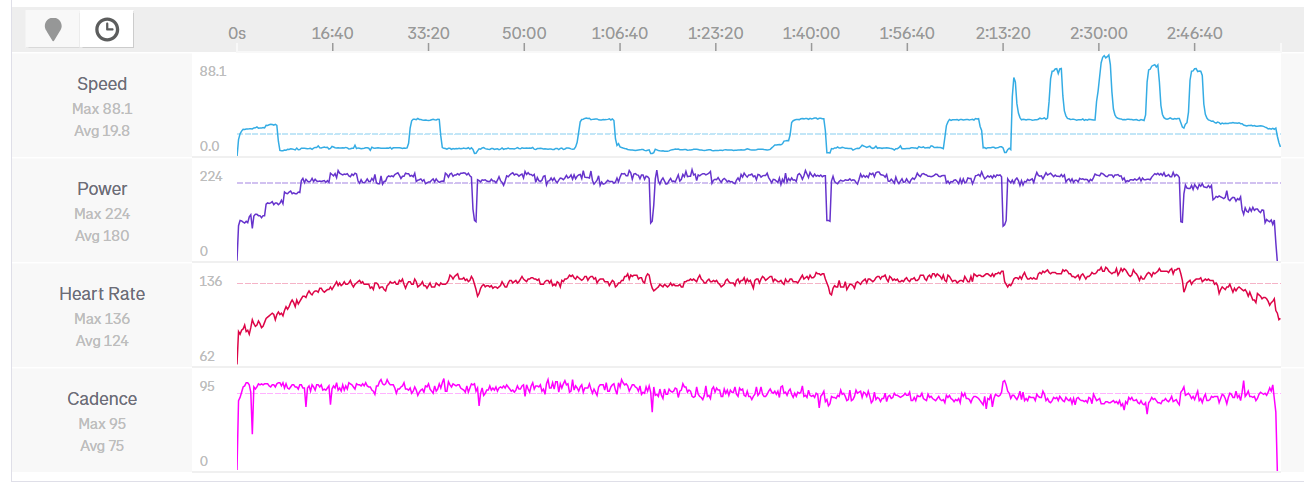
this morning I made my new Z2 workout with some small changes to increase a little bit the intensity.
Each block of 5 minutes is now 70/75/70/75/70/75 FTP% instead of 65/70/75/70/75/65 FTP%, moreover in MyWhoosh I increased my FTP from 260w to 265w.
I made the workout completely rested, drinking only plain water, without any carbs.
Is this the correct approach? in the video shared in the previous comments we can notice that the author was eating a gel during the MAF training. Should I also add some carbs to the water? if we add it probably the body will try to use less fats, but it’s also true, as Maffetone states, that mitochondria need glycogen to perform their activity. In any case I think I had my reserve full (yesterday I made 4.5h z2 outdoor workout)
Flat lines on power, HR and cadence are a good outcome for this type of workout. On that basis, your results look pretty good. Nice work.
If you are referring to the video I linked above, I don’t think that is a MAF workout that Floris is doing in the video. He refers to his MAF HR from 10 years prior being 150, so he would be above his MAF HR throughout that 3 hour marathon.
On carbs, we can refer back to Maffetone’s own website. He writes that carbs can be helpful during very long workouts or races. For example:
" Avoid pre-exercise carbs. Turning on your fat-burning metabolism is a must to improve aerobic function, but turning if off can happen by eating refined carbohydrates, especially sugar, prior to a workout. This causes the calories we burn during a workout to be more sugar calories than fat calories. In fact, a pre-exercise meal containing fat with few carbs may further stimulate fat-burning by boosting metabolism. For very long workouts or races of 2, 3 or more hours, carbohydrates during activity can be helpful.
The caveat: Eating refined carbs before workouts will result in less fat calories burned."
Hi @Ivegotabike
thank you for your feedback and for the appreciation of the workout!
Yes, I know that pre-exercise carbs are a no-go; the insuline would block the fat usage as fuel.
Tnx also for the interesting link. But also after reading it I’ve not clear when to intake carbs during the workout. I read that it’s important to intake carbs for a 2,3+ hours workout, like in my case. But how and in what forms? Is it ok inside the water? but should I start driking water without carbs and, only after some time (how much time?), water with carbs?
But from the link I also read another super interesting paragraph that was source of discussion in this forum
“Training around your personal Fatmax HR zone is a key. While laboratory testing can guide you to an optimal fat-burning training HR (which also corresponds to the aerobic threshold and the first ventilator threshold), these are evaluations most people won’t obtain. Instead, the MAF HR also corresponds to Fatmax”
Here Phil Maffetone states that MAF HR corresponds to Fatmax which also correspond to the first ventilator threshold (+ @Alex !)
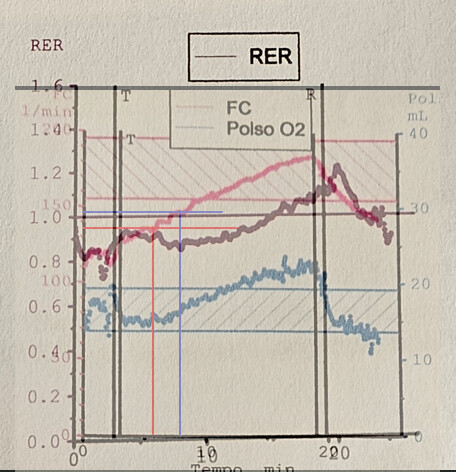
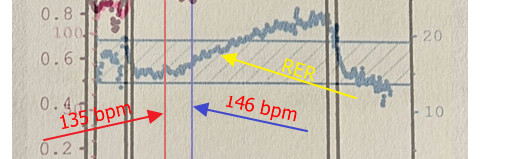
I’ve a laboratory test confirming that my first ventilator threshold is 146 bpm which is much higher than 180-age (=180-46 = 134 bpm, which might become 134+5 = 139 bpm). In that test the CFMax (184 bpm) was +9 bpm compared to average.
The pasted paragraph is enlightning for me. Does it mean that I might train at 146bpm instead of 134/139 bpm to follow the MAF model?
Of course we all know that 180-age is a model, not rocket science written on stone that is 100% perfect for everybody.
I will respond tomorrow, but realize this carb intake concept has two totally different things. For performance above say 80% of FTP in most cases you are going to do better but in this specific case we are talking educating your body, so the education process and causing the adaptions is something completely different than trying to optimize performance.
It would be interesting to know the 0-60 vs 60-120 decoupling percent as well as first 1/2 vs second 1/2 just as two more things to track. Overal it looks good to me.
PF states that in case the glycogen stores are depleted also fat utilization is impaired. I think that this should not be the case with pure MAF training, but I was trying to find a reason on why the HR was going up on the 5th block (that is not taken into account into the decoupling rate - I’ll not do that 5th block so frequently)
From the table you provided, there is still some room to get closer to the MAF target, isn’t there?
Your average HR by set: 122 / 125 / 125 / 126 / 130 (overall 125)
I put forward, as a suggestion for your consideration, that you could raise that average, whilst wholly respecting the MAF HR cap, just by increasing your cadence.
The table shows cadence by set: 81 / 80 / 75 / 71 / 69 (overall 77)
If you i) want to and ii) can, what would your HR average look like if the cadence average across all 5 sets was, say, 85, or even 90?
Could you manage your cadence during each set to move the average HR closer to your MAF HR target?
@Ivegotabike
you’re right, there is room to get closer to MAF target, but there are 2-3 points:
if the MAF target is the MAX and not the average I should also account for the HR fluctuations. You can also see the Max HR in the table, and sometimes it touched the MAF HR (let’s say 134bpm, but it should be 134+5 = 139 bpm because I’m training > 2 years without injuries)
I would keep the workout that we’re commenting like it’s (but tune it now that are the first times I do it). In theory, while my aerobic form progresses, I should see the HR go down. If I try to keep the HR up while progressing with the training (eg by working on the cadence) I’ll not be able to monitor the results (except when I really perform the AeT test).
What would you recommend? if I push the workout to 135bpm it becomes a low Z3 workout, and not a Z2 workout anymore
We’re repeating that in the base period we should do more Z2 than Z3. Yesterday the average intensity of the workout (including warm-up and cool-down) was roughtly 72% which is the top of Z2 (expecially considering 40 minutes of warm-up/cool-down)
Point 3) what do you think about the Maffetone stating that MAF HR “also corresponds to the aerobic threshold and the first ventilator threshold”? in my case such threshold is 146bpm, much higher than 180-age (46) = 134.
Is your objective for this block of training to be able to produce more power at and around your MAF HR, or to produce your current Z2 power at a lower HR?
They aren’t quite the same thing and the answer to that question may inform the thinking on whether to stick with (current) Z2 power workouts, or HR controlled workouts for this block of training.
As I wrote above, I think you can develop the ability to raise the average HR whilst wholly respecting the MAF HR cap.
I think the benefit of doing so will be small (very small): I wrote it in primarily in response to your obviously very strong desire to train at higher HRs.
ON VT1 / MAF, I think this 10 year old paper from Alan Couzens is a decent piece.
Is your objective for this block of training to be able to produce more power at and around your MAF HR, or to produce your current Z2 power at a lower HR?
That’s a good question, and I’ve not an answer yet. As I’m unsure I’m trying to do both, because in any case I’ll be within the MAF zone. I know that I should do this base period, and normally the base period is Z2, while with MAF method I’ll be a little bit above (expecially indoor).
Is it a bad idea to do both?
What would be your recommendation to have the greatest results from this base period? I think that a variation of pure MAF HR training + Z2 is quite good.
Tnx also for your link (also saved in my bookmark); I love it because it states exactly what I said in my previous messages “Any estimation method is prone to these errors but this doesn’t discount the benefit of estimation methods as a starting point for a large population”.
After reading it, it seems that the short answer is that for me the MAF HR threshould can be considered 146 bpm (VT1) and not 134/139 bpm. This is also the level where in the graph pasted above my RER starts to rise more:
It is clear that finding a reason to train at a higher HR than the standard MAF formula gives you is a very high priority for you.
It seems you have found it.
It isn’t for me to recommend anything, or to agree or disagree with you.
If, as per your opening post, you are “convinced to follow his principles for this winter (3-4 months) and see what are the results” then do that.
If what you wrote back then is not your current thinking and you want to do something different, be that some hybrid of power Z2 / power Z3 combined with AeT / MAF testing, or something based on the VT1 test results you have in hand, then do that.
Whatever you choose to do, I wish you well with it.
I love your diplomacy yet transparency. Tomas and I have become good friends and it would seem swear words are perfect here do frick’n Maffetone or do your own thing either could be effective.
the aim of this conversation was to understand the principles around the MAF formula and what PF states in general (and he also states things like the VT1 providing answers different from the formula).
You know that I like to understand, more than enjoy riding
FYI in any case I’ll not train above 134+5 bpm. I’m not striving to squeeze the last final beat from the workout, but I’m happy to have found some more “convincing answers” than a simple formula.
I would not assume that a vt1 test, is more well founded than something that has worked for tens of thousands of people including hundreds to thousands supervised by maffetone himself. We like to tie this stuff back to something physiological or measured but this relationships is aways a bit questionable yet we like to attach our beliefs/ideas to the science.
I would keep focus of the message “low heart rate” or easy-ish training at least at first for most.
I have taken the +5 myself at times but as we know the qualification to raising it is a bit higher than either of us qualify “competitively” but still I agree +5 is fine for you. Acceptable compromise and if it is not working just lower it more…
I bought a muscle oxygen sensor a few years back and that seemed to be a semi clear relation to 180-age but I can say it changed daily.
My Maffetone studying gave flexibility on the lower end, so I think training by power is fine. It’s a little possible that keeping hr consistent and power going up could be slighly more efficient, but I think there is no proof. n=1 for me worked fine keeping pace/power consistent and letting hr drop. If you like mywhoosh obviously power base is easier.