Dr. Ferrari Training Method

I don’t expect this thread will be popular, but I felt it worthwhile to post it for a different view point. I made some comments about Dr. Ferrari earlier in a different tempo thread and thought it would better be used in its own thread.

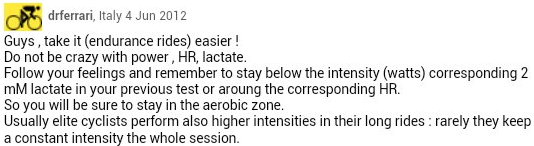
Dr. Michele Ferrari is an interesting character and a complicated figure. He was originally famous for professional cycling team success and later banned from the sport due to doping. The ban is obviously a concern, but I think he is generally thought of to have an excellent understanding of human physiology and was very influential in the world of professional cycling during his time.

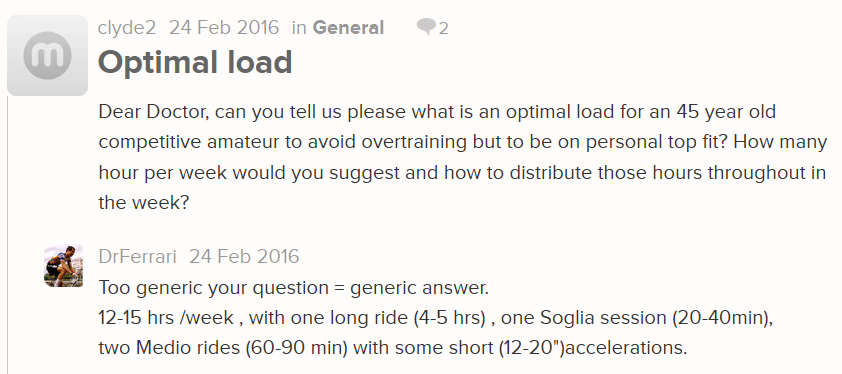
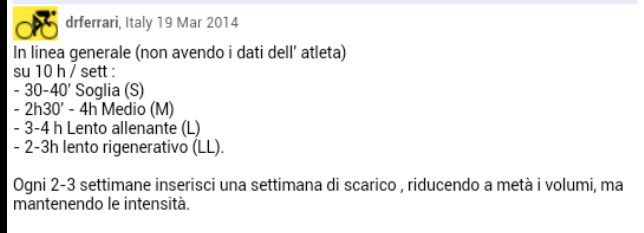
He has a web site 53x12.com that features many articles and used to contain a forum that is no longer available where he would converse with talented amateur cyclists. Another cycling forum, not linked directly here out of respect to TD, has a 116 post thread that is about 5 years old and had screen shots of Dr. Ferrari’s interaction with the cyclists on the 53x12 forum.

What I find unique about Ferrari is that he is very direct about what he feels needs to be done. I haven’t seen anyone else so close to the top of professional cycling who answers questions with specific answers rather than “it depends”. It is refreshing to see actual answers.

I plan to loosely follow the suggestions from that thread this winter. How relevant the advice of a doctor from ~ 15 years ago applies to me a middle aged recreational athlete of mediocre talent instead of 20-year old professionals is also highly questionable, but I think it is a fun way to train and there isn’t much downside.

I will plan to post a few replies to this thread with what I think the key takeaways are. As the 53x12 forum no longer exists those screen shots are only on the other forum, I’ll be respectful and not take too many copies of the screen shots posted there, but some of them will be required to present Dr. Ferrari’s perspective.

Dave

2 Likes

You can link to TR forum if it is relevant… I am not afraid :slight_smile: There are discussions there about TrainerDay… :slight_smile:
2 Likes

AIUI he was (is?) pretty big on lactate testing.

Are you going to do some of that?

No, such precision is not needed for my humble goals. Find a proxy for AT4 through long form test and estimate zones accordingly.

Dave

1 Like

I expect his training ideas are pretty sound, even today.

I doubt they are any better than a seileresque polarized plan, or a sweet spot plan, or a coach jack plan.

An important part of any training regime is, of course, doing the training. To do that, some element of it has to appeal to the athlete enough to make them throw their leg over the bike enough times. If that element is the way Ferrari responded on a forum, so be it.

However, aside from the obvious, I can understand why some people might find it hard to seek inspiration for their pastime from someone said to be involved in getting his own daughter DQ’d from a triathlon for cheating!

I also had some recollection of Ferrari running training camps that anyone could pay to attend. A quick google confirmed. Here is an article about such a camp in Lanzarote.

The thread has been more popular than I thought!

The first question I think is Who is this methodology for?

Based off the screen shots I’ve seen and articles on the 53x12 web site it is clear the primary users are real deal road racers. I didn’t see anyone ask for help who didn’t have a lactate threshold of at least 300 watts.

I am sure Ferrari would work with amateurs who were willing to pay, but primarily the questions appear to be coming from racers. The Road Cycling UK site Ivegotabike references triathletes.

That said, I don’t see an reason why this can’t work for a normal amateur, but I doubt they would pay the rate for the 53x12 coaching program.

Dave

The second question then is What are the principles of the methodology?

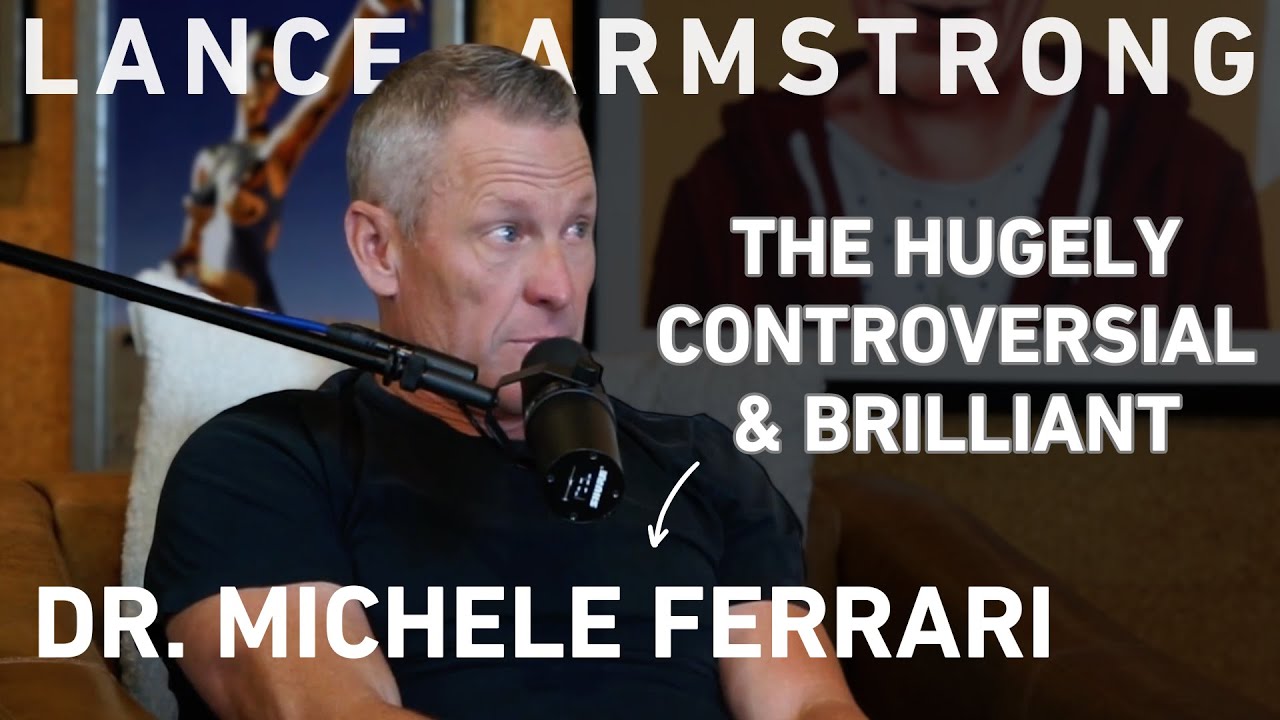
There is a short snippet from a Lance Armstrong interview that I think summarizes a portion of this at a high level:

Ferrari bases the training system off of lactate levels. He is specifically interested in the power at 2mM (AT2) and the power at 4 mM (AT4) and the relationship between these two points.

There is an article on the 53x12 web site called “The Lipid Power” that better defines this: https://www.53x12.com/the-lipid-power

He says:

AT4 is the anaerobic threshold (similar to FTP) and energy use here is almost all carbohydrate.

AT2 is approximately where the highest quantity of fat burning occurs.

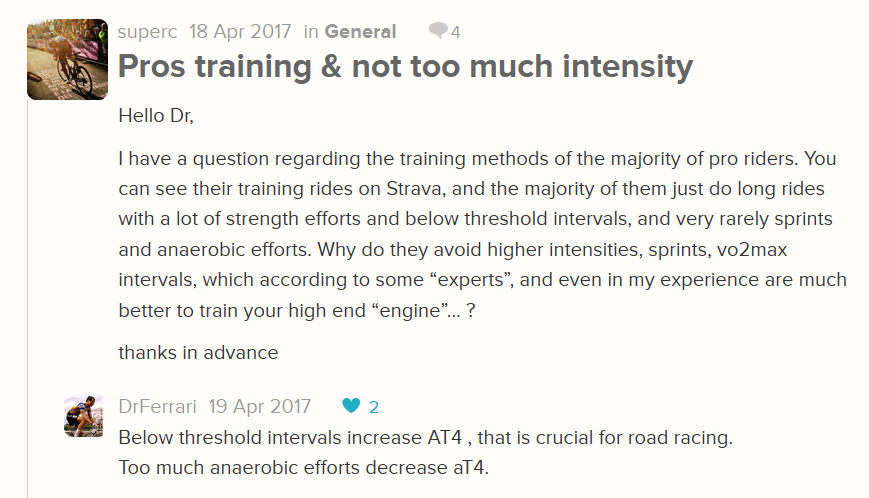
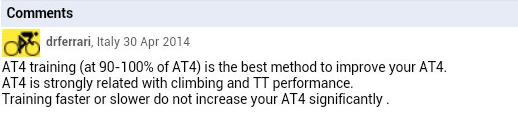
Dr. Ferrari believes that training under AT4 will increase AT4 and training too much over it will decrease AT4, this matches Armstrong’s comments. Intensity over threshold from this method comes from racing not from training.

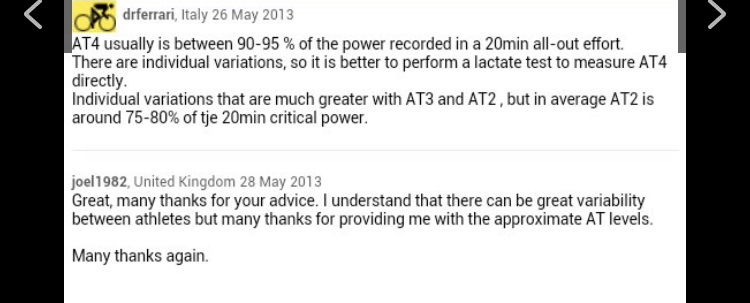
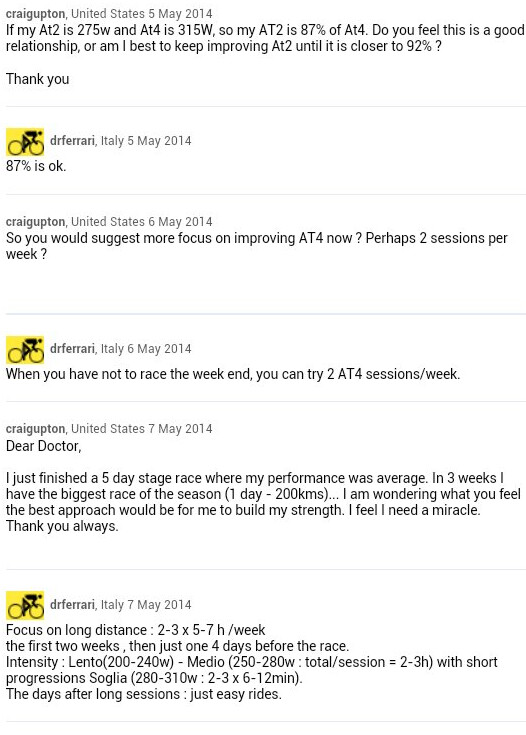
Where he wanted his athletes to get is where AT2 was a high % of AT4, such as 91% in the example below.

The lactate values can be used to develop zones.

There is an article on the 53x12 called “Training Intensity Levels” that better describes the zones.

https://www.53x12.com/training-intensity-levels

There are other ways to develop zones such as 20 minute or 40 minute time trials without lactate, but Ferrari preferred lactate data.

More zone detail will follow in a subsequent post.

Dave

I am not a Lance hater, I rather like him. But when he says Ferrari is the most knowledgable coach ever and proceeds that with something absolutely wrong it’s hard to take that as a credible reference in that specific case. Lance says lactate acid is what stops you from sprinting forever. That is absolutely been proven wrong. Just realize most top cyclists find their guru coach and trust them. Really nothing wrong with this approach, if you want to follow Ferrari it sounds reasonable. While you know I like polarized training, I am not a believer in Seiler’s VO2max as the best long term training approach. So I generally like Ferrari’s Polarized training (I am sure his is polarized too) more than Seilers… Which could be sweet spot/threshold and zone 2 for the bulk of the build period a bit of sharpening during a peak period.

So, I am not disputing anything about Ferrari’s training methodology. I just feel it get’s back to what @Ivegotabike said, anything reasonable can work (I know you want someone to draw a line in the sand). If you go out and train at 200w lactate based or 205w FTP% based does not matter it’s still likely to produce similar results and who knows which is better. Fine tuning small % of differences in training is not likely to be the the thing that makes or breaks your training unless you are shooting to be be a podium finisher.

2 Likes

I’m not a fan of Armstrong either, he is interesting but the way he behaved himself during the various doping investigations was sociopath type behavior.

I haven’t gotten this far in the write up yet, but I think there is actually a ton in common between Ferrari and Coach Jack Progressive Sweet Spot. It is really the same basic idea. The testing protocol and recovery between sets is different, but both of them are focusing on accumulating time at mid-tempo.

The only real issue I have with Coach Jack is that I have to do a lot of finessing to get it to do what I want – (1) I have to make the workouts super long to get enough interval repeats to make it worthwhile, (2) the standard recoveries are too long/easy and I have to skip much of them to avoid too much HR drop, (3) there are a lot of games in FTP setting etc… to make the intensity feel right, (4) the progressions are pretty big going from 70%-78%-84%. I feel like even if I get the FTP part right to get 84% to feel correct and skip a good portion of the recovery than the 70% takes the pressure off. I guess I could just reduce limit the recoveries more to just 20 seconds or something and repeat the next interval, but it ends up some mental gymnastics.

The alternate is I just made my own workouts, which I like to do anyway, that are a halfway point between Coach Jack Sweet Spot A and Ferrari.

Seiler’s stuff is ok, I’ve just never really gotten that much following some of the principles. I listen to the easy day stuff and for whatever reason I end up making them super easy (and probably a lot easier then he really intended). You combine that with not riding a ton of volume as a busy adult and the end results aren’t improving.

I can get amped for Seiler’s once weekly thrash yourself workout, but the specificity to what I actually need for my outside rides is minimal. I need to be a diesel most of the time with the ability to do 30 second over FTP repeats to get over the short hills we have in my area.

Coach Jack/Ferrari actually offer the specificity for what I want to get better at.

Sorry this is too long!

Dave

I was saying the opposite. I did not follow Lances doping stuff, and since everyone was doping it did not bother me but I have never been a sports watcher. So I did not pay attention at the time, and these days he seems like a decent guy and that is how I judge him.

This LLM builder should make it much easier to get what you want. Just follow the instructions. We are still doing some enhancements to it, more coming soon. It should allow simpler customization to get exactly what you want or very close anyway. It’s hard to keep the the current plan builder simple enough but add more flexibility to it to handle the million different combinations people can think of.

Thanks, I appreciate it but the time for faffing is over and the time for training is here. I don’t mind making my own workouts and plan to be consistent this winter.

Dave

1 Like

Ok, we’ve summarized who the training method is for and what the principles of it are now and identified how the zones are determined by lactate. How do you determine the zones without lactate?

Ferrari has 5 basic zones: Super Soglia (SS), Soglia (S), Medio (M), Lento (L), Very Lento (LL).

There are 2 types of tests as options: 20-minute TT and 40-minute TT.

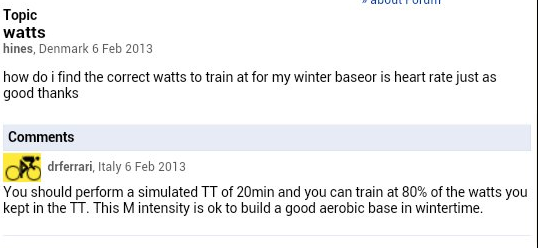
20-minute TT: This is NOT the Hunter Allen test with the 5 minute blow out period. It is specifically a 20-minute ALL OUT TT. Preferably outdoors and going up a hill where VAM could be assessed. Take the 20-minute test and apply a correction factor to determine AT4. This is more referenced and I think is Ferrari’s preference.

53x12 web site article on VAM: https://www.53x12.com/measuring-a-rider
53x12 web site article on critical power: https://www.53x12.com/the-critical-power

40-minute TT: An amateur cyclist can do ~ 40 minute TT and take the value as is to determine AT4. I think this is better because there are no correction factors required.

image

Now, finally calculating the approximate zones let’s use this case study:

So, for this athlete remember AT4 = 315, AT2 = 275

Super Soglia > 310 (top of zone begins at AT4)
Soglia 280-310 (top of zone just under AT4)
Medio 250-280 (this is in the region of AT2)
Lento 210-250 (I think this had a typo there should not be a gap between 240-250, I used 210 here, but whether the bottom is 200 or 210 I don’t think particularly matters)
Very Lento < 210

Expressed as percentages of AT4:

Super Soglia > 0.99
Soglia 0.89 - 0.99
Medio 0.79 - 0.89
Lento 0.66 - 0.79
Very Lento < 0.66

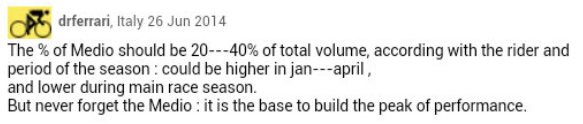
Dr. Ferrari believes Medio is the key to performance:

image

image

Low intensity rides should be kept within the correct range.

image

Approximate training time distribution:

image

Dave

So Medio is very comparable to the Steve Neal Fatmax “85% of FTP”

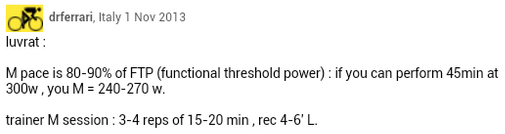
And Ferrari’s prescription of trainer M session 3-4 reps of 15-20 min, rec 4-6’ is very comparable to Neal’s 3x20 at 85% FTP, but without the HR governor to avoid pushing too hard when the rider hasn’t yet developed the necessary aerobic capacity.

1 Like

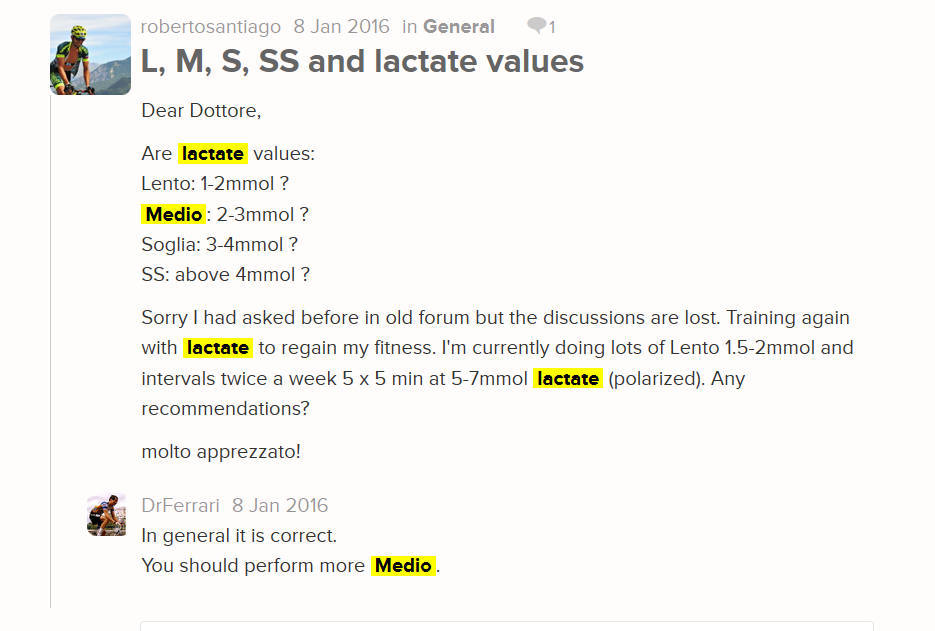
Fundamentally yes, but remember Medio is supposed to be ~ 2-3 mM lactate so for serious athletes the governor would be the lactate level.

His recommended recovery in this instance is Lento. This is still pushing the pedals and is not easy, ~ 70% AT4 power.

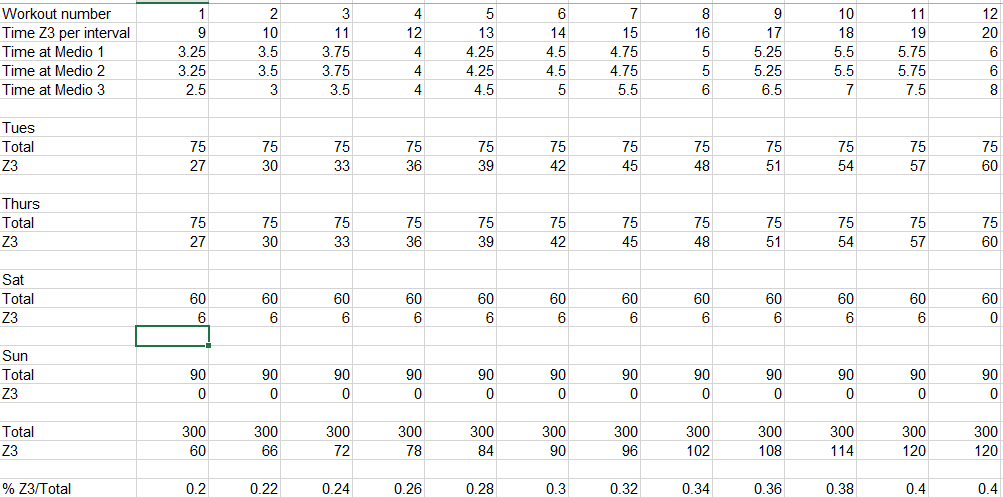
I don’t know who created this table, if it was Sryke on the TR forum or someone else, but it gives more detail and presumably this is a detailed version of the Dr’s prescription.

Dave

We established previously that Ferrari believes Medio is the base upon which cycling fitness is built and how to establish the zones. He believes Medio should be 20-40% of the cycling time depending time of season and the athlete’s needs.

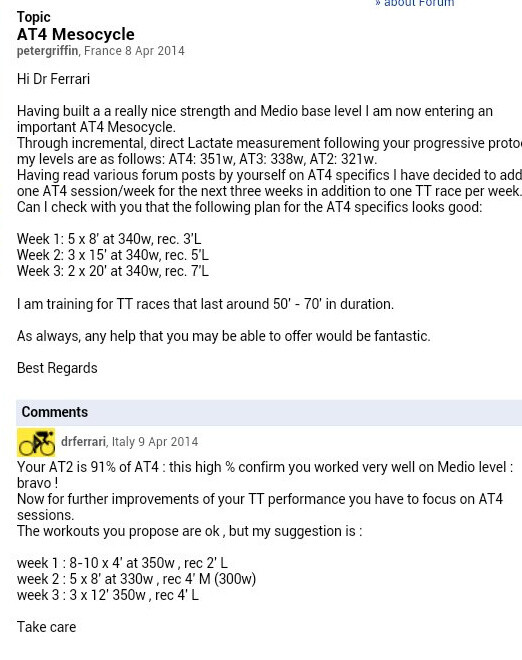
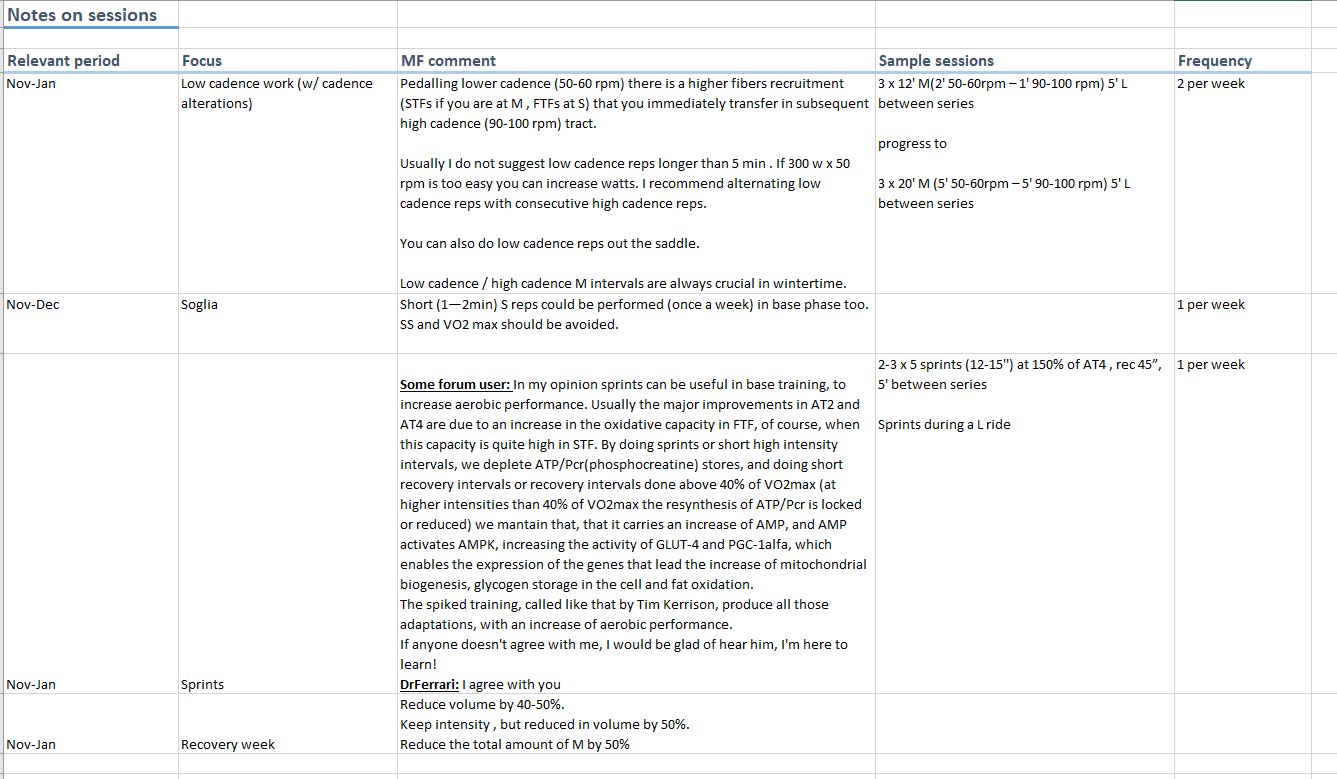
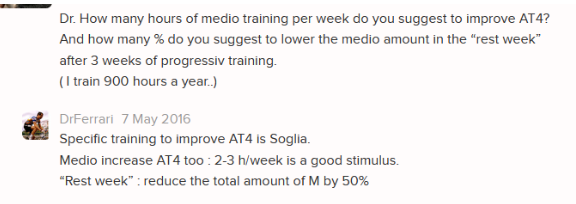
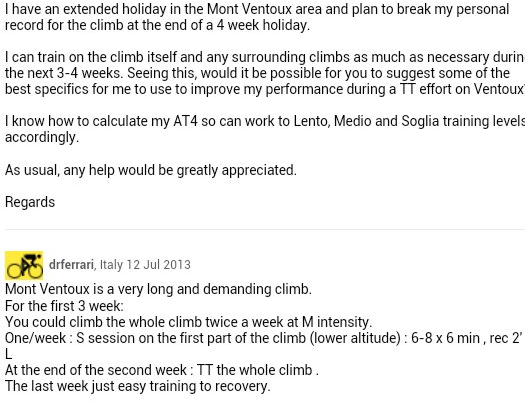
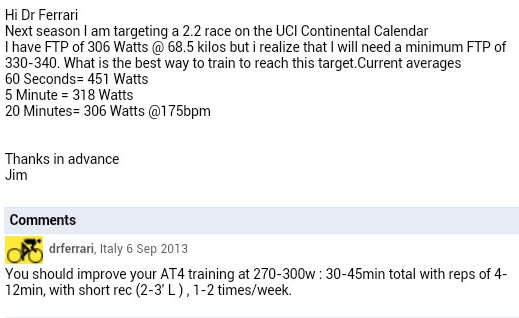
So how do you improve AT4? Medio work will improve AT4 per Ferrari, but the primary method for improvement are Soglia intervals.

image

image

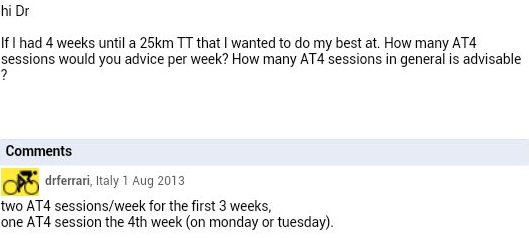
How do you structure the Soglia intervals?

image

image

image

The interval design seems to vary, but the longest recommendation he’s given are 12 minutes. A key observation here is that the Soglia recoveries at Lento, again we’re not talking 40% here this is actual work.

I think this wraps the detail up.

Dave

That’s a lot of detail! What is the TL;DR?

a) Dr Ferrari believes in tempo training or Medio to build the base.
b) Spend 20-40% of time in Medio during the base season. This is ~ 79-89% of FTP/40-minute time trial power. Consider doing some of these intervals at lower cadence (50-60 RPM) but limit the length to 5 minutes.
c) Once you’ve built a sufficient base move onto Threshold or Soglia intervals ~ 89-99% of FTP/40-minute time trial power to improve your anaerobic threshold. These intervals do not need to be 15+ minute efforts, the Dr advises up to 12 minute intervals repeated to achieve 30-50 minutes TiZ.
d) Do not spend too much time above threshold during training. Dr. Ferrari saves over threshold efforts for racing.
e) Recovery during the Medio and Soglia intervals should primary be done at Lento which is ~66-79% of FTP/40-minute time trial power.
f) Long distance endurance rides should include work at Lento, don’t make these only super easy (Very Lento).

What are criticisms of Dr Ferrari’s methodology?

a) Why should we believe a Dr who is banned from cycling for doping?
b) Modern training says tempo/threshold type training is not effective. “There’s too much pain for too little gain”.
c) This isn’t polarized at all. Where are the really easy intervals? Where are the really hard intervals?
d) Why use fixed 2 mM and 4 mM lactate? Shouldn’t these levels be customized for each athlete?
e) Isn’t all of this Medio going to lead to a lot of fatigue?
f) Other published studies show that 2 mM lactate is too high for maximum fat oxidation so why does the doctor say this is maximum?

I think those are the main ones.

You mentioned you’re a middle aged recreational athlete. Why are you planning to use this model?

  1. I think this is a fun way to train. 2) I need to be a diesel for the style of riding I want to do, to become more fatigue resistant in outdoor 3-4 hour rides. My natural strengths are shorter efforts. Long rides do not come easy to me.

How exactly are you building the plan and specific workouts?

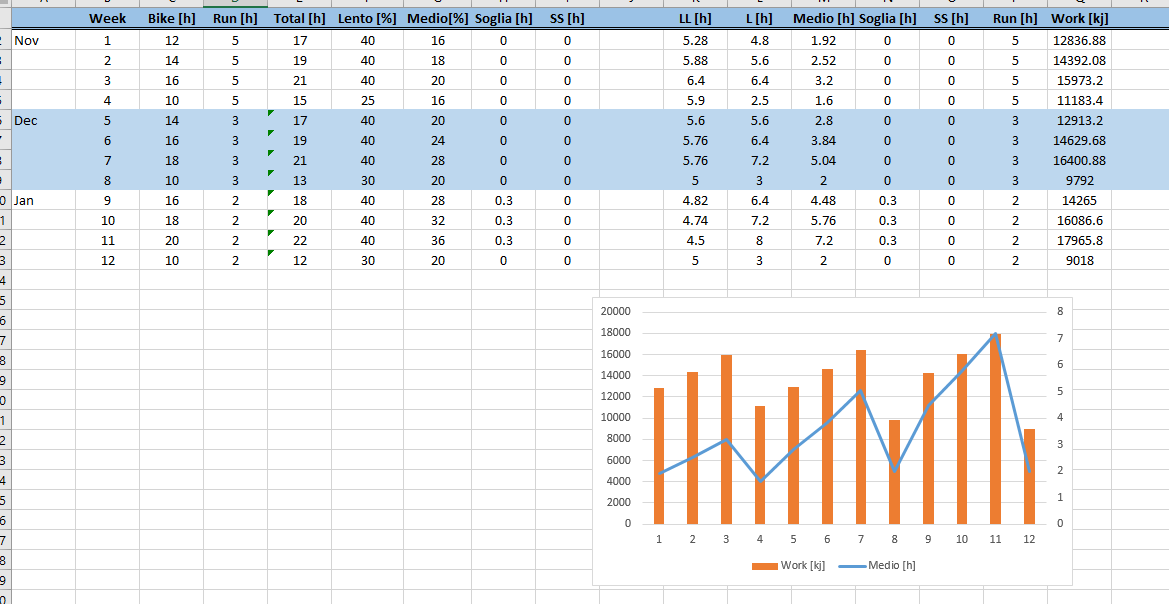
My exact plan is here:

https://app.trainerday.com/plans/progression-tempo-base-build-peak

I’m a low volume cyclist and can devote about 5 hours a week to training. My goal is to use this from 10/27/25 through 3/22/26, this is exactly 21 weeks.

Each week is broken out as Tempo 01 to Tempo 12. Tuesday/Thursday are Medio interval days and the weekend has longer rides. The plan starts at about 20% Medio per week and builds to 40% the end. Soglia is not considered as part of this plan as it doesn’t align with my goals. About every 4th week is a recovery week where Medio is reduced by half.

I’m planning to work at the lower ranges of the Medio/Lento zones to avoid unnecessary fatigue. If zones at 79-89% and 66-79% respectively my plan is to work at ~ 83% and 71% respectively.

I completed a 45-minute time trial in August and I’m using that result as AT4. It is close enough. I’ll tweak the intervals/recoveries a little bit as required to make them feel right, but I think this will be close.

How do you know this is going to work?

I don’t. This is an experiment. The reason for posting this is partly to share what I think is an interesting training model and partly to build accountability. I have historically been a waffler and It is hard to quit now after sharing this.

Dave

1 Like

I look forward to your updates as you progress through the plan.

As you already know, the higher your compliance with it, the better the outcome is likely to be.

Enjoy!

2 Likes

I agree with you, although I believe compliance has a lot of definitions. Obviously consistency being the most important aspect. It’s interesting to think how the other elements of compliance factor in, or what weight they hold. Also what is the measurement of success. In this case it would almost seem 40m TT before and after and x% increase. But in 40m TT your ability to suffer plays a major factor and with or without external motivation like an actual race.

So what does he want out of this? Improved ability to sustain threshold output? Aerobic improvement? It feels really good being able to push yourself to the limit but that takes a lot more mental dedication than aerobic improvement which can be measured with a MAF test.

I live in Poland and barely speak Polish, but started talking to our new mechanic or the guy that owns the shop. His English is a lot better than my Polish. Anyway, he is rather an amazing guy and needed some motivation to do something other than work too much (me too). So he loves cycling, he is 50 and he said he is happy to go and does not care what the weather is like, snow, rain, does not matter. That made me decide to dust off the winter bike and stop making excuses…

2 Likes

Which the plan

https://app.trainerday.com/plans/progression-tempo-base-build-peak

should make a pretty decent contribution towards.

I ride outdoors through winter too. Not as much as I did before I got a reasonable trainer set up, but sufficient to keep in touch with real - rather than virtual - cycling.

1 Like