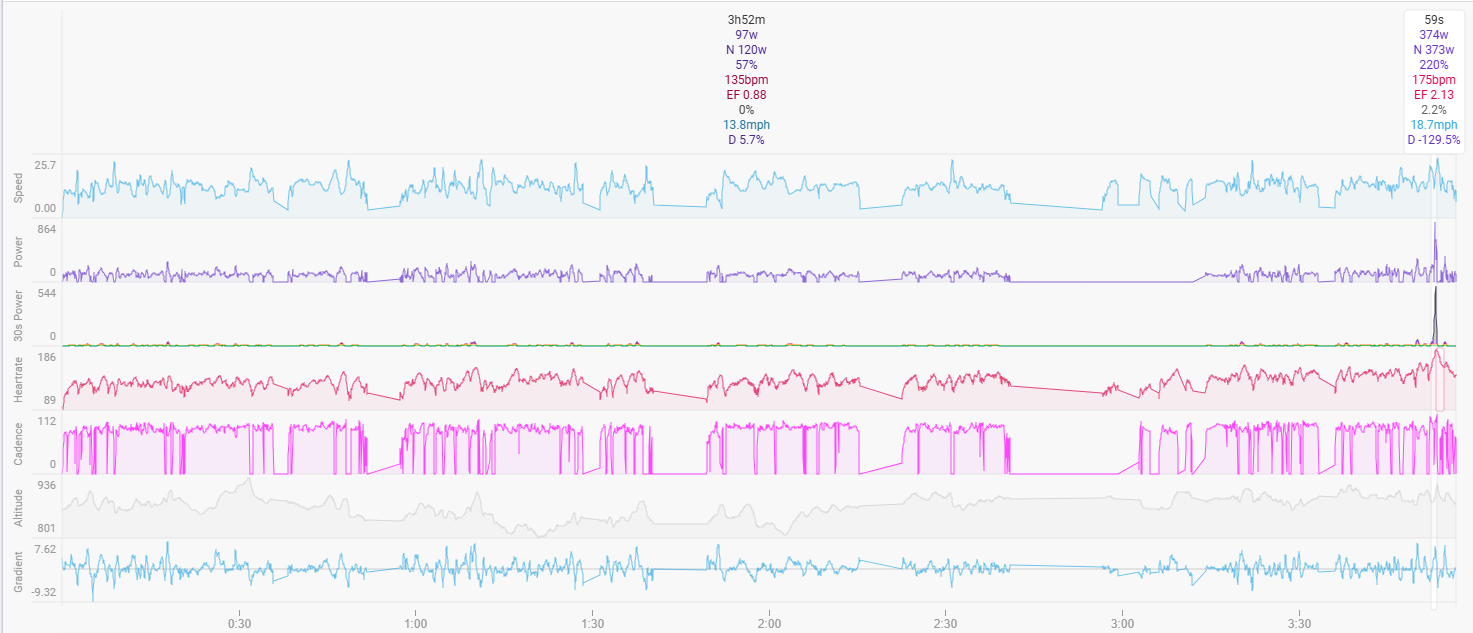
It’s fun because it’s sub-maximal and “easy” to set up. All you do is hold steady power a few times during a ride. Some pro teams are starting to use this protocol, and it’s proving revealing.
What is a durability test?
Durability is how well you hold your fitness deep into a long ride. Anyone can be strong when fresh — the question is what’s left after a few hours of work in your legs.
A durability test repeats the same hard effort two or more times in one ride, with rest in between. Comparing the fresh effort to the tired ones shows what fatigue is costing you.
Two ways to measure it
Same power: Hold the same watts each time. Watch how much your heart rate climbs. Lower climb = better durability.
Same heart rate: Hold the same heart rate each time. Watch how much your power drops. Smaller drop = better durability.
Why it matters
The smaller the gap between fresh and tired efforts, the more durable you are. Tracked over months, a shrinking gap means your endurance base is getting stronger — the kind of fitness that decides long rides and races.
How to do it
Find a climb or stretch of road where you can hold steady power for 6 minutes at around 85% of FTP. Do one effort about 20 minutes into the ride, then repeat it later — ideally around the 2-hour mark, and even later is even better. The bigger the gap in accumulated work between efforts, the clearer the durability signal. Timing consistency matters more than perfection: similar warm-up duration, similar target power, similar terrain.
6 min at 85% is the easy entry point. If you want a cleaner result, go longer and harder — 8 to 12 minutes at 88-95% of FTP is what most research protocols use, and the drift will be more obvious.
FYI - Because this is rather experimental at this point there is some flexibility. But keeping the TSS or kj similar between efforts likely has an impact but that is harder for us regular joes.
Also I would point out this is especially important for racers
Yes this is not comparing how much drift you have, this is comparing how much you can process fatigue at higher intensities and improve that. If you can hold 90+% for 40 minutes after 3-4 hours you have very good durability.
I have seen examples of riders testing race specific efforts too, as part of their training block for that event.
For a 120km race with a decisive 5 minute climb near the finish, they are interested in what their 5 minute power after 3 hours of near race pace riding is.
And, more importantly, how to improve it between now and race day.
Is it better to perform this test indoors on a trainer to eliminate outdoor temperature variables?
I find that ambient temperature is the main driver of my heart rate drift. When I ride outdoors early in the morning, the temperature starts around 25–27°C but climbs to 30–36°C over two hours, resulting in 13% decoupling by the end of the ride. In contrast, doing the exact same intensity and duration indoors with a constant temperature results in only 3–5% decoupling.
Should I stick to the trainer for cleaner data, or is that outdoor thermal stress supposed to be accounted for as part of the durability test?
Pros are finding it useful outdoors… maybe the do it cooler mornings but I think in general the consistency of indoor testing improves accuracy so does Andrea… so I would say indoors is the safer option especially with very consistent environment and ideally good fans or reasonable temps.
I think you’d want to do the test where it has relevance for your riding. If you race outside then do it outside, if you race Zwift then do it inside. I find the indoor experience and outside experience are not the same – outside is much more difficult and I agree the root cause appears to be temperature and solar load, plus perhaps the additional muscular requirements to support the bike, etc…
That’s an interesting thought… Meaning is it different to be durable outdoors and not indoors or visa versa… Mentally for most for sure. Outdoors is easier to be durable but physiologically… I think consistency in environment is a more relevant factor.
In my point what @Ivegotabike said earlier is probably the key for competitive riders:
"I have seen examples of riders testing race specific efforts too, as part of their training block for that event.
For a 120km race with a decisive 5 minute climb near the finish, they are interested in what their 5 minute power after 3 hours of near race pace riding is."
5 minute power is gold for that rider.
I think your concept of a 6 minutes at 85% after some kJs in your legs is a get plan for the average guy.
This is actually just a test, not really a training session or event specific…. You are just trying to answer a question is my durability improving. Testing race specific efforts is a different form of test, similar but different.
Yes it depends on personal definition of durability. For Dave that is his 3 hour durability so probably testing durability at lower tempo, so let’s say his 80% of FTP durability but if you struggle getting dropped on 5 minute hills then 5 minute durability matters most.
It’s a great tip, I’ll rather do the one with the FTP since power is rapidly measured, so you variable is almost instantaneously visible in your device.
Doing it with HR has the drawback that it’s a little Out of sync (decoupling) compare with the effort you’re doing in watts. It’s still a good measurable variable if you don’t have a power meter