Fatigue resistance workout

When the outdoor season resumes my go to ride takes 3 hours give or take. I would like the training I do to provide improvement for that ride, but on the indoor trainer I’m only good for about 90 minutes and anything longer than that is not very comfortable.

The past couple weekends I’ve been doing a 90-minute ride where I do a warm up followed up zone 2 and then starting at minute 55 a 30-minute interval at 90% before a 5 minute cool down.

This workout is very nicely simulating fatigue similar to what I’d see in hour #3 of that outdoor ride.

Maybe the particular workout details are different for you, bit if you’re trying to recreate a similar effect I think this approach could work for you too.

Dave

2 Likes

Out of interest, how much of the 3 hour ride would typically be coasting / freewheeling?

1 Like

I would say doing 2 one hour rides indoors, with a half hour break in between probably would help.

1 Like

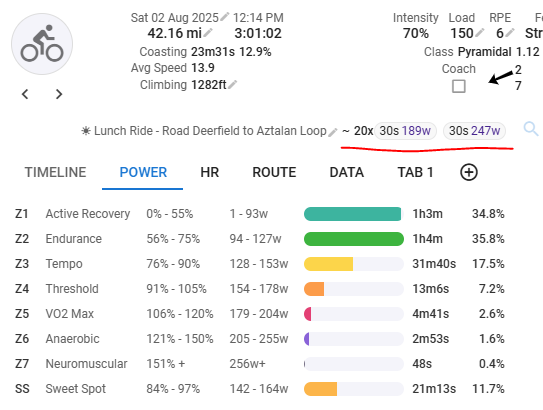
10-15% coasting, typical zone distribution is below. There are a lot of rollers. I had it count 30 second segments over FTP and there were 21 of them, 20x just a little bit over and 1x way over.

Dave

2 Likes

Hi Dave,

That is a good way of thinking. I like to do this by putting the intervals, or at least some of them, at the end of the training session. Typically, after three months of base training, and doing the intervals with fresh legs.

I know I’m repeating myself, but if three hours is hard with the intensity you are riding, you are not fueling enough or your ftp is to high. But probably the first.

Try the same ride, same intensity with 60gr of carbs an hour, and a proper high carb meal two hours before.

Have fun, Coach Robert

I’m quite happy with RPE of 6/10 on a 3 hour ride with IF of .70 and multiple rollers steep enough to go over FTP repeatedly. There are lots of people who couldn’t do that.

My point was to share that if you are stuck inside and have a 90 minute limitation, finishing the ride with 30 minutes at 90% seems to produce a response that is somewhat like the longer outside ride.

Dave

2x 30” intervals fit into a 90” minute workout :slightly_smiling_face:

that might be a step too far, but extending the 30” to 35” and then 40” might be a decent progression.

If you’re time crunched how much sweet spot is too much? I’m able to do 2x20s in 1 hour workouts on Tuesday and Thursday and the 1x30 on Saturday. I add in 30 minute recovery spins on Wednesday and Sunday. That’s 110 minutes at 90% in a total of 270 minutes riding time or about 40% of the rides. Does it make sense to make Saturday harder? I’m capable of doing 2x30 without issue. I know based off past experience too high TSS without recovery weeks leads to issues, but for the first time I have programmed recovery weeks this year to keep that from happening. Maybe a little higher TSS now is ok.

Plan:

Dave

1 Like

post replaced w/later one

Things to consider

  1. Only as much as you can properly recover from in time for your next workout.
  2. TiZ is the main metric. Can you squeeze in more SS & less warm up / cool down.
  3. Is 90% to 91%, 92%, 93%, 94%, 95% a sensible progression for you, or not.
  4. Don’t do only sweetspot forever. Consider when to mix it up a bit.
  5. Whatever keeps your consistency persistently high is the best thing.
2 Likes

Thanks, I appreciate it. I’m going to do another 4 week block after this one is over and then if I’m lucky it will be nicer outside and I won’t be doing intervals on the trainer anymore.

Dave

1 Like

Looking a bit more at the perspective of Dr. Coggan to get an insight his thought process ~ 2015, he’s an interesting guy with a lot of knowledge when in a mood to be helpful as he’s famously difficult at times online.

On 2x20s at threshold:

1. If doing them on the ergometer, 100%, and I either complete the 2nd effort or I fail (due to inadequate recovery from prior training. If doing them outside, ~100%, but I take what I can get (i.e., if I’m tired I’ll still do two, but power may be down a bit).

2. 5 min, but really only for the mental relief (i.e., if you couldn’t do 1 x 40 min at that intensity, then it’s either too high, or you’re too tired).

5. Note that there’s nothing magic about 2 x 20 min, i.e., you can come up with many different workouts that elicit the same adaptations. For example, alternatives that I have used include A) 4 x 10 min w/ 2.5 min rest (although I haven’t done these in years and years, because I think the shorter efforts let you go a bit too hard), and B) 8 x 5 min w/ 1 min rest (I like these better, esp., e.g., when trying to get used to a new aero position, but even 1 min rest is a bit too much).

On FTP build and his personal training plans:

What has been claimed (observed) by some is that it seems better to train more at <100% of FTP than less at >100% of FTP if your goal is to raise your FTP.

To help put things in context: my “build” has historically consisted of 12 wk of twice-weekly 2 x 20 min intervals on the ergometer. I start conservatively, i.e., at a power that allows me to complete both efforts almost every time, then add 5 W every other week. This rate-of-increase slightly outstrips the “growth” of my FTP, such by the end of the 12 wk, when my FTP is essentially maxed out, I am pushing the upper end of the level 4 intensity envelope. At that point, I either 1) go racing (if aiming for a longer, e.g., 40 km, TT), or 2) switch to chasing other adaptations (if aiming for other events, e.g., mass start races).

One other comment: again, there’s nothing magical about 2 x 20 min efforts, e.g., last year I built my FTP up to w/in a handful of watts of historic maximum by doing nothing but level 3 efforts practically day-in and day-out (i.e., the UniModal^TM training plan). If injuries hadn’t gotten in the way, my intent was to next “ice-the-cake” via some higher intensity training, but I don’t expect my FTP would have increased much further, if at all. OTOH, I am sure that my actual performance in a 10 mi TT would have clearly benefited.

On level 5/level 6 (he prefers “levels” to “zones”):

For VO2max work, I’ve always done (i.e., for ~40 y) either 6 x 5 min on, 2.5 min off, or 10 x 3 min on, 1.5 min off, with the intensity as high as possible and yet still be able to complete the final effort more often than not (but definitely not always). I stopped doing the 3 min intervals a decade or so ago, though, as they seemed to be a bit less effective/a bit more of a level 5/6 “tweener” workout.

For what is now called level 6, I’ve almost always done 10 x 1 min on, 3 min off (just 10x time up a ~1 min hill, turn around and ride down, and do it again).

When training for the pursuit back in 2006, though, I incorporated some of what I call “go hard, puke, go home” sessions, i.e., level 6 intervals at maximum intensity with really long recovery. These worked quite well for me, but I can’t really say whether they were more or less effective than what I’d done before. I will say, though, that it has always caught my eye how much progress others (in both research studies and in actual practice) seem to make using this sort of approach.

Of course, lots of ways to skin the training cat, YMMV, etc.

On level 3/level 4 border:

PPP: Sooner or later, you have to increase the power.

I was doing all of my UniModal^TM sessions on the ergometer, i..e, as isopower efforts at ~90% of FTP. As a percentage, that’s right on the level 3/4 border, but in this case intensity factor is a better way of looking at things, so really right smack in the middle of level 3.

(Note that I generally don’t train at level 3 when riding outdoors, and when I do, it is as a fartlek rather than a tempo session, i.e., trying to maximize the variability in power to simulate mass start racing rather than, e.g., TTing. I therefore don’t really know how well lots and lots of tempo outdoors would work for me, although way back in the day I did do particular sessions that would fit that description, and found them effective.)

On FTP testing and experience:

No formal tests whatsoever (esp. now that I have the WKO4 power-duration model at my disposal to estimate FTP).

If anything, though, I’d say that the relative intensity crept up over time, as experience has shown me that “gentle upward pressure” is what is needed to continue to make forward progress.

One advantage I have over most is that after wrestling with the same ergometer for >25 y, I know it and myself quite well.

Basic summary then:

  1. Specificity, specificity, specificity. Dr Coggan’s specificity was time trialing.

  2. Train hard enough for adaptation to occur.

  3. Formal tests are not needed if your threshold interval workouts are pushing you hard enough.

  4. Consistent level 3/level 4 border work, 6 days/wk in the case of Dr. Coggan was roughly equivalent for him to 2 days/wk 2x20s at FTP.

  5. Effective VO2 training should sometimes result in workout failure.

  6. After you work hard either enjoy your spoils or move on to a different type of training.

I don’t think most people are willing to work as hard as he would though and very few could recover from those workouts. I’ve heard him admit when interviewed that as a younger man he would peak very early in the season and then fade, I think there could be a causal relationship with training so hard early in the season.

I’m not trying to be Coggan. However, it is very clear to me that if you have only ~ 4-5 hours a week to ride inside during winter due to lack of time, boredom, dislike of indoor training, etc… you need to ride harder than zone 2 some or most of the time.

Dave
1 Like

My question is what type of injuries? I’d guess overuse, unless there was a crash. He was also probably doing way more than just 4-5 hours/week.

I think you’ve said you do 4-6 hours per week. You might be able get away with it as a time crunched cyclist, but probably not. Someone who is young, a hyper responder to training and genetically gifted stands a better chance of getting away with it at just 4-6 hours/week. Maybe 3x/week with 2 off/recovery days and two zone 2 days properly placed.

In reading that whole thing you posted, that is what stood out to me and I couldn’t ignore it. For someone who is so highly regarded (Dr. Coogan), it surprises me. I’d be very curious about those injuries.

1 Like

I don’t know if it is the specific injury referred to in those timetrialling forum posts that Dave has collated, but he had a hip fracture from a bike crash when he was 30.

EDIT: I found it: How about long sweet spot sessions? - #46 by holograham - Triathlon Forum - Slowtwitch Forum

Got in the best shape I had been in over 10 y, to the point that I was contemplating “icing the cake” with a bit of higher intensity stuff and entering some races. Then I fell off my bike, compressed a vertebrae and nearly paralyzed myself, and have struggled for any sort of consistency/fitness for over 2 y.

Dave

I’ve been doing a block of weekly: 2x 1 hr 2x20s at 90%, 2x 30 minute recovery spins, 1x weekend 1x30 at90% after Z2 time. I’m on week #3 and coping with it fine and I think FTP is going up! Week #4 of my block is a recovery week.

6X a week at 90% would most definitely cook me though!

Coggan’s Unimodal^TM: How about long sweet spot sessions? - #42 by Andrew_Coggan - Triathlon Forum - Slowtwitch Forum

As long as you are increasing the load on your body in a sensible way and are recovering properly I don’t see why you would burn out - especially considering you’re not also doing VO2 work.

FWIW, over winter 2013/spring 2014 I trained in the sweetspot for 1 h/d, 6-7 d/wk, for 24+ straight weeks. I dubbed it my UniModal^tm training plan.

It appears he was only riding 6-7 hours per week.

Dave

I stand corrected. It was a significant injury and he was only doing 6-7hrs/wk. A search turned up it was a relatively minor accident but he suffered from osteopenia. (common among cyclists who do little to no other activities that involve weight bearing.)

Dave, your plan sounds good. I think you also recently incorporated de-load weeks into your plan so you should be good.

As long as you are increasing the load on your body in a sensible way and are recovering properly I don’t see why you would burn out - especially considering you’re not also doing VO2 work.

This is a pretty clear principle, highly individualistic as well. This takes discipline and understanding one’s body well. I think most of us at some point, even knowing better, have cooked ourselves because of a desire to complete a plan for fear we won’t be ready for an event or personal goal.

I still think it holds that for the vast majority of us, we could not do this sort of intensity day in and day out, and without a de-load week on top of it. Most people are not elite/highly gifted athletes with lots of time for recovery and a life that is structured around riding the bike. It takes years if not decades for people to learn that the training load or TSS alone is not the only thing to consider. A stressful day or week at work, travel, babies, car troubles, poor sleep, etc. Maybe TSS should stand for TOTAL Stress Score.

1 Like

I like your thinking. The problem is, as I am sure you know our bodies don’t adapt to chronic stress like they do acute or training stress. Or they adapt, but it’s with things like diseases or chronic elevated cortisol.

But to your point, and the Maffetone concepts: there is an interplay between these, I just don’t know that we could capture it in any kind of formula. Or let’s say we’re not mature enough in our understanding of chronic stress. The simple one is lots of chronic stress focus on Z1, Z2. Get rid of the chronic stress. I just see, as I age, I have to totally baby myself. I think my chronic stress is more towards the lower end.

1 Like

I think you guys are both 100% correct.

If you want to get better you need to train hard enough for adaptation to occur, but only so hard as you are able to recover from. I think that’s what makes it tricky, how much we can recover is individual and you don’t probably don’t really know until you get close to the line of “too much”.

Dave

People pushing closer to failure have a better idea, meaning if they can’t complete a workout because they pushed too hard previously and did not recover.

I feel I can tell fairly well. My sleep is affected. My minimum resting heart rate is affected. HRV is affected. And it has some level of reasonable alignment with TSB on a PMC chart.

Every time I return to consistency, I always try to do an extended period of zone 2 and my intensity comes from weightlifting, which I also start with one harder set, not very close to failure. And just gradually build the intensity on the weight training first. I’m actually going on almost 60 days of high consistency 4-5 hours a week now. Next Friday starts a ski vacation.

Once I’ve established a solid baseline of everything feeling right, then I would start to add in aerobic intensity. People with better consistency like yourself don’t have this exact struggle.

1 Like