How do you plan a full 6-month winter training using Coach Jack or TrainerDay plans?

Hi everyone :wave:

I’m planning a solid 6-month winter training block (October–March) using Coach Jack or other plans on TrainerDay. I really like how each Jack plan (Base, Base+, Build, etc.) is structured — but they seem to work best for short phases, not an entire season.

My challenge is this:

How do you structure an entire 6-month period using these plans without hitting VO2Max in October and without losing progression?

Also — each plan is limited to either 4 or 8 weeks, but what if I want a proper 6-week Base, or mix and match slightly?

Questions:

  • Do you manually stack 2x 4-week plans?
  • Do you customize them using Coach Jack’s filters (duration, workout types)?
  • Anyone built a fully periodized plan this way (Base → Build → Peak)?

Would love to hear:

  • How you handle full-season structure
  • Any creative setups with Jack
  • Workarounds for the 4/8 week plan length limits

Thanks in advance!

3 Likes

Hi Peter,

What a good way to approach your training. I would even take it a step further and create a plan for a year.

So here is how I do this for my clients. I select 3 major goals with them. These goals can be anything from riding a Gran Fondo to just getting fitter. Preferably, these goals are spread over 6 months.

Next, we start with a base period. I always use hiit training all year round. Only in rest weeks is there no interval training.
I like to use 3 blocks and spend 4 weeks in each block. This makes it easy to follow, since each block will be one month. After 12 weeks you ride a goal (or subgoal), followed by a rest week.
Then you start the whole cycle again.

Every cycle starts with what I’d like to call a relative rest week. You are training, doing hiit, but the total volume is lower than week 4. It is a periodisation within your periodisation that prevents you from overtraining, stimulating proper rest and growth.

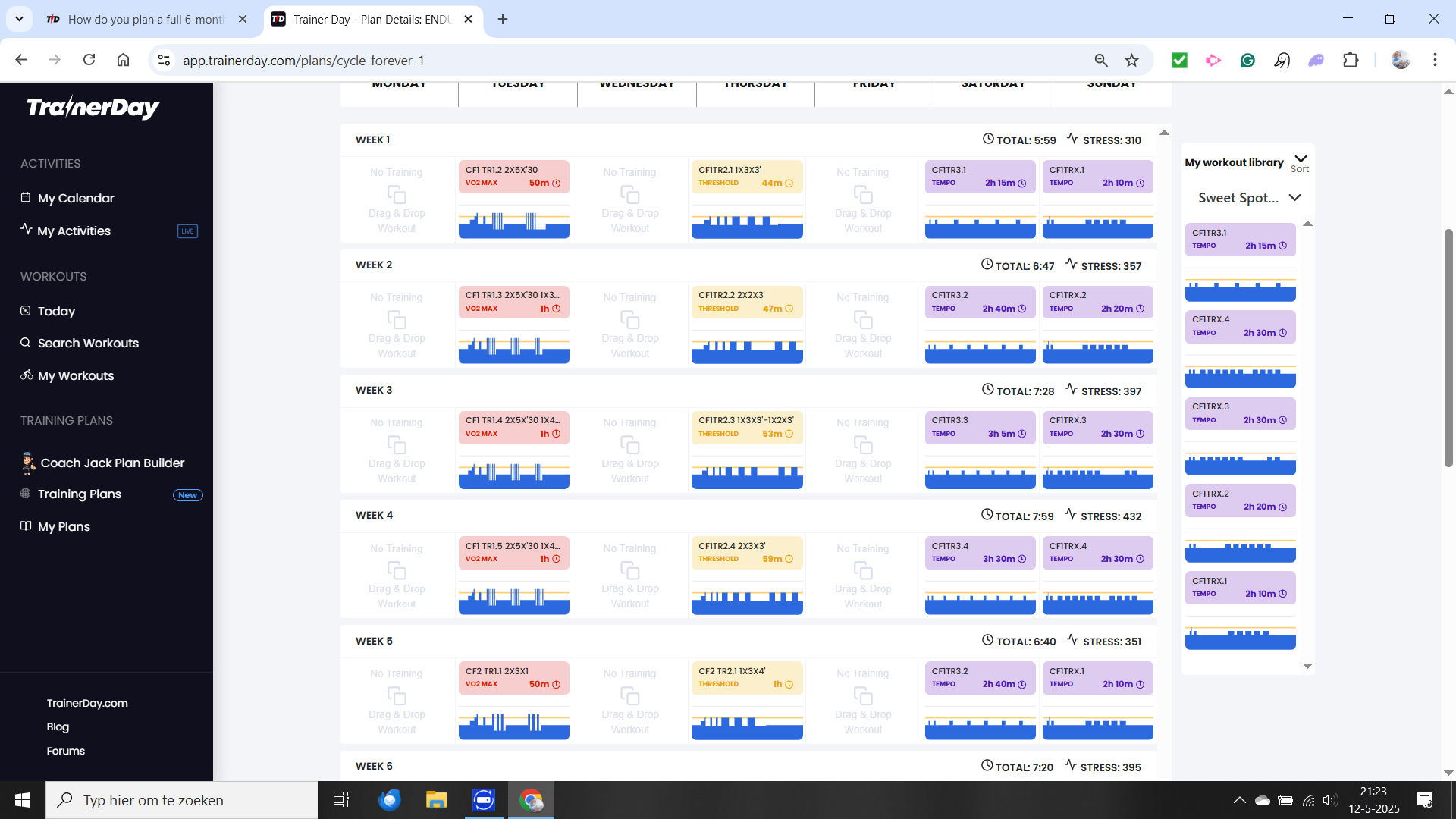
I’ve added one of the plans I wrote for a client. It is one month in a build phase, but the base and peak look similar, with a few differences specific to that phase.
You can see the tss building up and going down in week 5.

Hitting Vo2max is not a big problem, and neither is the loss of progression. In a rest week you might lose a little fitness, but you gain back form. As long as you train consistently throughout the year, over the years to come, these slight changes are not important, but natural. Most cyclist focus to much on their progression for this month instead of the bigger picture. Building true fitness takes time. Learn to love and it will be your friend forever.

I would just play around and try to build and follow some blocks now, in order to be prepared for October.

A last, but important tip is to keep your plan flexible. The first draft of your plan is like a red wire through your season, but it shouldn’t be written in stone. When you are sick, you take a week off. No problem. Adjust the plan if you need to.

Have fun, Coach Robert

ps: the weekend training seems like tempo, but they are really zone 2. That is also the mission for the client. Ride zone 2 in the weekend.

2 Likes

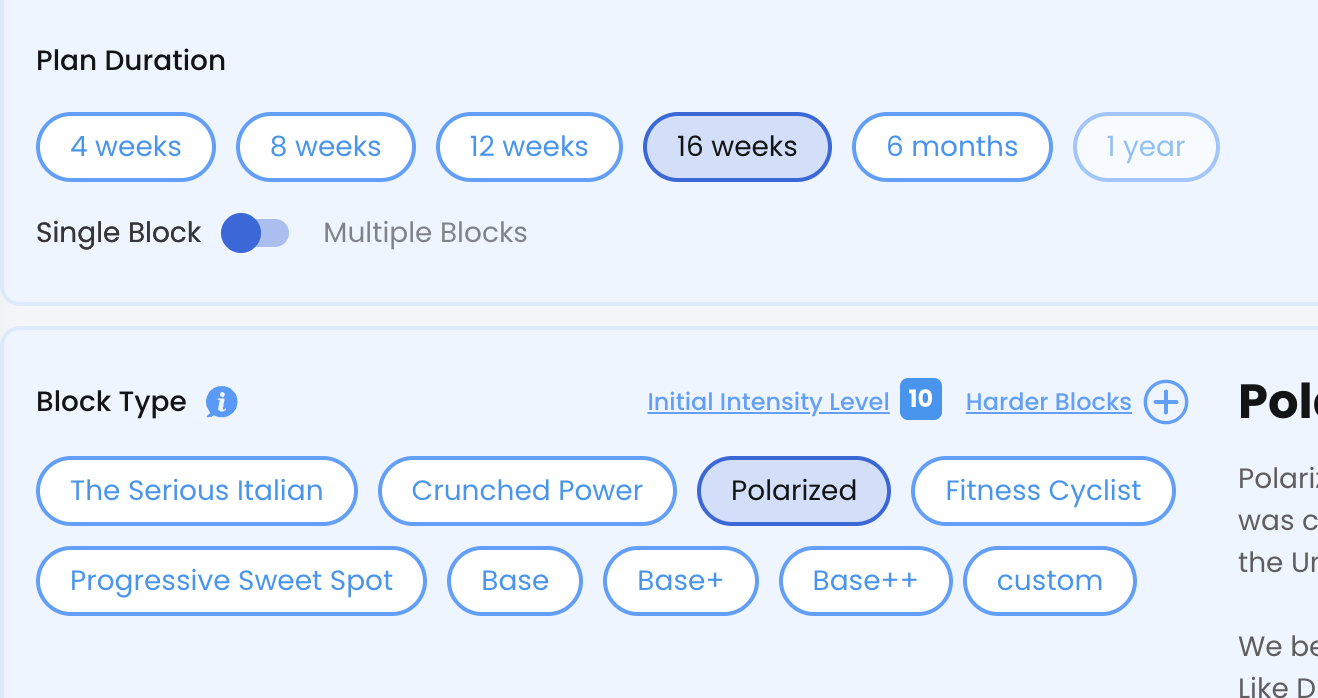
Thanks and I agree with Robert sounds great. You can always create your own 16 week blocks and just schedule them one after another. Any of these standard blocks are good.

You also can click on that custom button and design your own 16 week block. Which can be exactly the same as one of the standard blocks with a little more control. It’s very easy.

The main thing as Robert suggests is around your goals. If you like a hard indoor winter and feeling strong in the spring for outdoors that could be the driver that everything revolves around. Frequently around this time of year it’s more about just holding on to the fitness you gained for the next 3-6 months and then repeat the cycle trying to get to a new high… But it’s about matching the training with you and your preferences and goals. The main thing is not to just try to push harder and harder for ever, have some ups and downs. That could be rotated blocks like Robert does of about 3 months each, or that could longer full yearly periodization that many racers do. But 6 month plans are in between those two or something that cyclocross racers follow frequently for example.

2 Likes

EDITED as I’m not planning to follow the original polarized plan…

I wanted to comment on a concept using the 6-month training plan with Coach Jack that uses reverse periodization.

I live in northern Illinois USA. There is enough cold and snow here that we have 4 distinct seasons. Starting the beginning of November until about the middle of March there is a lack of daylight and enough cold that it is tough to ride outside. I personally draw the line at 40F/5C for temperature, any colder than that and the ride isn’t very fun.

The high level concept is to have a pair of 6-month plans. One for the outdoor riding season and one for the winter.

Outdoor season – Using custom repeat a base style plan, mostly ride outside but try to get 1 interval session a week done inside. Base+ or Base++ I think both could work well.

Indoor season – Pick a base, build, peak approach starting 26 weeks before you want to peak. The CJ 6-month plans are formatted as: 8 weeks base, 12 weeks build, 6 weeks plan.

Dave

Good question! I think the honest answer is you listen to your body and don’t know until you do it.

However, I’m highly confident the 20-40s and 30-30s once a week won’t cook me and I have some experience with the harder 3 minute intervals and think those will be fine once a week too.

This isn’t like a TR plan where you are flying close to the sun all of the time. There’s some margin. Vo2 #14 will be the hardest one, but there’s several weeks that build to that point.

Dave

I was thinking that amateur cyclists may be too focused on trying to have this long term plan: “I need to develop a plan that is going to take me all of the way from end of fall until the spring!”

Of course what ends up happening is that something details the plan, maybe it doesn’t work quite as well as anticipated etc… , and then you’re left picking up the pieces.

Maybe it is smarter to approach this as smaller blocks. Set up a 4 or 8 week block and commit hard to doing it. Then when it is over pick something else based off how you are feeling and what you learned from that block.

Does that make sense?

Dave

@Robert_UCL does 3 month blocks just like this for his students. I think if it is more fun it’s very reasonable and no reason to think it can’t be very effective. It depends on goals and events for optimum performance but fine approach in general.

Hi Dave,

There is a bit of both involved. Alex and I constantly hammer on consistency. We do this because if you train all year, you will get better results. Of course, with enough rest.

From the perspective of consistency, a year-round training schedule would make sense. However, it doesn’t make sense to create such a schedule on the first of January.

You never know what happens or if your goals throughout the season change. Injuries or sickness change your schedule, and since we are all amateurs, so does a change of jobs, moving, having kids, etc.

I try to inspire my cliënts to pick one or two goals per year. We divide the year into periods and, as needed, choose subgoals. These subgoals are there to measure progress, prepare for event circumstances, and have fun.

I make 4-week schedules. 3 Weeks of training and one week off. Actually, it is four weeks of training, but that first week is so easy that it is a rest week. It is the week when you can figure out how to execute the training in a few intervals, so you can nail it in the coming weeks.

It is like your new gym schedule: you start doing a new press, and you have to adjust the weight a few times to get it right.

Depending on the client’s fitness and the time of year, I build these monthly blocks into a two- or three-month period. After this, there is a 5 to 7-day rest period. Only zones 1 and 2.

Rinse and repeat. Sometimes the emphasis lies on base and power, sometimes on base and anaerobic. That’s how I play with the schedules.

In my mind, I have planned a whole trajectory for a year. I discuss the various options with my cliënt to reach his/her goals. Next, I plan the first 2 or 3 months. We adjust when it needs changing.

The main goal is consistency. That’s why cliënts can only book me for at least one year. If you can’t see yourself committed to structural training, it is not a fit.

Hope that helps.

Have fun, Coach Robert

1 Like

That makes a lot of sense. Anyone dedicated enough to have a coach probably has events, or at least goals, in mind.

I still prefer the idea of 4-8 weeks blocks for myself.

Dave

1 Like

I believe you are looking at it differently, meaning Robert coaches people just like you but what he does is inspire them to create goals not necessarily have them when they come to him. The goals have a significant effect on the outcome of consistency, comfort and performance. The goal does not have to be a race, although doing it with others can be motivational… but again it can be just to finish…

He is also kind of saying 4 to 8 weeks and I also like this approach. I succeeded, I did my 4 weeks is great. Just a few of these blocks together can lead to an event, and that event might be you and your wife going 100km ride and her on an ebike…

I inspired @BlackTek to get his wife an ebike and he says it has been great and now she pushes him and they both have fun. I know your wife likes riding a regular bike but to push you an ebike might be fun for both of you too she can still get a workout and only use it on longer faster rides.

3 Likes

Good call.

I suspect many of use are “planners”. We like these big elaborate training plans that last seemingly forever. You are right too that I prefer finishing something short and then deciding what to do next, it makes you feel good about yourself.

I have zero motivational problems. You won’t catch me taking 2-3 weeks off the bike. This is my primary hobby and my mental health tool. I see some others on the internet who really need a race, an event, or something… otherwise they won’t ride at all.

E-bikes are fantastic. My wife and I are actually very fit for normal people, but when the wind is blowing 15 mph we have a really rough time on open road rides.

We thought about e-bikes as a supplement last fall/winter and decided to go for it in August when aluminum Domane+ with mid-drive TQ motors came out.

It has done a few things for us:

  1. In tough conditions it can be the difference between going and not going for a ride.
  2. In tough conditions it can be the difference between going for a short ride versus a long ride or being able to still go on the route you want to go rather than compromising the route for wind shelter, etc…
  3. When tired it helps on weekends to be able to go back-to-back days.

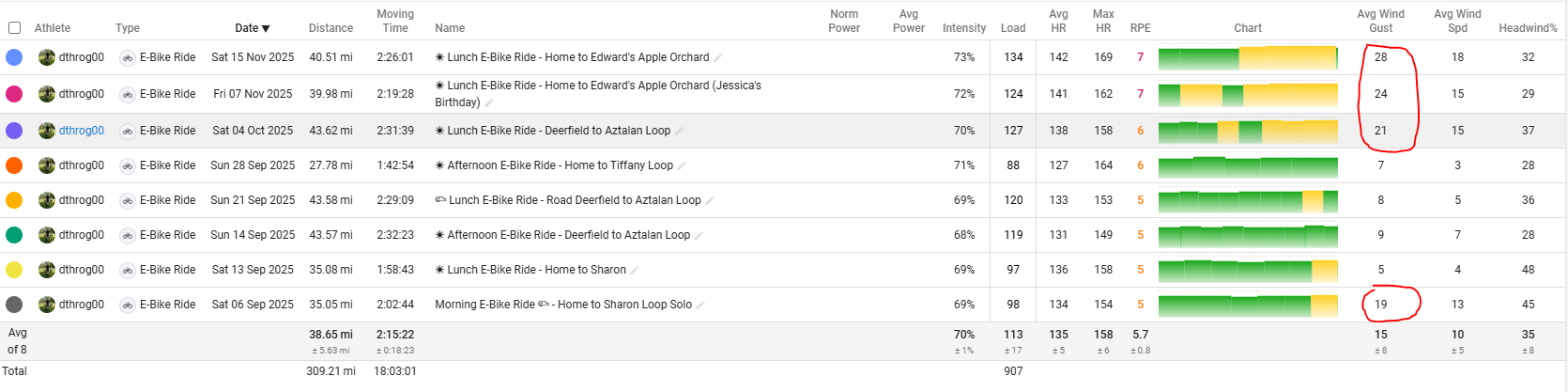
I don’t have it set to help a ton. My HR is still getting up there, there is very little difference, we just go faster on these. The rides circled are circumstances where it made a huge difference.

My preference though is the traditional bike.

Dave

2 Likes

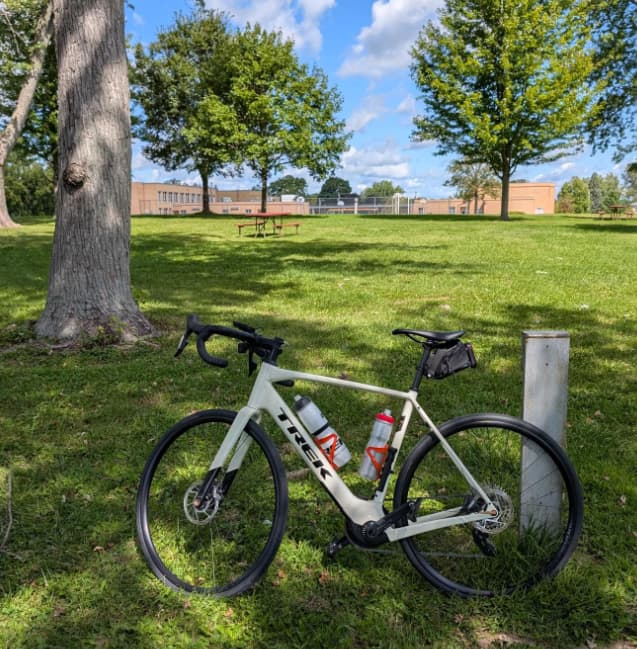
So you are great at consistency, this is most important and the rest is gravy… Nice bike. The goals of an event will have some element of pushing you a bit harder, either in distance or performance… I want to do that 100k in 5 hours… meaning if you want to increase your performance then an event can help solidify the training goals… but again this is all gravy, if you are good with block goals and just getting out there consistently that is absolutely perfect and not so different than me but my consistency wavers more than yours…

1 Like

A funny fact about me, is I go through all these “strong feeling” for an unemotional person… and I think, I dont like strava, I am not tracking there. I don’t like wearing a watch so not going to track anything… Purist on the cx bike with no bike computer… Then it’s I am going to track everything with fitbit and use apple health. I am currently semi anti strava. I think strava is ok but everything combined it feels like facebook to me to some degree. I have fitbit on one arm and garmin watch on the other but garmin feels good for a few weeks now so I am taking the fitbit off.

1 Like

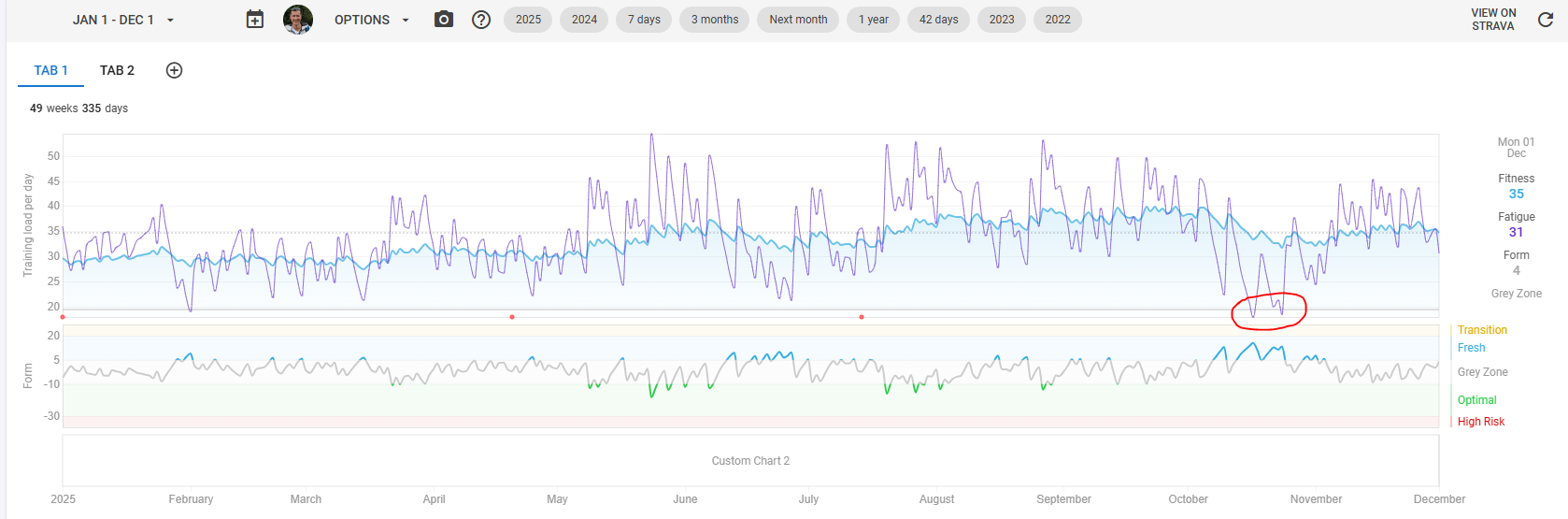
This is my “fitness” chart from intervals.icu. I had a dumb crash in October. Thankfully, I didn’t break anything, but I was suffering from road rash for a period.

Dave

Nice consistency… Another side track is I think CTL is a poor metric for people to strive for but on the flip side, I bet if you got it up to 60-70 by the spring you would feel a lot faster/stronger. I know duration is not in your cards and big intensity is risky or unfun… just have to point that out.

There maybe some creative options like faster long walks or something…

1 Like