How to do a ramp test?

When I started a Coach Jack program in April, I did a ramp test that led to me setting my FTP to 160. While I often increased the target power in the workouts by about 10%, 160 seemed reasonable (fairly new to cycling, and definitely wasn’t in good shape, but have a history of endurance sports participation). I just today did another ramp test, and based on 75% of the average power for the last 2 full minutes, my FTP is now a robust… 167.

I had genuinely expected a higher number after spending the last 4+ months training, and I was left wondering something fundamental about ramp tests: should I be focusing more on maintaining a specific cadence (say, about 80, which is where most of my riding seems to take place), and allowing automatic resistance to fluctuate to achieve power targets, or should I focus on keeping the automatic resistance steady and use an increasing cadence to achieve power targets?

I know that for actual cycling I tend to ride around 80 (see the “fairly new to cycling” note, above), and if things get harder I shift gears to maintain a cadence (though in the lowest gears I tend to have a higher cadence anyway). My question is not about real-world performance, but about how to use the test to provide meaningful input into training that will eventually translate to better real-world performance.

I would like, for example, to be able to maintain a higher cadence overall. I saw noticeable improvement in that through the last four months, as well as overall fitness. Is a ramp test w/ increasingly high cadence but consistent resistance a poor indicator of FTP for someone whose intent is to be able to pedal at a steady but lower (albeit slowly improving) cadence? Would I be better off letting the resistance increase and holding my test cadence steady?

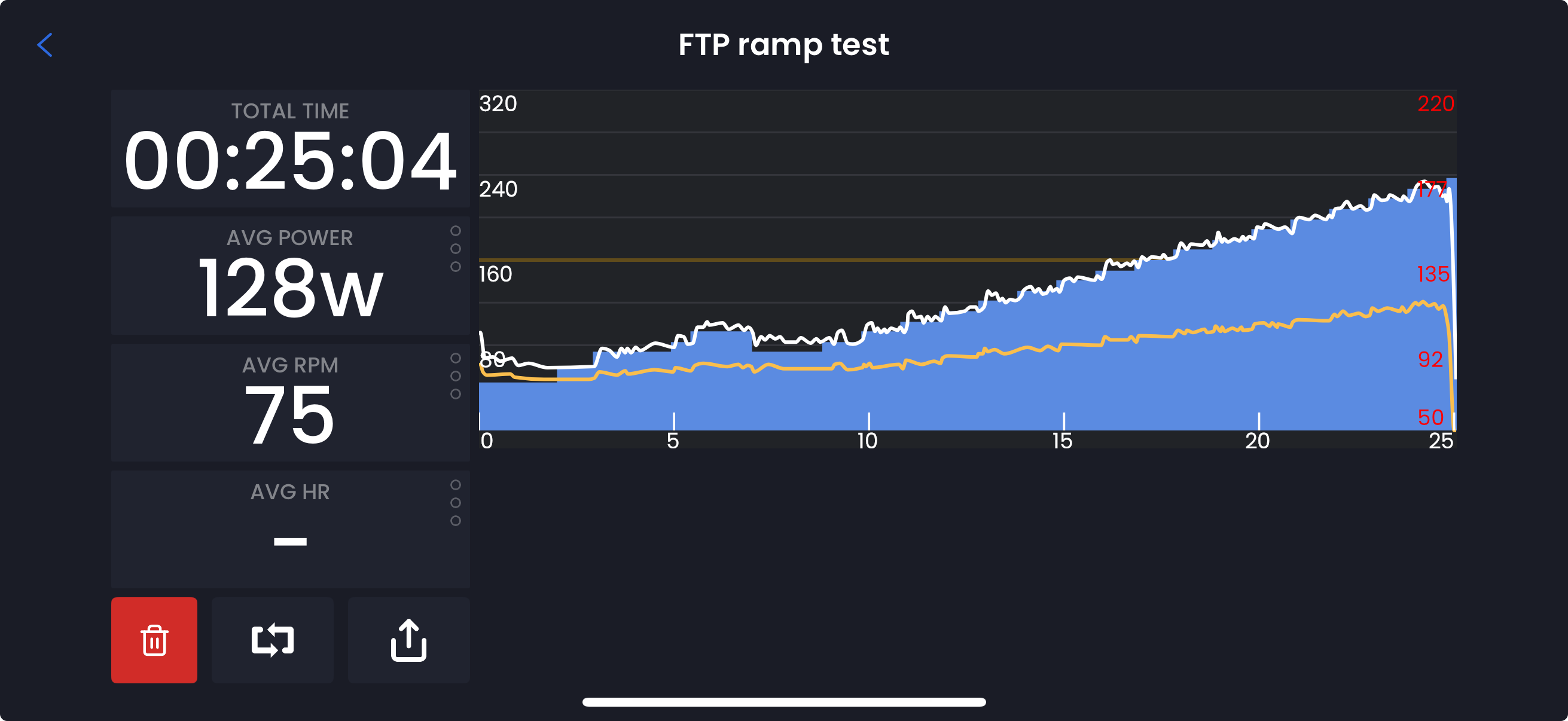
Here’s a screen capture of the workout (is there a way to “share” a workout with the forum?):
1 Like

When doing a ramp test you fail when you can’t turn the pedals anymore.

It looks like you’re using a smart trainer and are doing the test in ERG mode. ERG mode is going to adjust resistance to hold you accountable to the power.

If for any reason your power dips, the resistance is going to increase. If after the resistance increase your power still isn’t where it is supposed to be, the resistance goes up even more. People call that “the spiral of death”.

Basically if your cadence falls off, let’s say it gets to 60 or so… you’re toast. If you keep cadence higher you’re more resistance to the spiral.

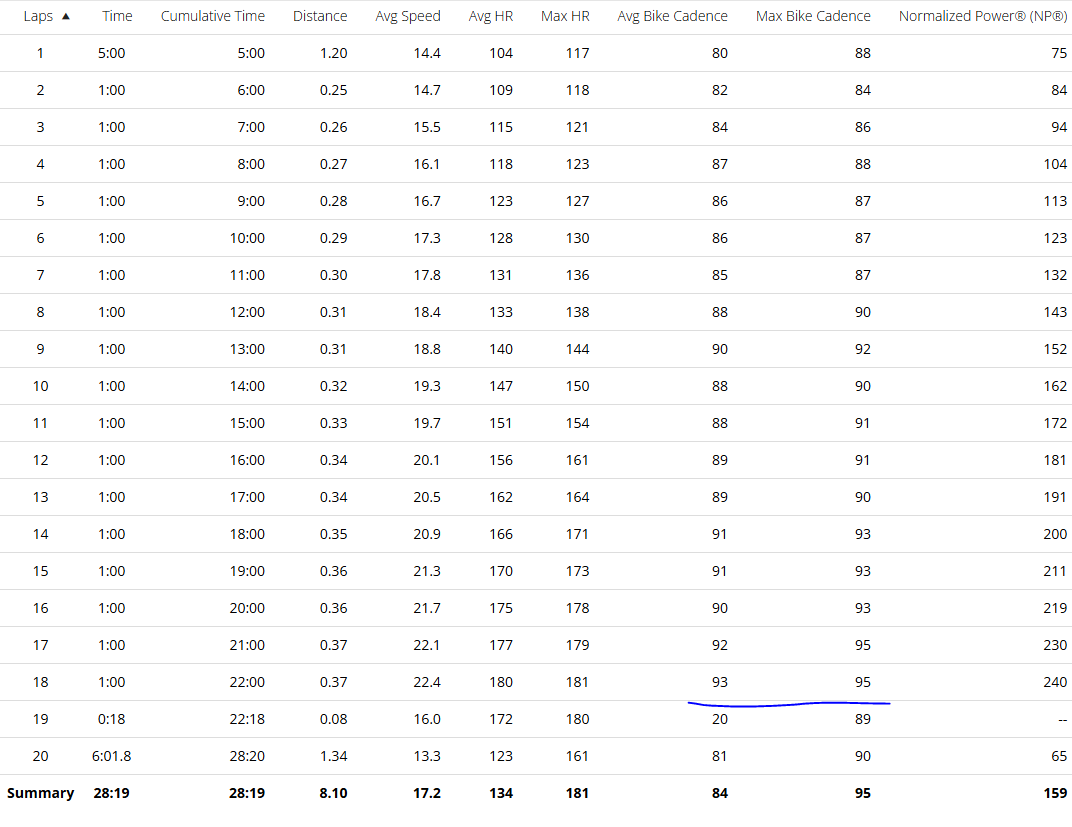
I try to keep cadence in the 90-95 range. This is a recent test I did, the stats are from Garmin laps:

I failed where the blue line is. My test was a slightly different protocol. I prefer 6% ramps, it is a slower burn and I get a better FTP estimate that way.

Dave

1 Like

Thanks for that insight. I was indeed in ERG mode. However, the resistance adjustments never happened… The only time it adjusted was actually a step downward when my power output was way higher than the target for a moment. It might be that I don’t have the sensitivity set low enough (when I was in a training program, I changed it so that it was less sensitive, so that I could manage interval transitions more effectively, essentially using cadence to trigger resistance changes based on power targets). Or maybe ERG mode is not the right tool for the job, either. I’ve no clue!

It looks like you were trying to maintain a specific cadence. You must have been adjusting your resistance, then, to hit the power targets (whether ERG mode or manual), right? That seems like a more real-world riding condition, which makes me think I should retake the test and focus on cadence.

Did you build your own FTP workout? The one I used was one I found just by searching the workouts available in TrainerDay.

Thanks for the help!

Marc

1 Like

ERG mode if used should change the resistance for you. I just tried to keep a natural cadence, but towards the higher end.

My workout is a custom one.

Maybe you were in resistance mode?

Dave

1 Like
  • What smart trainer do you have?
  • Did you go to absolute failure where no way you could have gone much farther -because you were too tired?
  • What was your training/riding history before the plan
  • What plan did you do?
1 Like

Hi Marc,

Nice to have another cycling enthusiast, welcome. You already got some great tips. Let me give you some background on testing.

I’m back from a holiday in the mountains. And of course, I use these holidays to spend some extra hours on the bike. When I look at Intervals.ICU, I can see I’m getting better, but I know that when I do a ramp test, the results won’t be spectacular.

As cyclists, our goal is to cycle longer and faster. We tend to be in the saddle for hours, so a 10 or 20-minute test is not a very accurate predictor of endurance performance.

A test is done when the subject is fresh, but on the road, the last half hour is significantly harder than the first half hour. We call this fatigue resistance. How much power can you still produce at the end of your ride.

Since your ride is taking hours, you are automatically dividing your energy. There is no point in wasting it all in the first half hour, because the rest of your ride will be impossible or at least very unpleasant to finish.

In this light, a 10 or 20-minute max effort is not representative either.

The training you have done is also going to influence your outcome. You want the highest ftp you can reach? Do 3 short but hard interval sessions a week with a lot of strength training.

Your ftp will be great, but your long rides will still suck. This is not the way you want to train for long endurance rides.

Then there is the question of what type of rider you are. If you are a sprinter, your ftp will be better on a ramp test than if you are the locomotive that keeps one steady pace throughout a 3 hour ride.

So, if it seems that a short test is not a good predictor of endurance performance, why do we use it?

Well, first of all, we haven’t been using power meters for very long. Second, the result is not that bad. It is usable. Finally, it has great bragging rights. :wink:

What I like about the Trainer Day platform is that we have nice discussions about training without the testosterone you see on other platforms. That is all Alex. He creates this vibe, and I’m happy to contribute.

A long test, one that takes a couple of hours, would seem logical, but it takes to much training time. You would need to rest a day or two before the test to be fit. Next you have a test day that would be quite brutal and wear you out completely. Finally, you would need to recover foor two or three days, before you can start training again.

It will cost you a week of training. Time you can’t spend on the bike to improve, and who would want to take such a brutal test!?

To increase your cadence, you do cadence drills. You want ot ride longer, so you do long slow distance training. To get faster, you do short, hard intervals.

You want to do different tests to measure your results. There is a zone 2 test on TD as well.

Don’t worry about the end result. You got some great tips. Look at your schedule. Tweak your test. Every time you will take the test, you will execute it better and get better results.

The only tip I would like to add is to look at your heart rate. Are you in the right zone?
If your first test was not executed correctly and you have set your zones too low, you can ride perfect training, but you won’t get any better.

That is why power is important, but heart rate is your control factor. When you see that your wattage is on point, but your heart rate is too low, you need to test and set new power zones.

Have fun, Coah Robert

Hi Alex -

  • What smart trainer do you have?

I’m using an Echelon EX-5 paired to QZ to make it visible to TrainerDay.

  • Did you go to absolute failure where no way you could have gone much farther -because you were too tired?

Almost? I was still able to pedal, but could not hit the power target— couldn’t pedal fast enough.

  • What was your training/riding history before the plan

It was a coach jack plan that I slightly customized for my goal — to get me from zero to an 80+ mile ride on four months. In terms of history, I was a daily bike commuter before the pandemic (about 14 miles a day), and have been active most of my life but never a serious cyclist and have no background in cycling specific training.

  • What plan did you do?

I think it was the “crunched power” plan, using a 3-day a week, 17-week schedule.

Marc

Is the Echelon EX-5 a controllable trainer?

You say that you were in ERG mode but that the resistance adjustments never happened.

If that is because the EX-5 isn’t controllable, that will need a bit of rethink on how to perform an FTP test.

Is it this one? Echelon EX-5s Connect Bike | Exercise Bike with screen | Echelon Fit UK

Mine is the version without a screen, and a few years old, but basically that. It is controllable, using QZ as a bridge. My original question was based around the fact that I used cadence to maintain the power target at each step, rather than keeping a consistent cadence and letting the resistance level change. So when the power target changed, I pedaled faster. If I had not, then the resistance level would have increased. You can see from the screenshot below that as the power went up, so did my cadence. The way that QZ manages this is that TrainerDay uses QZ as the trainer, and QZ connects to the bike itself. QZ has sensitivity ranges for when power output is too high or too low relative to the target, at which point it will adjust the resistance. My initial question was really about the philosophy of an ftp test — should I manage power output via cadence, or via resistance, for the measurement that will get me something most useful for planning around (the workouts in my crunched power plan seemed to be tied, generally speaking, to power output).

That is not not ERG mode. You should not need to pedal faster to do more power. For ERG mode and how that ramp test was designed should be able to maintain a constant RPM the whole time and it just keeps getting harder and harder.

1 Like

What I think is your bike supports slope mode but not ERG mode. So to make your life easier we could design a sloped ramp test so you don’t have to keep pedaling faster. This way you could get an accurate test. I have a spin bike and done ramp tests fully manual with turning the knob by hand and cadence. It’s not so easy but it is possible. But if your bike can be automatically controlled in slope mode (sounds like it can) then yours would be much easier. We could check this very easily.

OK, I am not familiar with QZ, so I appreciate your explanation of it.

You need the resistance to increase so that the test ends due to you not being able to put out the required power, rather than because you can’t pedal fast enough.

For an ERG FTP test, I have always aimed to keep cadence at around my normal cadence level.

That said, it isn’t unusual for a rider’s cadence to be lower at lower power levels and to increase at higher power levels. Also, when a rider gets fatigued, it isn’t unusual for their cadence to drop too.

With that in mind, it might be expected that cadence will go a bit higher on the last couple of steps that are completed properly than it was on earlier ones.

This recent GCN video on cadence is quite interesting, particularly the contributions from Peter Leo - he has done some specific research in this area.

So you likely did increase your FTP over that time. Your first test may not have been accurate if it was limited by your pedaling cadence. We know for sure this one was limited by cadence and not accurate.

The good news is I am fairly sure we can fix this very easy and you can take another test and for see your FTP go up :slight_smile: and be accurate.

The first key is just

  1. Start our app
  2. Click on quick start
  3. Start pedaling and see how hard that feels
  4. Then click on slope button and see if it feels the same resistance
  5. If it feels different press up or down at the bottom until it does feel the same, remember this slope value
  6. Then press the up key until you get to a resistance that feels like at your natural cadence you could survive about 3-5 minutes

Write down both of these slope values. The we can design a better ramp test for you.

Also send me a link to your ramp test. Just copy it from the URL in our website.

All of this really makes me think I’ve no idea what ERG mode and slope mode are. :slight_smile:

What I can say for sure is the following: when I have both TrainerDay and QZ set to ERG mode, I can control my power output using cadence, OR I can allow the resistance to adjust (based on a power level sensitivity range). Either I pedal faster, or the resistance changes.

According to an “AI overview” the bike itself “can support ERG mode” but only via third-party app interfaces like Zwift or Qdomyoszwift (QZ). The native Echelon controller app doesn’t do it. So it must be some sort of simulated ERG mode that I’m getting into. Here’s an interesting reddit thread that likely applies to my specific model, given the age of the bike and the thread: Echelon ex5 : r/Zwift

Your note, and

Thank you for that; I love the GCN guys! This is all leading me to think my FTP test was executed entirely incorrectly.

All of this really makes me think I’ve no idea what ERG mode and slope mode are. :slight_smile:

What I can say for sure is the following: when I have both TrainerDay and QZ set to ERG mode, I can control my power output using cadence, OR I can allow the resistance to adjust (based on a power level sensitivity range). Either I pedal faster, or the resistance changes.

According to an “AI overview” the bike itself “can support ERG mode” but only via third-party app interfaces like Zwift or Qdomyoszwift (QZ). The native Echelon controller app doesn’t do it. So it must be some sort of simulated ERG mode that I’m getting into. Here’s an interesting reddit thread that likely applies to my specific model, given the age of the bike and the thread: Echelon ex5 : r/Zwift

Your note, and Robert’s note, and Ivegotabike are all suggesting that my approach to the test – pedal faster – is fundamentally flawed, since that’s not how we typically ride in the real world.

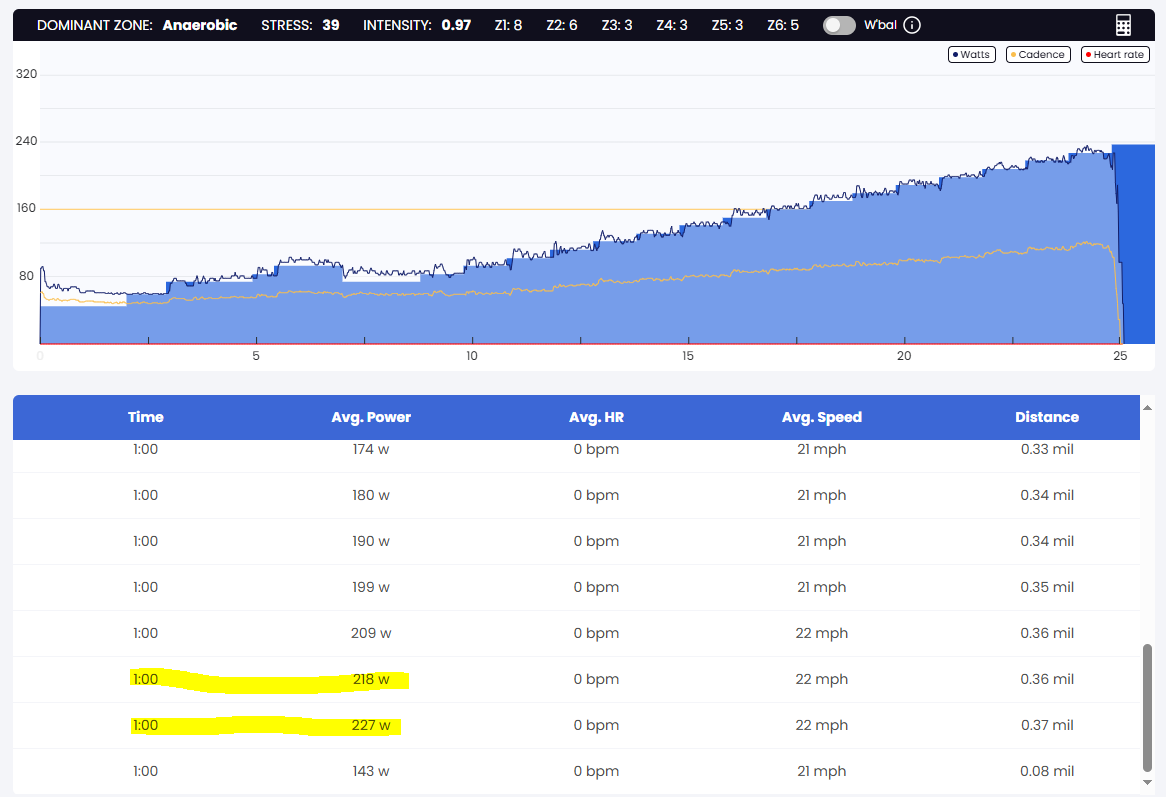
When I have a chance this weekend I will go through your slope mode test. In the meantime, here’s a link to the workout that I did: Trainer Day - Activity Detail

Thank you for all the help!

Marc

ERG you pedal and close your eyes and everything is perfect. Slope is basically resistance mode. Higher slope = harder resistance. Slope or resistance mode you basically manually control the intensity with the slope setting and cadence. But we do have an automatic slope mode as well. LIke going over hills and flats.

Just click on slope in our app and press up arrow. Your resistance should increase. Yes 120RPM at the end… Right now you can just use our ramp test and click on slope and press up arrow as you are going so you don’t have to pedal so fast.

It’s not easy to do a ramp test using a spin bike but it’s doable…
Keeping power and cadence right it’s a bit tricky…

Christmas is coming :slight_smile: and I think that Santa should think about a Zwift Ride for me, I’ve been a good boy all year…

Selling my spin bike and those Favero power pedals should help a bit…

Ciao,
Erik Il Rosso

1 Like

Hi Alex -

I think I did this right, but not entirely sure.

Started the app, connected it to the bike via QZ. Set the app to slope mode. I was able to use the up and down arrows to control the “slope.” At 0% slope and minimum 21 resistance (bike setting via QZ) I could go forever. Pushing slope to 3% changed resistance to 26, which felt like something I could maintain for 3-5 minutes at about 80 rpm (a normal cadence for me).

Here is a link to that specific workout: Trainer Day

Cool :slight_smile: I would not call that right but at the same time it does give us the basic idea. If you can sustain 260w for 3 minutes, your FTP is probably between 200-220. If you though in all out death you could make it 5 minutes probably 220. I would use 200 for your FTP for training purposes but when people ask say 220w :slight_smile:

Realize you bike may not be that accurate but at the same time it might be consistent enough and that is what matters. If you want more more accuracy to really make sure you are improving, do the ramp test like you did before but increase the slope a couple times so you don’t have to pedal at such a crazy fast cadence, probably towards the end of the ramp test it should be 90-100rpm or so if your natural cadence is closer to 80. Anyway good job.