Do you (plan to) repeat your AeT (135 bpm) test even though you have moved on to including more high intensity work?
Knowing the value of the improvements you made in your low HR phase, spotting any changes in the results of such a test sooner rather than later would, surely, be an advantage.
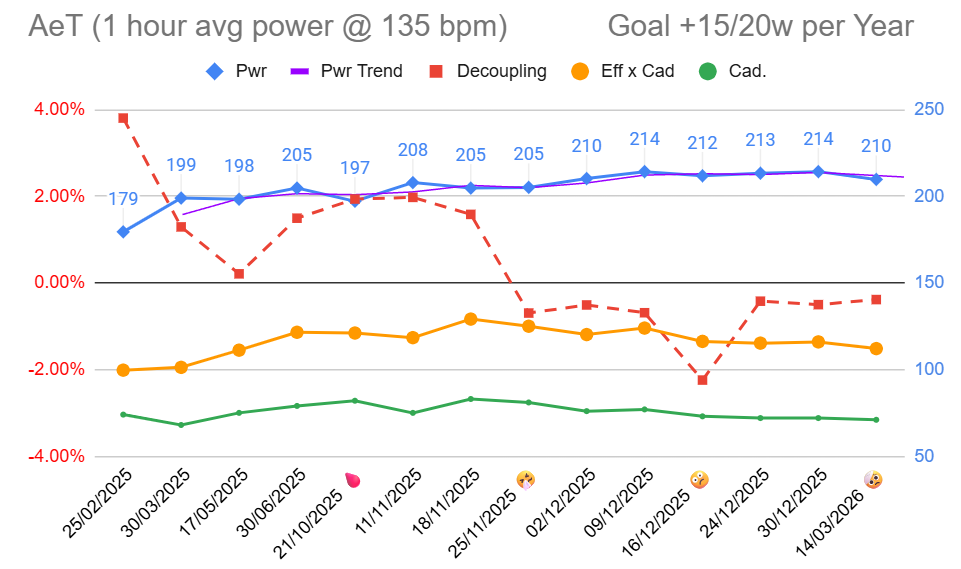
I repeated the AeT test at 135 bpm last week, but without good results (210w vs 214w made in December, still with negative decoupling). I hade some little ache at my back (due to too many deadlifts the day before), but I think it was not the main issue.
The power at 135 bpm is not increasing a lot over time during the last few months (and it makes also sense because I started the intensity sessions):
But Today I made a long indoor session (>4h) with 210w average on 3h and 206w average on 4h. Quite good, the effort was completely aerobic with avg hr 136bpm and always below my (new) LT1 of 149bpm.
Not sure why, but it seems that 135 bpm is a too low level for me to produce good power aerobically, perhaps too far from the 149bpm LT1 (just a guess, not sure).
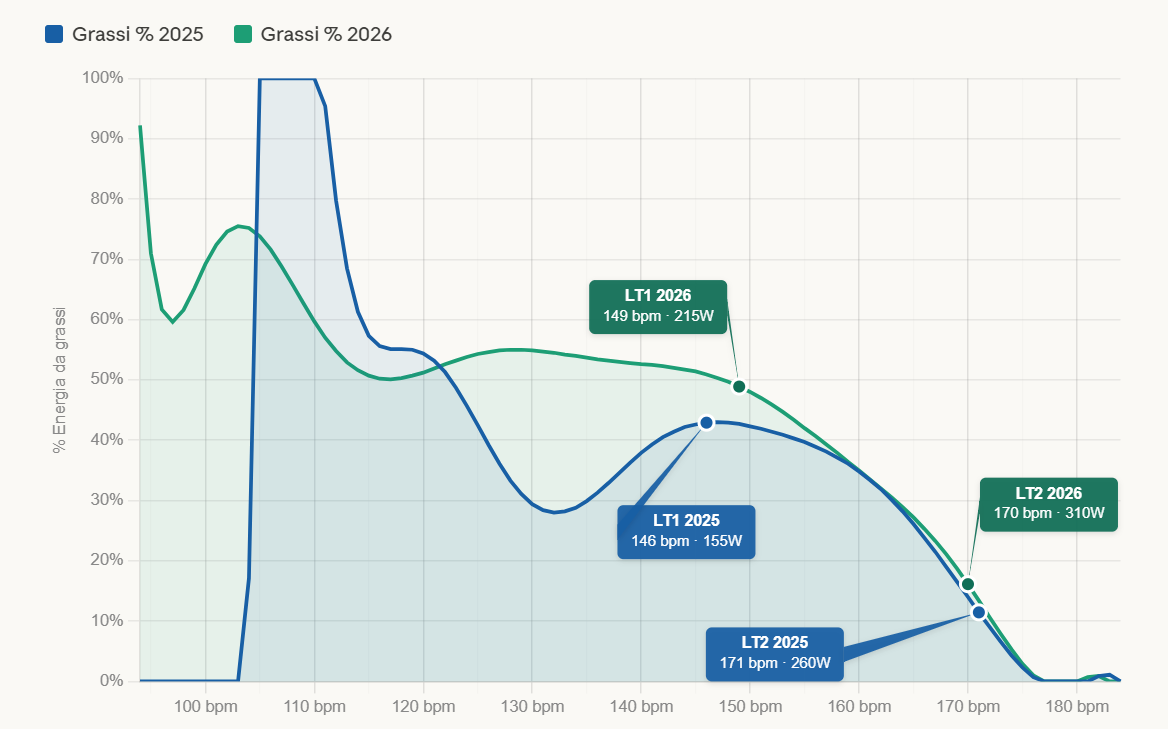
I also made another chart putting on X axis the bpm and not power (it makes less sense) to see the % of fat usage
@Alex over last year my FTP moved from around 260w (LY) to around 293w (this year). But the thing I like more is the progress on fat usage.
Also today during the 4h indoor ride I was still able to go on, despite less power after around 200 minutes (I made it fasted, probably glycogen stores were completely depleted - I consumed 3000 kcal).
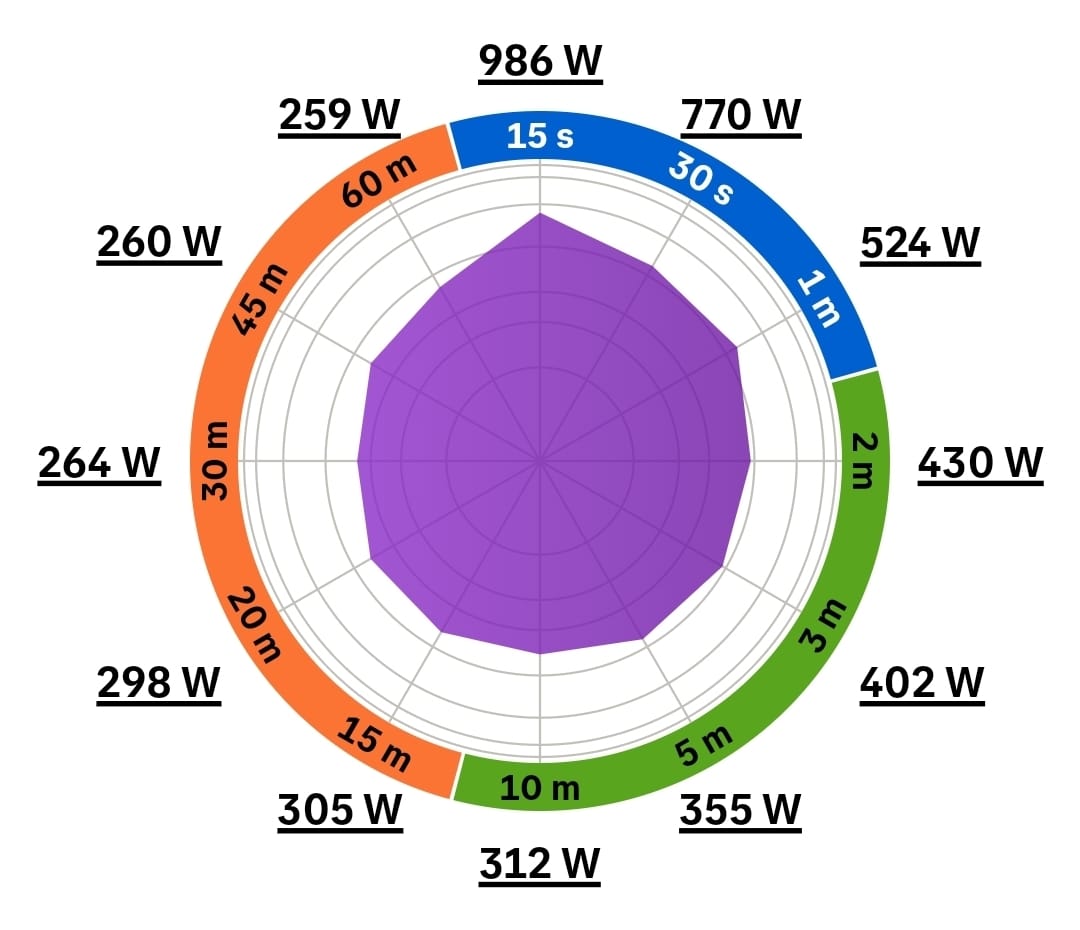
Not sure it’s relevant, but I also attach my current power profile from Strava:
As I am still relatively new to the low HR / MAF type training, there is one thing I haven’t yet got clear in my own mind.
After reaching a plateau from pure low HR work and, therefore, adding some high intensity work, what is the the correct trigger to switch back to pure aerobic again?
As well as high intensity work, it seems to me that “event specific” work needs to be in the mix somewhere.
For example, someone intending to compete in tight circuit criteriums is going to need to include some sprints in their training at some point.
As I posted previously in the Zone 2 thread. “Even though I know that I have a lot of room to grow my aerobic fitness, that doesn’t mean that I shouldn’t do FTP - VO2 - anaerobic. Indeed, such work will be beneficial. I accept that the results of higher intensity training would be better if I had better aerobic fitness."
I mean, shouldn’t include or should include, I would just follow Maffetone’s advice. Which is make sure you’re doing an AET test. And it should be improving every week or every two weeks or something. And once you have a steady progress, start including more intensity and see if it stops the progress. If it doesn’t, then it’s fine.
I also would go traditional on the loop or one of two traditions, which is, I would say, something like a three-month base period or however long you’re going to do this zone two. And then a build and a peak, which is somewhere around four months. And then have fun for a while, enjoy it, and then repeat the loop. So you could try to squeeze that into two six-month cycles, or it could be yearly. You could extend the base a little bit longer. I’d say you can extend the base as long as possible, as long as you’re seeing growth.
The only point on which I’ve some doubts, and no clear answers yet, is to restart the pure MAF approach when aerobic progresses stop. I’m not sure that the AeT test is a perfect proxy of the overall performance (for somebody it might be power at LT2, instead of power at LT1).
That said, I think that for myself I’ll continue with aerobic works, but closer to LT1, and not at the MAF threshold (in my case, at 47yo, the latter is 133 bpm, while LT1 is 149 bpm, increased 3bpm over last year). From what I’ve studied and read around, I think that the biggest aerobic improvements are long steady sessions closer to LT1 and not above.
I also don’t know if I’ll do only pure aerobic works without any intensity during my next base period. Probably I’ll do 3 base sessions and 1 VO2/threshold session per week. (now doing 2+2). There are some studies showing that doing only base work creates a too big gap on threshold performance that is not quickly recovered during the season (not as fast as groups doinb base+intensity)
Yeah, right. So you did the lower intensity last year, you gained 20% and now you’re not sure if it works. Sounds like good logic. You’re just a kid. You got years ahead of you. If you fail this year and don’t gain anything, it’s fine. You can always go back to this one. Actually, I love experimenting, so I would be really happy to see you try the higher intensity and see how the results work. I don’t expect you to get another 20%, but still, even if you gain another 10 and you follow your method, I would say that’s success.
We already read on MAF website that the maf formula is a proxy for LT1/VT1 estimation.
The only point is the one day of intensity per week. On this I’m not sure yet, but I’ve time to think on it. It’s true that last year I improved by 20%, but the same last year I shifted from 2 workouts per week to 4, and added indoor training (which allowed to not miss any workout due to bad weathr or other things). We can’t grant MAF all the merits of the +20% The year before I also had a similar improvement (that is quite easy when you start basically from an untrained state)
Actually his answer is a bit more nuanced than that. He seems to prefer RQ of.85 or more. And definitely not LT1. But we weren’t talking here about what he said. We’re talking about what you did. What you did is you saw 20% results and it worked doing low hr. And now you want to change it. Usually the formula is if it worked repeat it. If it stops working, do something else. But if you like the reverse of that “If it’s working, do something else.” I’m all for lab rats.
During my last CPET I had RQ of 0.85 until 150bpm (max bpm to see 0.85 - after that 0.86 / 0.87). Please don’t forget that I did two months at max 135 bpm and another one closer to the previous LT1 of 146.
In general I agree with your way of thinking, but life is one to wait too much (at least at my age); if we follow the principles and concepts I think that we’ll arrive there. In any case I can’t expect another +20% for the next season, no matter the method I follow
During last months I’ve learned to listen to my body, check rhr and hrv and base the next sessions on those parameters and my general feelings. I think that the basic and most importan goal of MAF is to avoid injuries, while improving aerobic performance. His goal is not to optimize the speed of this process
Yeah, correct. 20% is unrealistic. I agree with that. And yes, like we said, trying something different is fine. It’s just another test. I mean, it’s not completely different. As you said, you went higher. I believe if I remember correctly though, as you went higher you stopped seeing AET gains.
I just hear everybody wanting to do higher and higher heart rate, so I get excited. Pretty soon zone two is, I can only do it for 10 minutes. My zone 2 included about a minute of 350 watts to 400 today. Does that count?
I’ve not understood exactly what you mean with the second part.
I think that the wish is to get the maximum benefit from the time spent with training. Surely also doing 180-age-20 gives benefit, but slower. MAF gives corrective factors (also +5/+10) under certain circumstancies: why? because they can give benefits faster.
180-age is a model, is not science. Science is doing lab test and finding ventilatory thresholds and optimize training based on those. My 2 cents (but not only mines).
We all believe that aerobic improvements leads to better performance and we can state that the main way to train it is through training below LT1 (but not too far from it). On top of that MAF adds a lot of other SUPER interesting concepts like cortisol and insuline production and all the effects of anaerobic training and how it can block aerobic progress (under certain circumstancies).
I think that for athletes who have always done too much intensity and too little Z2 — which is the majority of amateur athletes — the MAF protocol works very well because it corrects a chronic imbalance. In that context, eliminating high intensity training for 3-6 months produces remarkable improvements.
Yes, I am not talking about maffetone you are talking about math and values… none of that really matters. What matters is what works. Trying to optimize by going right to the edge increases the risk of failure. Everyone wants to maximize and thinks harder is better or more efficient but zone 2 proves that wrong at some level. Maffetone knows everyone motivated wants to go as hard as they can. Sweet spot is very popular for this reason. So I am just saying you can always justify more and trying to maximize gains, maximizing gains is risky overall but we all want to do it. The people that can push more and recover well do well. Most fall apart or stop improving. So you did 133 this year, the safer route would be to try 138 or something… if that works try 144. Rather than going all the way to the limit and taking the most risk of failure.
“What matters is what works” this is true. But who can be 100% sure that the improvements made last year were made mostly by the MAF approach and not by higher consistency, volume, training precision (started using powermeters) and 4 workouts per week (without missing one) for months?
I think nobody, honestly. What do you think @Alex ?
I agree completely. I’m just saying something worked and worked extremely well, and now you’re trying to optimize further. That’s risky. As you and I talked about individually, it’s possible that just a base reset made a big difference, and how you do that base may be less relevant as long as your body’s getting rested and holding on to aerobic and possibly improve it. Pros have long done a base that was not a Maffetone base. It’s just that as people age, and if they don’t sleep very well, and they do other anaerobic work such as strength training, it’s important to error on the side of safety from an aerobic intensity standpoint.
Now, if you are saying I’m going to do below VT1 for my next base because it’s going to be a lot more fun and I think it’ll work, that’s an absolutely perfect strategy from my perspective. But trying to optimize on incredible progress is risky in sports. You’ll likely never know if it worked better or not because it’s very unlikely that you increase 20%. But you will know if it doesn’t work at all.
I’m also curious to see what happens. The next goal is to hope to see 225w at 135 bpm (from 115w) by the end of the year. My guess is that the increase will be higher at LT1 and LT2 than at 135 bpm. But let’s see.
Tnx for your very precious feedbacks. Surely now I’ve a bigger bag of tools to use
 You’re just a kid. You got years ahead of you. If you fail this year and don’t gain anything, it’s fine. You can always go back to this one. Actually, I love experimenting, so I would be really happy to see you try the higher intensity and see how the results work. I don’t expect you to get another 20%, but still, even if you gain another 10 and you follow your method, I would say that’s success.