While fitness wise it may not have moved the needle, it probably does help with that much time in the saddle with comfort – getting your neck, back muscles, etc… used to being on the bike that long.
Dave
While fitness wise it may not have moved the needle, it probably does help with that much time in the saddle with comfort – getting your neck, back muscles, etc… used to being on the bike that long.
Dave
The word among Ultra athletes goes ´As soon as your HR reaches 3 digits, you´re training endurance´.
Alluding to what Dave said, I believe it is still a matter of volume. No proof just gut feel. I bet if you rode your bike with your kids for 60 hours a week with your kids, you likely would get some adaptions… (hopefully healthy ones)… So volume and goals affects ratios of z1-z7… and how much affect they have. and if they are the most efficient and most required at the moment. The big point of polarization and maffetone is that this is shockingly less volume and less intensity than we ever imagined to gain adaptions. So most will argue, minimum intensity, minimum volumes for low intensity, most are wrong. Now sure, in specific cases or goals, < 60% of MHR might not make sense or be most efficient. But it it’s not vey likely to happen anyway that we stay under 60% for most of a ride, at least for most of people.
But we are talking in the context of targeting zone 2, and other factors that might affect it like heat, laughing or having a bad day. Most of the time that might take you from a 68% target to a 63% target… And in the case of temporary changes like laughing or changing positions on the bike, it does not matter in the bigger context. Although it’s better to target a little lower than higher to account for these as frequently going up is easy and getting your HR back down is harder.
If you are on the bike especially when focused on training and the intensity is very low, the odds of it not being beneficial are extremely low. In your case <50% is likely not doing a lot but hard to say. If I go with my kids my HR is usually higher than my training intensities  But with my wife it is very low…
I think we’re more or less on the same page now. Everybody here it seems agreeing that too low is not beneficial (or at least not efficient due to too low adaptation compared to the time invested). Double digits or 60% are more or less the same concept in trying to find what can be too low.
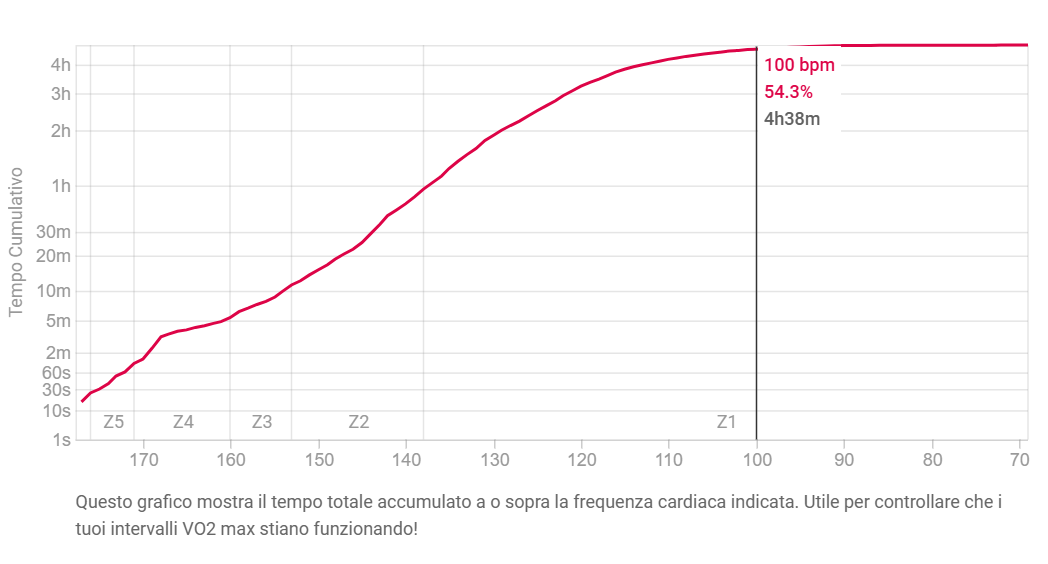
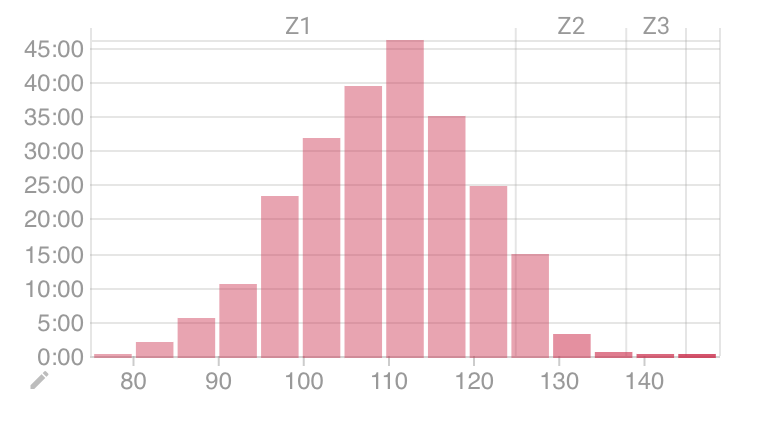
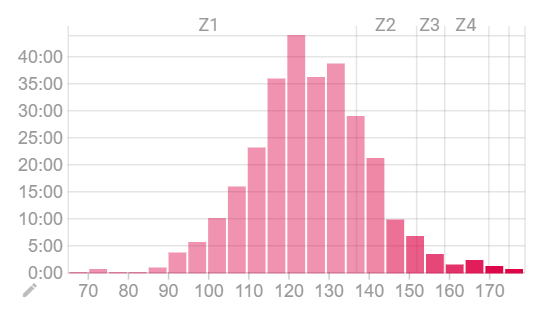
During my Z2 ride today I made 4:38 above 100 minutes and 57 minutes above 138bpm:
Good time in the between in z2
I agree on the Z2 approach, I’ve married it and I see that it’s delivering results (also anaerobically, as expected).
You are an MTB rider… there is no such thing as Z2 in MTB
Here is my Z2 ride yesterday… Below is closer to true z2, you have too much intensity in yours to qualify as a true z2 ride…
But I am only talking from a total purist stand point. Yours is likely just fine from the perspective of being an ride that you can recover from in 24 hours or before your next ride which is one of the most important aspects of z2… From a Maffetone perspective even mine is close to too much since my Maffetone HR is about 122. But I am not trying to fully follow his suggestions at the moment and cycling is different than running. Might be a slightly higher AeT.
right; doing true Z2 in MTB (on steep uphills) is impossible. I try to stay below 135, but not always possible (at least without a “huge engine” :D).
I don’t think that not doing a pure Z2 ride has a huge impact on the end result. Probably every once in a while we use more carbs, and after few minutes fats again. What is your opinion?
The aspect of Z2 that I care more about is not much the recovery time, but the capillarization, mitochondria development and rest of adaptations that it creates
I agree with Alex that most cyclists are trying too hard to get better. Their training is often too hard, leaving a lot of low-hanging fruit on the table.
@BlackTek: don’t underestimate the impact of going too hard on your zone 2 effort. It is not just the hr that spikes. Lactate does as well, and it can take up to 45 minutes before all lactate has been cleared.
The beautiful thing about lactate is, that your body will use it as a source of energy. It compromises fat as a fuel.
In the Netherlands we have many grouprrides that screw up their endurance training like this. The ride together in a group. Every 10 minutes another couple takes the lead and ‘pulls’ the group. Every couple does this for 10 minutes every hour. In these 10 minutes they ride hard to keep up the pace for the group. They build a lot of lactate in these 10 min, and it will take them almost an hour to recover and fully go back to zone 2 training. By the time they are ready, they are up at the front again.
In my group, everybody can choose where they ride. Sometimes I ride a full training in the middle of the group. Ideal for zone 2 training. Sometimes I do a complete ride at the front of the group. When I’m at my peak that is still zone 2, else it is interval work.
When I’m in the fast group, I skip the front as much as possible. Just try to make it through the training. 
This is very interesting @Robert_UCL, producing lactate that is later used as source of energy is something that I underestimated 
Based on this, we should do Z2 as initial part of the training, but probably it’s also not perfect (perhaps body will use more carbs at the start of the training, also at low effort, if there is too much sugar/carbs/energy around - possible?)
It’s very clear and supported if you start fasted and get a slow warmup into z2 you will stay in fat burning mode. You will notice it’s easier to keep your hr down. For sure start with z2. Maffetone suggests for some riders, going over z2 too often in the week can’t block aerobic progression. If you are doing hr/power tests in z2 and seeing progress then you are fine.
These things can drive cyclists insane. It makes it one big puzzle.
Alex and I were responding at the same time, and we seem to have different opinions.  So, I edited this after I wrote it to further explain.
Since research has shown us that fasted training doesn’t lead to improvement in performance, but it does lead to bad eating habits, and eating any carbs will spike your bloodsugar for hours, I wouldn’t worry about this.
Research has spoken; there isn’t much you can do on the intake part of your energy that is perfect for our training and reasonable from a daily intake perspective. I need 300+gr carbs daily without any training. Whenever I do a 3,5 hour lsd training, this can spike to 600gr. The 300 is already a big target to reach daily. It doesn’t leave any room for skipping a meal. Let alone if I combine this day with more carbs, because of a long slow-distance training.
You could delay carbs before your long-distance training, but since most cyclists start early to make the most of their hours on the bike and the rest of the day, this isn’t practical either.
What I do for shorter, indoor lsd training is delaying breakfast and eating after the first hour on the bike. I usually have a big breakfast smoothie with oatmeal, frozen fruit, and low-fat French cheese (which contains more protein than yoghurt).
The next question this problem raises is zone 2 before or after your intervals?
If you have enough time to combine your interval session on working days with extra hour(s) of zone 2 work, that is.
Early in the season, you want to do your intervals before your zone 2 work, because you want to be fresh and create the biggest possible training effect from the intervals.
Towards your goal, you can put them at the end, and do zone 2 first, because you now want to focus more on durability.
This is why focused zone 2 training is so important. Especially pre-season.
Two more important points I want to make:
If the goal of z2 training is fat utilization. If you consume pre-ride carbs you will clearly see your hr is higher or power is lower for a given hr and it’s well proven that you will be using carbs as predominant fuel.
So while cyclists don’t need to follow this kind of training if your goal is burning fat, it is the way to do it. If you don’t fully buy into the importance of fat utilization it’s fine, it’s just another method of training (high fat burning) which is what he mentioned. But again, this is the purist approach and Pog does consume carbs for his z2 rides but he does not seem so obsessed with fat utilization.
But if we produced lactate the body will use it first, right? This was the part that I underestimated when doing some very short hard parts (steep climbs) during Z2 training
Yes, before fat for sure. Robert is totally right here. You want to put your z2 first and ease into it z2, trick your body into thinking it is not doing anything. Just that fight or flight feeling will bounce you quickly into consuming carbs, the gentler ease in the more it thinks it’s not doing anything but going on a walk… And I also agree with Robert that their would be no proof that fasted training makes you faster… If you want to become very good at utilizing fat then fasted works but essentially no one is doing that in the cycling world so no reason to think it is effective for top performance. I just obsess (like you) on some of the theory as to why and test it. Fasted burns more fat… kind of obvious this is likely It also forces you into z2 because doing hard efforts feels painful
all clear @Robert_UCL @Alex thank you for your detailed explanations. The picture is much more clear now.
I still have another question about HR and Z2.
During my SFR I’m able to stay below my AeT, much below, but I guess that I’m also producing some lactate, possible?
It’s Z3 power zone, but Z2 HR zone:
My AeT / LT1 is 146 bpm and during the efforts I’m at around 125bpm (at 32/35 cadence). I do my AeT test at 135bpm.
What do you think that my main source of fuel is during those intervals? carbs/glycogen if I had breakfast and fat in case I didn’t?
It would be nice to consider the SFR as Z2 training (just because we look at HR zones and not power zones)
No SFR is not zone 2 Think of zone 2 as “easy to very easy.” Also I strongly suggest just keeping it simple and not following every rule out there. Zone 2 is mostly for base building… well base period is over and it’s time to have fun I personally would just focus on recovery with HRV or RHR (I like lowest night time HR)… and do what is fun. Also make sure you are getting variation. SFR is great for variation although, in MTB you do low cadence high output already… so if you going up super steep stuff, you don’t really even need SFR… I would forget about z2 at this time other than using as a tool to ride more and get good recovery. If everyday you wake up with the same RHR/HRV… ok then do what ever you want.
I agree with Alex. This is why so many cyclist blow themselves up in the mountains. They ride with a very low cadence and a high power, but the hr stays low. So they think they are doing fine, but it takes a lot of energy. Boom, all of a sudden you’re gassed out.
It is like you are weight lifting. HR stays low, but you are still working very hard.
Hello folks,
it’s a long time I’m not on the forum; I had a 3 weeks vacation and some other issues to fix; I hope to be able to restart training seriously from next week.
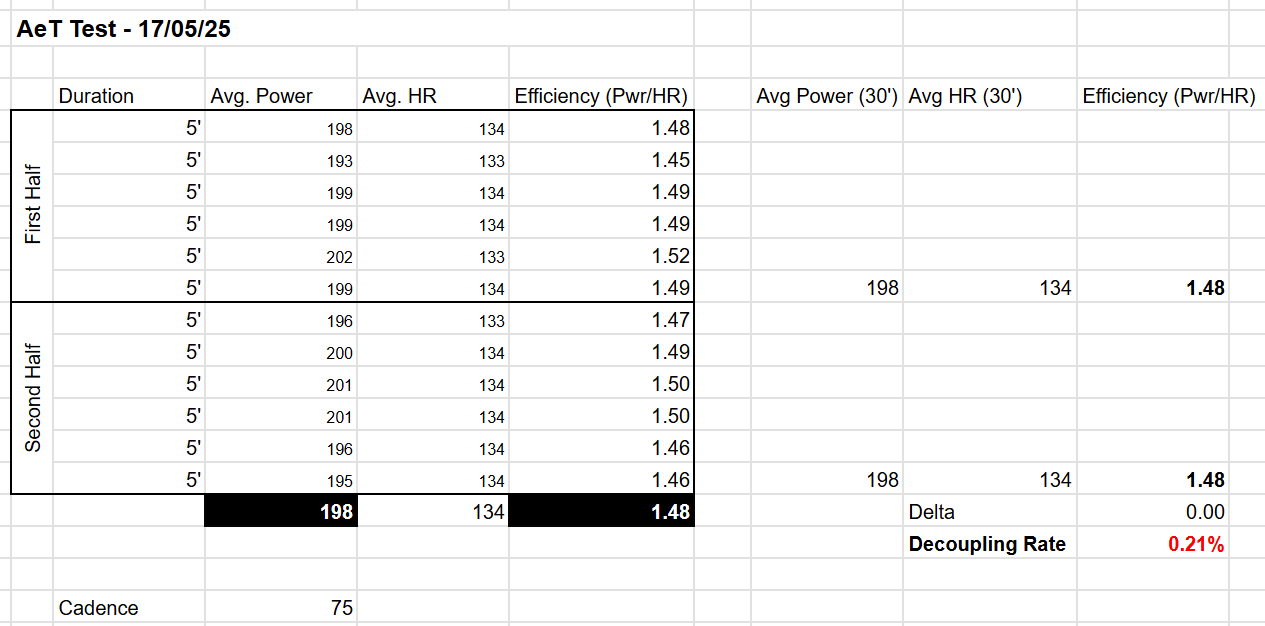
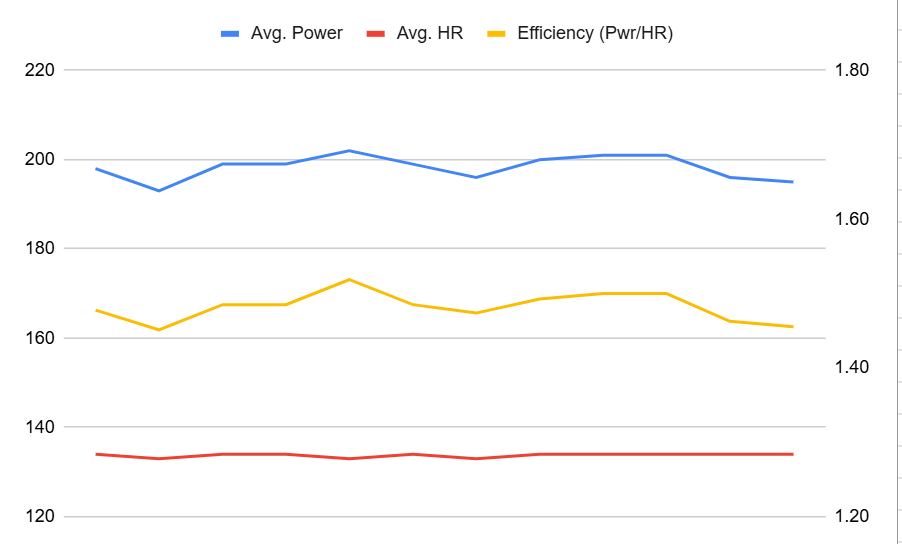
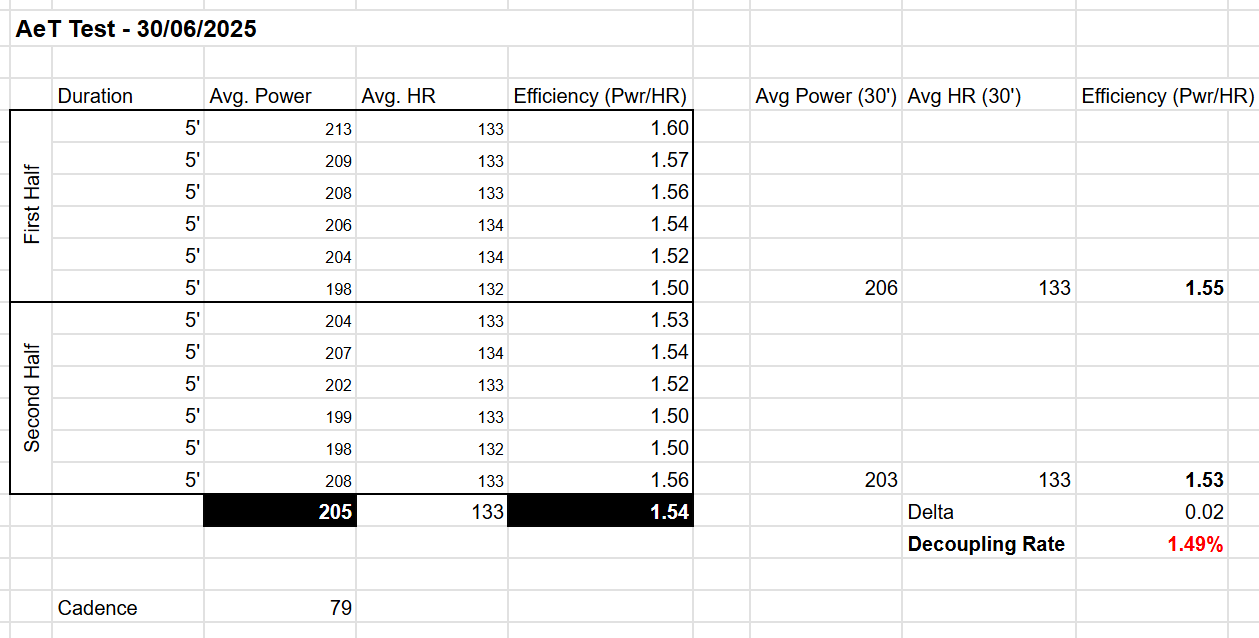
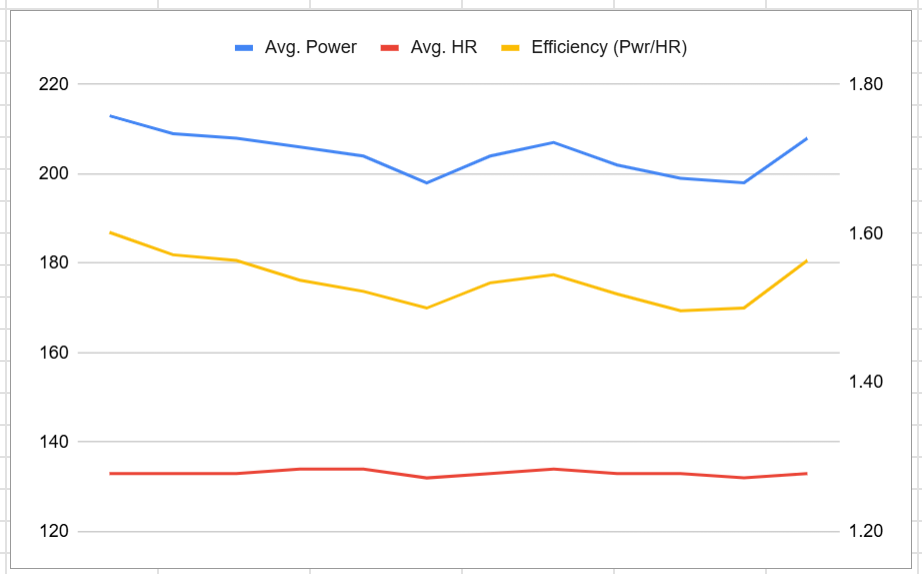
Today I made a new AeT test, and, as usual, I share the results:
Long story short not big differences from last time, and it’s good considering that I just did some weights and running, to (try to) keep the anaerobic form. But the HR drift seems improved, despite it was already very good last time (1.21%). I also tried to ride at a little bit higher cadence, to avoid the “discussions” / doubts of the last test
Before the test I slept only 5 hours and had a big sushi dinner with family outside, also not perfect for the test results 
Looking at my last couple of rides it seems that eFTP went down about 7 watt (also not too bad)
I’ve purchased four books (Maffetone also), now reading Mastering Mountain Bike Skills. Next one will be Maf because it’s the one that @Alex loves more
enjoy rides and good weather!
I think your results are great.
Do you really think 1.21% and 0.21% HR drift are different through? I don’t think they are. I think you’ve demonstrated outstanding aerobic conditioning at ~ 200 watts.
There’s something called Measure Systems Analysis in the quality world. This assesses whether a measurement system is capable of measuring what it intends to measure. For example, if you were to use a tape measure to try and measure the ID of your car engine cylinder bore it would not pass. Tape measures are good for other things, but are not capable of that level of precision.
Dave
4 posts were split to a new topic: 175 vs 165mm Cranks
@here
today I made a new AeT test. There is an improvement, but it was really hot (28.3°), as also visibile from the HR drift increase (quite surely with colder temperature it was going to be better).
Last test was at 21° and those before at 17°
Ps cadence improved a bit, but with lower cadence I’m able to maintain higher power at the same HR (last 5 minutes made at 76 rpm instead of 71 rpm of the 5m interval before, and I made +10w)