Yes, my point was nothing about what they talking about fits the definition of polarized. They used the term without understanding the “accepted” definitions.
Below marathon pace does not mean easy, and 18% time in zone is not polarized, it’s 20% of sessions and about 10% of time.
I am not saying their suggestions are bad or wrong just their use of that term is.
In the context of the Billat paper, below marathon pace (vMarathon) is used to describe training below lactate threshold. In the discussion section of the paper:
“The fact that these elite marathoners perform the majority of their training at velocities well above or below vMarathon does contrast with common wisdom that large values of training be performed at the lactate threshold intensity.
…
This pattern of training load distribution primarily above and below the lactate threshold intensity has been termed “polarized training” 15”
The paper cited 15 is a paper by Hagan et al in 1981 (a long time before Seiler appeared on the scene) that, I confess, I am not familiar with
I just deleted what I wrote because, I think I am getting into the weeds about something that is irrelevant (my crazy opinions…)
Not sure about you Dave but @Ivegotabike and I seem to be agreeing on
Pyramidal seems to be more proven than 100% polarized in long term adaptions.
I think we all agree there is value in easy and how much likely depends on the individual case.
Dave and I seem to agree that a polarized plan is reasonable as a long term health and fitness strategy.
We all are not convinced at different levels zone 2 + strictly 4x8 is the best long term training strategy for the majority even if it was effective in the study.
Yeah, there were a couple of similar discussions a few years ago.
And I remember getting a lot of headwind on my interpretation.
But I’m still convinced that it was the correct interpretation of what Seiler actually wanted to say.
First of all, I’m happy to see that we all agree on the 80/20 session distribution. I stopped responding to anyone who wants to project that to a TIZ distribution. It is wrong and completely ignores the core of the idea.
Second thing is that Seiler’s core description does not talk about Z1/Z2/Z3. He was talking about 3 buckets Easy/Moderate/Hard and earlier this year he changed that to 2 buckets, Easy/Hard. In those older discussions, I remember having said at a certain point that any intensity can lead to a hard session, simply depending on the duration. If you do an extremely long Easy session and you’re highly fatigued after that, it should in my opinion be considered a Hard session because it requires a longer recovery.
What I basically think about the practical implementation of these principles is very simple (and I love ‘simple’ ).
When training 4 to 6 times per week with a min total volume of 6-8hr, just make one of those sessions Hard and keep the rest Easy. If the frequency is higher (> 6/week) and you already have some decent base, you can do 2 hard sessions, but monitor fatigue/recovery.
Now to what is Hard. I already mentioned that any intensity can be hard depending on the duration. A hard session can be a very long Easy one, but also a short one with lots of High intensity. And that balance should be used to adapt the nature of the hard sessions depending on the training period and the goals you’re training for.
Why should a marathon runner or a IM athlete do VO2max or Anaerobic sessions the whole year round? That doesn’t make any sense and it’s simply not what the elite’s do. They will do periods with those intensities but the goal is probably to break through a plateau. Then they will go back to more race specific training. Tempo and threshold will be their bread and butter. Nearing their main event (peak period), they will throw in ‘Race Pace’ sessions.
Now when it comes to amateurs with limited time to train. If you can only do 2 sessions a week and fall in the 4-6 hr range, it means that you have 5 recovery days. That’s a whole different story. Your best bet is probably to make both sessions quit hard, unless those two sessions are on back to back days. The difficulty with this strategy is that you will rather quickly find yourself on a plateau. And then it is important to find what works for you to get through that plateau. The usual mistake here, is that the people in this case who are eager enough to improve, will find some extra time to do an extra session after all. And then they will do that extra session with the same intensity as the other two, thinking ‘that works, so I just have to do more of it’.
In most cases this will fail, because the load is becoming too high. If they would keep that extra session Easy, it probably will work, although every one is different.
Lower intensity rides definitely do become hard rides if they are long enough. If you can find time to do such a ride now & then, I would encourage it.
Is 20% TiZ “hard” really a thing that people do? I could not sustain that. Maybe I could get there for a week, but I would be wiped out. Properly wiped out and, I think, at risk of injury or illness.
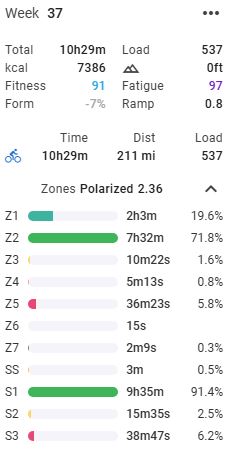
Looking at this week as an example, I have done all my training indoors so far. My two “hard” sessions were 5x 5’ @ 109% with 3 minute recoveries on Tuesday and 4x 30" hard start (200%) into 3 minutes at 111% with 8 minute recoveries (just done that this morning).
Intervals shows this summary
38 minutes in zone S3. It would not have been possible for me to have done just over 2h in that zone this week whilst respecting the core rule “only make this workout so hard that you can properly complete the next one.”
Correct, you see that very rarely, but some do it distributing hard efforts all over their total training time just to get there. And that ruins basically every session because there’s no longer any specific session goal. Everything becomes the ‘same’… I would say: always keep in mind what the session goal is and avoid getting distracted from it.
People are using a one-time quote from Seiler that states ‘80-20 session distribution, results in something along the lines of 90-10 TIZ or maybe even 95-10’. That was an answer to a question regarding TIZ. it was NEVER the intent to use that as a rule for Polarized, but it started living its own live on the net. And in discussions like this one, someone will come up with it because they have read it or they have seen a 30sec excerpt from that Podcast without having the whole context.
Andrea tells me that pros start at 0/5% to start the season and may end at 15-20% but 15% would more likely be the top end. A seasonal average would be <10% just like Seiler suggested. One key difference is it’s is not a static year round 10% it’s periodized.
As Claude pointed out you see many people on forums looking at TIZ, talking about 20% and even that running reference on North suggested 18% and that sounded more like TIZ than sessions and they alluded to the idea it was polarized. That is what drove my suggesting the clarification. Your distribution looks great to me.
This video is very long and I’m not necessarily suggesting anyone should watch the whole thing, but this is one point of evidence why I’m saying Pros/Joes are not the same species.
If an amateur cyclist tried to even come close to what Simmons is doing they would completely cook themselves in quick order. His greatest skill is probably the ability to recover.
My honest opinion is that I’m not sure that I’ve actually paid the dues required to be part of this debate. I think the other 3 participants here are all real deal athletes. I may be a real deal athlete compared to the guys at work who don’t exercise at all, but that’s about it.
However, for what my opinion is worth, I think most of these discussions are quite far in the weeds of fine detail. Consistency and doing the work are the keys.
It seems like the 2 main pitfalls amateurs can fall into are: 1) doing too much intensity and are not able to recover, 2) doing everything too easy and never pushing themselves.
I think about any training can work if you’re consistent and can avoid those pitfalls.
If you want to compete at racing I think that is a different discussion.
I can see why frequent racers (and, therefore pros in particular) would have more time in higher zones - the races themselves would make a decent contribution.
We look at Quinn’s training regimen and can see why it is labelled as brutal.
Other World Tour riders will look at it say “Yep, that’s about where its at for me too.”
Young amateurs with aspirations to be World Tour riders will look at it and say “OK, that’s the training load I am going to need to do when I’m a World Tour rider. How do I progressively add to my current training to get there in a controlled way, without destroying myself in the process.” A few will make it, most will fall by the wayside before they come anywhere close.
It is the same in other fields. I know a top tier pianist. She trains 6 days per week, 6 hours per day. She has a coach and she does proper structured stuff to improve various aspects of her playing, not just banging tunes out. Then she usually does a couple of 2 - 4h concerts per week too.
If I tried to play the piano for 6 hours per day, my hands and arms would be aching so much before the end of day 1 that I couldn’t play again for days.
And there are people that she was at music school with, who were at her level back then, who never made it to be professional musicians. Even of those that did, there are very few who are still at her level in the field now.
Not same species. Andrea says the same. But we still need air to keep muscles moving so that makes us surprisingly similar in some basic principles. Variety, volume, progression…
So we shouldn’t try to fully mimic pros, it’s a reasonable strategy to find the parts of what they do that works for this species. “mostly easy” some hard being a strategy that keeps people healthy and more consistent. For some unbreakable guys they have more latitude. Tanyo 400w ftp comes to mind, although he said he eventually broke and had to back off a bit.
Even 4x8 is too much for many, even if they can should they? I think not, or not all year round and don’t start there. Should most people avoid middle intensity training, probably not other than be careful with how much.
While there are “go kill yourself” coaches, my belief is when a person is a bit serious about outdoor performance, most suggest plans that follow similar principles to what pros do.
Again general health and fitness is another animal which is different than a more serious performance plan. I believe Seiler is more in a maintenance plan for him self and likes suffering and racing.
I’ve taken a step back from self-coaching as I’m a classic waffler who will change things too much.
I’m riding outside whenever possible until it gets cold out, but am going to follow Coach Jack’s guidance with a Sweet Spot Progression style plan to better align with the specificity of how I ride outside/improve fatigue resistance.
You really sound experienced. You understand TR’s magic formula well. If you look at our progressions they are actually z2,z3,ss progressions, as well as week to week progressions so much more comfortable than SS blocks like TR’s. Andrea is big fan of progressions especially for a build phase and then maybe blocks for a peak phase.
Yep, I saw the example @dthrog00 posted in this thread
then had a nosy through the workout catalogue and had a look at a coach jack sweet spot progression plan too. It looks good.
Those old sweetspot base plans that TR had (especially the High Volume ones) were a bit savage, especially for beginners. I expect the compliance with them was pretty low and that, in part, guided the process that came up with TR’s current (and still evolving) adaptive plans.
Yes, I know they have improved a lot. The old motto should have been “Get Faster or Die Trying”.
It’s best to play with the CJ plan builder to see how the intensity slider work and the ride feel to see how you can dial in intensity. As well as custom with harder blocks… It’s very flexible.
Yeah, you’ve got it! That was the thread I started. If I have anything notable to report I’ll put it there.
Really, high level the plan is to do a 12-wk block of Prog SS #4 to #12 starting this week and follow up that up with a 16-wk block of Prog SS #10 to #21 wrapping up in March. The #21 workouts (the hardest ones) are A: 4x14 minutes of 72%-80%-90% and B: 4x12 minutes of 73%-80%-95%.
I mentioned in the other thread that I will do these workouts about 7% harder than written as they’re designed for more of a ramp type than long-form FTP test…
The weather has been great so I’ve been riding outside this week and didn’t do any of the trainer rides, but I’ll transition to the trainer as it gets colder out. The idea is to keep the weekly hours consistent and training load in line. I did A #4 a couple weeks ago and enjoyed it.