I hate the clickbate videos too, but they work. There is not one system, but polarized can fit many. The point is that everybody should do what fits their needs.
It’s like the 40/20’s. Since there has been a study that 3 sets of 13 reps work, everybody is doing 3 sets of 13 reps every week. There should be a progression in your training. So the 3 sets of 13 reps is only for the top athletes that I coach and only at the hight of their peak block, which might be one, two or three times at most per year.
The rest of the time they are doing 30/15’s 20/10’s and/or a lot less reps than 13 per set, and there are many more variations that keep your training interesting and help your progress in other ways.
What I like about hte people on this forum is that they try things. That’s a great way to get better, learn new skills, and have fun.
Great breakdown of your approach, Dave!I really like how you’re structuring your polarized training with one high-quality interval session and long endurance rides — it seems like a smart way to balance intensity and recovery. Observing HR changes during zone 2 after intense intervals is interesting and could definitely help simulate those later hours on outdoor rides.If you’re interested, you can also read about how structured wellness programs help people maintain consistency and performance here: Workplace Wellness Challenges: We List The Best Ways To Motivate Employees and Boost Productivity - BetterMe — just like structured support can make following a training plan easier and more effective.
My “prescription” was to try to perform all of them as hard as possible while keeping one interval in reserve. So my highest measured HR during the last interval would be about 90% of peak cycling HR and I would be glad the workout is over, but I wouldn’t be destroyed.
All of them were RPE of 8/10 or “Very Hard”.
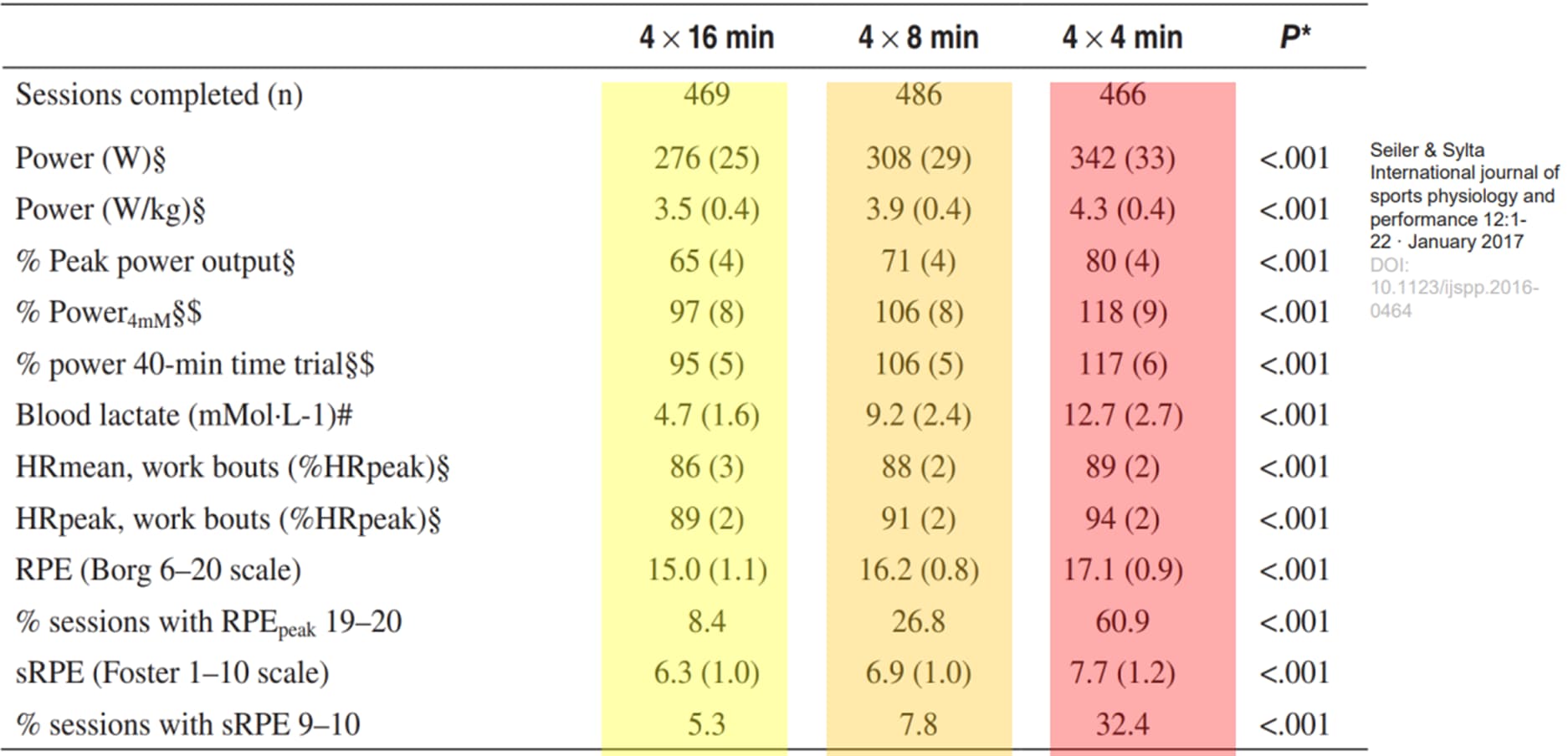
This is a different methodology than the famous Seiler interval study 4x4, 4x8, 4x16. His subjects went twice week at the hardest effort that allowed them to still finish the workout.
I think this is an important distinction. I would imagine they probably were destroyed and they did it twice a week!
I think of the folks on the forum that participated in this thread that I find more value in polarized training than they do although I’m not using it now.
There’s a really good article about the 4x8 interval at wattkg.com:
I’m not sure how much review you’ve already done, but if you are considering polarized training my advice would be:
Review the specificity of what you need for your cycling and how polarized training relates to it. If you’re a racer I would carefully review the demands of your race and your strengths/limiters. I’m a recreational cyclist so this is of lesser concern. If for example you are a TT racer then I probably wouldn’t recommend this type of training.
Choose a high intensity interval design that works alongside this. I think if you alternated 4 week blocks of 4x16, 4x8, 4x4 that would potentially be a good way to do this.
You are probably going to need trial and error to dial those intervals in properly. Start a little easier than you think and adding intensity is better than the “fly and die” approach.
The low intensity training I never quite figured out. I think the goal is to have this be easy enough that you can do it day after day, but not so easy that you are getting minimal benefit from it. Maybe it is a defect on my part, but I think I was going too easy. I think these should be not that far away from your estimated LT1 unless you have a really high FTP and the fueling required to achieve this is prohibitive or you really struggle to recover.
is now the most viewed video on that channel and is, for sure, a contributor to her just landing a three year ambassador / athlete role with lululemon.
She was, in that video, one of the earlier people to call our Zone 2 as over hyped.
It’s all because of you. You made her famous. Tell her you want a commission. I don’t remember what you’re doing now. Are you doing your build process? When’s your first race?
I am not going to race. Whilst I sort of like the idea of going back to time trialling, the number of events these days is way down from what it used to be. I would have to travel much further than I am prepared to, in order to do more than just a couple of races.
I just started a bit of a build on 21 Feb - did my first threshold session yesterday (24th). I am leaving picking the specific workouts to the new TR AI tool. I tell it which day I want to do what sort of workout on and it serves one up.
To say I haven’t done a threshold workout since August, it did well with its selection. I rated it as “hard, 8/10.” The one on the schedule for next time looks like a sensible progression.
Now that most users have completed one full AIFTP cycle since the launch, and the TR folks have spent so much time explaining how the system works, the feedback is increasingly positive.
I am continuing using the TD HR+ function for the “easy” days between “hard” sessions.
If you see me in a lululemon cap, you know where it came from
Oh yes, I don’t want to go any place in my car if I can help it so I understand.
I would love to hear how that works. Meaning, I think that is TRs specialty in general which is making most workouts medium hard to hard which is a what a lot of people prefer. The feeling of the workout that pushes them hard enough that they believe it will cause adaption. I do also believe towards the end of build and peak this is how it should feel pushing. into very hard just not sure that it needs to feel like 8/10 at the beginning unless you have a shortened build and peak period. But I wonder how the progress at 8/10 to match your next workout, I guess they are guessing and the next one could be 9/10 when really 8 is probably better at this point.
But if you like it and feel it works for you that’s what matters. I wish I could change my thinking to matching more mainstream desires like this, even though the science supporting it is questionable, but science these days is questionable in general. I am slowly moving in that direction
MAF and a bit of low end sweetspot (with the ~80% HR governor) until this week.
The new TR AI has noticeably changed the way it trains athletes. They have obviously worked hard to reduce burn outs. Rather than a cookie cutter plan of ever increasing intensity / longer intervals, the system really does show signs of adapting to the outcome of previous workouts.
If it predicts you will rate a workout as hard and you rate it as very hard, it will seek to give you an easier workout next time. If you rate it as hard but your HR was way higher than it was when you previously rated workouts as hard, it will seek to give you an easier workout next time.
The ramp rate can be changed for each workout type too - there are 5 settings and, for example, you could have very aggressive ramps for sweetspot and very conservative ramps for VO2.
Also, the endurance rides in between the hard workouts (of which there are two / three per week) are dynamic in duration. The AI suggests a duration from 30 minutes up to 5 hours, based on its assessment of your fatigue and the requirements of your next workouts.
Red light / yellow light fatigue warnings are still there too.
Finally, as the AIFTP runs every 28 days, it has more chance to dial your workouts back down generally.
The AIFTP number is intended to correlate to a “level 3 threshold workout” which is as low as 62 TSS / hour at 0.79IF. Even in a threshold block with 3x threshold workouts / week, you aren’t getting to especially crazy levels in 4 weeks, before it has the chance to dial you back down (if that is what you want it to do).