Training plan volumes for female riders

Looking at the strava stats for my cycling groups, I notice that the guys are riding way more hours. All the training materials I’ve found online are prescribing 10-15 hours for a mid-volume plan, but it seems completely unattainable for me without essentially riding Z1 all the time. In particular, any anaerobic efforts result in my muscles requiring an extended period of recovery.

I feel like I’m not doing enough, but then it appears that all the serious female riders in my group also do fewer hours, closer to 6-10 approximately. I’d love some advice from the ladies, and coaches who’ve worked with both sexes!

If you are doing 6 - 10 hours now and have the time to increase to 10 - 15, the key is to do it slowly, over, say, 6 - 8 weeks. i.e. add 1 hour per week.

If you aren’t training 6 days per week, add extra days. Initially Z2 / Z1 rides only.

If you are already training 6 days per week, add extra Z2 / Z1 volume to your existing workouts to build your overall volume.

Once you are established at the new volume then consider increasing the proportion of higher intensity work (in line with the requirements of the events you are training for). It is common that there are only 2 or 3 high intensity workouts per week. Specific blocks of training may have more, but for most people 3 hard sessions in a week is plenty.

Rest and recovery becomes more important as you up the workload.

Frequency, then duration, then intensity.

1 Like

In general I agree with your findings that the biggest volume equates to biggest performance, I analyzed about 20 thousand riders here and saw the same pattern, but in order to handle that you need to have the right combination of ingredients to recover fast enough to be healthy and make gains from that volume.

I agree with @Ivegotabike build your volume first with low intensity and most people can handle the the most volume at zone 2 heart rate or some were around 65% of max hr and once you get to your desired volume then start slowly adding intensity. Many of us are like you that we start to fall apart quickly with intensity. @Robert_UCL is respected coach here, lets see if we can get him to respond.

2 Likes

I’ve been a life long athlete, and did endurance sports for about 2/3 of my life. My training time unfortunately appears tops out at around 12 hours a week no matter what I’ve tried. I keep trying to push through this ceiling and end up either burned out or injured. It just feels like my body can’t recover quickly enough no matter what I do. Maybe it is just my physiology, but I’m not one for excuses! :stuck_out_tongue:

@Alex Would you have anonymized data sets of male and female riders, that’d be helpful in figuring out where I am on the bell curve in terms of volume (ala cyclinganalytics).

I’m super disciplined with intensity, as doing a hard race for example will set me up for a minimum of five days of recovery. I seem to make significant gains just doing Z2, so it kinda pushes the “house” up. My typical week has no more than 2 “harder days” and usually just one (Jack’s serious italian plan). I’m not sure if riding Z1 is more productive vs. riding a couple hours less in Z2.

1 Like

I have a lot of data but no easy way to access it. Intervals has the best comparison data, you can sign up for free and connect strava or garmin. You can do a lot of cross comparison m/f age based comparisons.

1 Like

You should read Maffetone’s books if you haven’t, he addresses your issues very clearly. Any of his books are good but the Big Book of Endurance is a classic.

2 Likes

I agree with the Maffetone suggestion. If you make significant gains just doing Z2, that is a sign that you (like most of us, whether or not we want to accept it) still have a lot of room to improve our aerobic system / aerobic capacity.

If you could do 12 hours of Maffetone aerobic base trainng per week for 3 months or so, I think you would then be able to add intensity back to the plan in a much more sustainable and effective way.

6x 2 hours MAF rides per week, or 4x2 hour plus 1x 4 hour, would be tremendously effective.

I also agree with the intervals.icu recommendation. I don’t think there is a better cycling data analysis tool / data set anywhere.

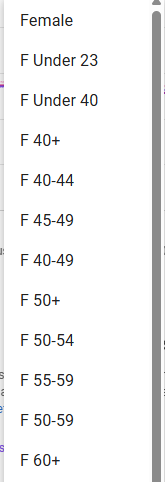
These are the categories in intervals that you could compare your own data to

Consider having a read of this thread too Building and Measuring aerobic fitness

1 Like

I can’t find a comparison for weekly training volumes though. I’ve done 12+ weeks very easy and ended up slower/ unable to ride at all. I’m sure everyone has a breaking point where more training volume results in a reduction in performance.

Men will tolerate (and need) more volume because they simply regenerate muscle tissue and red blood cells at a higher rate than women. I’m interested specifically in the magnitude of the differences, which will be some form of a bellcurve for both sexes.

Whilst I do agree with your generalisations, I don’t accept that they apply at the volumes being discussed in this thread.

12 hours per week can be structured to be persistently productive for M & F. It is a serious undertaking that should not be taken lightly, but it is achievable and maintainable.

That does not mean that someone (either M/F) can jump off the couch and do 12 hours, but it is straightforward to build up to that volume in a way that makes it sustainable and productive.

A couple of things have caught my eye from your previous posts

“it seems completely unattainable for me without essentially riding Z1 all the time. In particular, any anaerobic efforts result in my muscles requiring an extended period of recovery”

“no matter what I’ve tried. I keep trying to push through this ceiling and end up either burned out or injured. It just feels like my body can’t recover quickly enough no matter what I do.”

“a hard race for example will set me up for a minimum of five days of recovery”

“I seem to make significant gains just doing Z2”

Quite alarming was the “unable to ride at all” part of this “I’ve done 12+ weeks very easy and ended up slower/ unable to ride at all.” What do you mean by that?

Without seeing more data to make a more informed decision, these things point to you doing too much higher intensity work at that volume level than you are ready for.

Maybe your choice is to stick to 6-10 hours and make the most of that time, or do the work (on and off the bike) to build up to the 10-15 hours that you mention in your first post?

Decent cycling fitness can be achieved in both scenarios, but there is no doubt that there is a general link between higher volume and higher fitness in these volume ranges.

Those ranges you have mentioned are wide though: 10 is very, very different to 6, and 15 is very different to 10.

1 Like

As @Ivegotabike pointed out without seeing your data its hard to give solid advice but this “smells” like too much intensity based on current state at that time, you said you got slower on more volume but that can mean a lot of things. The general premise of building up volume on low intensity and then slowly adding intensity is a model that works. How much you can and should handle and optimize around is impossible to say without clear data and testing over a period of time.

I can say universally when I looked at data which is predominantly male most 280w+ FTP guys did 8-10 hours a week average for the year which likely means peaks of 12-15 and most people down around 180w did about 6 hours average. But generic values like this mean almost nothing for you specifically. How much sleep you get a night can have a major effect on what is your optimum volume. No one takes all the important factors and consolidates them. Genetics plays a major factor. Life stress. So just looking at age and gender is not deterministic as to what is best for you as an individual.

2 Likes

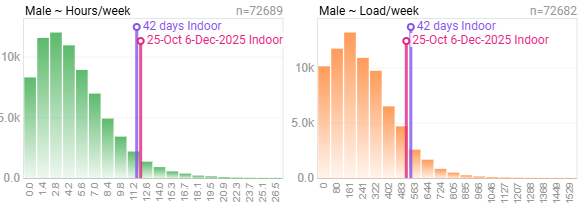
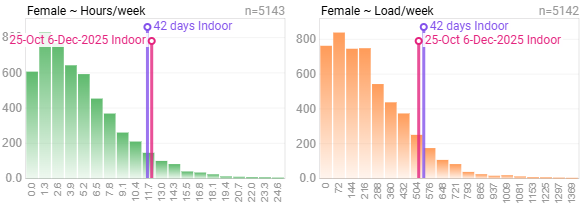
Intervals does have two charts that might interest you. I don’t think they have much value in the form they are presented, but they are there

Hours / week and Load / week

Here are the broadest categories Male and then Female

The purple and red vertical lines that are confusing the chart are my data that I couldn’t find a way to remove.

1 Like

Wow you found it! that’s exactly what I was looking for! The sample sizes are way bigger for the men (probably some self-selection bias). Thanks so much!

It looks like the right tail of the distribution past 10.4 hours is about 8% of the total area, so pretty much 92% of female riders are doing 10.4 hrs or less a week. I suppose I’m pretty much where I should be given that I’m not a kid/ pro/ retired :grinning_face: !

2 Likes

Yes, and as you alluded to, you know fast people doing lots of hours. That’s one of those things where part of the reason they’re fast is because they can reasonably recover from lots of hours. Many pros are pros because they recover so well. Obviously there’s other factors. But I think your evaluation is right. Somehow I get the feeling for a lot of serious cyclists that 10 hours is a good number to optimize their potential. I realize female might be a bit less than male and many serious males can optimize higher than that.

1 Like

I just like to have one higher intensity day, because it helps maintain my ability to do hard efforts… and it’s fun racing my club mates!

Hi Raven22,

Sorry for my late response. I have been occupied with some private matters lately. Most endurance athletes feel that they are not doing enough. This is exactly why I like to coach them, you seldom have to stimulate them to do more. Most of the time I tell them to do less.

For you, I would advise you not to compare yourself with others. Endurance is always a competition with yourself, even in a race with others. The truth is that you can never outrun yourself, so it doesn’t matter if someone else is faster or slower.

It is just you and your path to the best version of you. With that mindset, there is no need to compare and stress about not doing enough.

It lays the focus where it needs to be: on you!

Now that the others are out of the equation, your question is: Am I on the right path to optimize my performance?

While more hours often lead to better performance, making just more hours doesn’t complete the picture. Making more hours comes with eating more on and off the bike, sleeping more, and getting rid of other forms of stress in your life.

While the whole thread is about more hours, I hear you say that more hours are difficult because of recovery. As a coach, the first question I would ask you would be recovery-related.

Think about:

Are you eating enough carbs on the bike?

Do you eat a recovery meal?

Do you have a healthy, deep sleeping pattern?

Are there any other factors in your life that lead to above-average stress?

Important for a woman is also your period, which is very personal and can have a big impact on training and recovery. Does your period hinder your performance?

When that is tuned in, then we can ask the training questions:

How long have you been riding?

Over the last few years, have you tried to cycle for more hours?

Have you tried different schedules?

For instance, you can ride 3 rides a week. That will make it more difficult to do a lot hours, but it is doable. You should be able to do a 2-hour, a 2-hour, and a 4-6-hour training. That last training varies.

You can also do a 2 or 3 day block. I like to do these, but they ask for everything else to be right for the best recovery.

I really like a one-day-on/one-day-off schedule, but that is almost impossible to maintain in a regular week. Especially when you have kids.

It is important to know that building performance takes time. I’m not talking about weeks or even months. It takes years. Be patient and keep developing these mini steps. It is also important that you build rest weeks into your schedule and rest months into your year.

In short: Yes, more training will help, but it takes time to build. Don’t forget to change the rest of your life with it.

Hope that sets you on the right path.

Lots of fun, Coach Robert

2 Likes

WOW thank you for writing such a long detailed reply! I think it’s worthy of a pin somewhere, alot of athletes would find it useful.

I think you got me there with the nutrition and sleep! I almost always eat during rides, and really can’t much at all fasted. My diet is less than ideal (am vegetarian), and the best I can do is maintain about the same weight. Cycle tracking is quite useful, and I definitely have a strong week and a.. not so strong week ha. It helps to know so I can be easier on myself.

I came from swimming and running, which I’ve done alternately for about the last 20 years. I picked up cycling 10 years ago, but I took a few years in between to do other sports.

I ride about 5-6 days a week. As far as it being "“ideal” from a training perspective… I have no clue. Cycling works to manage my ADHD symptoms (I’m a non-responder to meds). There aren’t many days off and managing the intensity is crucial. I let myself drop off the back most group rides, and have very little time above Zone 2 (less than 30 min a week). yeah probably not ideal! :laughing:

It’s a long journey and early in the season, so don’t feel like you need to reply quickly! :blush: I have alot of reflect on!

1 Like

You’re welcome, Raven22. Thank you for your kind words.

As far as nutrition and ADHD, I’m a vegetarian with ADHD without meds, too. I do use fish oil for my ADHD. It’s from my pre-vegetarian diet, and it helps me from being an unguided missile to the state of a normal functioning human being.

But still, after a 170 km solo ride, my friends said: " You’re quiet tonight. “ That explains why you have been running, swimming, and cycling for 5-6 days a week during your life. :wink:

Just make small steps in your nutrition. Use an app to track what you eat now, and make the adjustments you need. My first guess would be that you have a typical ADHD high metabolism, and you don’t eat enough quality food.

Create a ritual before going to bed. Get yourself a paper notebook and make a brain dump. Just write and draw everything that is in your head. I mean everything. Doesn’t matter how long it takes. Next, do some strething or yoga, and some breathing exercises (in your bed) or meditation.

Finally, there doesn’t seem to be a plan in your training. Use TrainerDay to plan 2 focused high-intensity days. Keep the rest low zone 2 rides.

Have fun

2 Likes

Thanks, this is really helpful. I appreciate the practical tips on nutrition, routine, and training structure—definitely gives me a lot to work with.

1 Like

Wow what a cool coincidence! There are dozens of us! :laughing: Though I must admit that I go in the other direction from being silent to confessing to murders from a decade ago … kidding!

What’s the dose like for fish oil? I’ve been tracking my diet for almost 5 years now. Just pulling from the app I have 62g fats, 300g carbs and 97g proteins as a 30 day average. I’ve been pretty much maintaining this weight for the last year or two, so I’m reluctant to bump up the target…

Indeed, sleep is tough for me. Random thoughts keep popping in my head, and it takes a lot of mental effort to put them in phrases and sentences. Like a school of fish, they slip away when I try to grab onto one.

I have scary visualizations of crashes right before falling asleep, and that injects enough adrenaline to keep me awake for a good hour or more. The quieter and darker it is the louder it is inside my head, you know?

I’ve done 2 training plans this winter, but after the club season begins I admit I don’t do strictly structured workouts. I would have an objective of either doing endurance or intervals and stick to it fairly well, but it’s not like an ERG ride of course.

With regards to high-intensity, I’m not sure how a rider should feel afterwards. I did a couple 15k TTs, and after each one I couldn’t ride >Z3 for a good 5-7 days afterwards. It’s like I have to sprint to hit the power targets and then blow up way before a minute. So in order to keep up consistent volume, I’ve kept “high-intensity” stuff to a minimum. I honestly feel a bit sad about it, but its my physiology I guess.