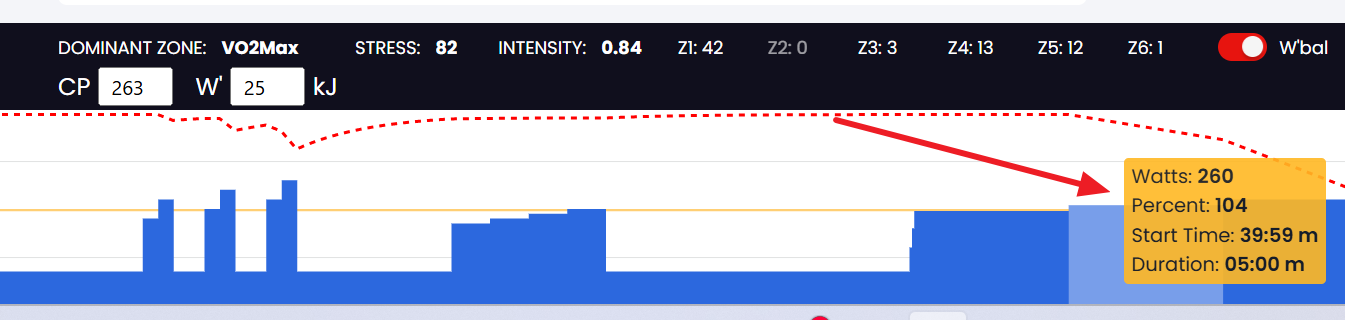
In the case above you can see that the interval target is 260W, and my CP is 263W. Why the W’ balance goes down there?
I knew that we use the W’ “fuel” only when the current power is above CP. Basically (Current_Power - CP) * duration_in_seconds is the amount of Joules used from the W’balance (when Current_Power > CP)
ps it’s OT, but in the CP and W’ calculator I would add the model based on 3 points, that seems to be more accurate. People can eventually leave one empty, and you’ll use the current model based on 2 points
There are two sides to this problem. There is the CP, W’ calculation and then there is the W’bal calculation. The problem is the W’bal method we are using only takes 2 parameters so this ends up making the two methods work very inversely similar.
None of this stuff is exact science… it’s just a ballpark that is much closer than using FTP only. Also realize that many people are taking these values from different days so again it’s very ball park. It’s just interesting that even with these ball park figures it can end up very close. But even the definitions of FTP and CP are very fuzzy… Now come on is it 20,40 or 60 minutes… Both of them are based on a power you can sustain for a long time and no one can even sustain their CP or FTP for 60 minutes
CP, W’ are based on models and you’ll have more/less screwed figures based on the model and on your individuality (if you’re a super strong sprinter or a super strong time trialist the model probably will not work perfectly - and in opposite directions)
In theory CP is the effort you can sustain over 30/40 minutes, while FTP on 60 minutes - and this is the reason that CP is normally a little bit above FTP.
That’s all an over simplification Again trying to map math to physiology is always a rough estimate. There are always tons of exceptions to everything. Focusing on the basics is enough. You don’t need perfect because you always have to add your own modifications especially if you want to go to 100% failure (which we don’t advocate, but if you believe that is best for you go for it ).
I think the most important reason for any of us to use CP W’ for this is to understand how these energy systems work, and seeing that the math basically works helps confirm this. It also gets you in the ball park for designing workouts that will completely exhaust you at the right or maximum level but it’s always still going to just get you in the ball park no matter how perfect the math is.
The way coach jack works in it’s progressive nature you will learn your limits. Now CJ VO2max or HIIT is actually different intensities for different people with different rider signatures… So some work harder and some less hard but overall since we don’t try to take people to the end of their limit it’s not so critical. They also can just slide the starting slider harder if they chose and the rest will fall into place.
Yes, our goal here is to keep it simple and give the most basic options when possible… So very small incremental and questionable value is limited… I do not want to be like Golden Cheetah or IntervalsICU…
Here is Alex Welburn on the roadman podcast talking about W’ and critical power.
It drags on a bit, but it is interesting stuff. You can probably skip the first 38 minutes if you just want to get to the W’ stuff
For time trial fans, there is a section on combining W’ bal with bestbikesplit to come up with pacing plans.
38:39 Let’s Explain All These New Terms - Critical Power, WBAL, etc 48:43 What Is W Prime? And Kilojoules Explained! 57:32 How We Can Use W Prime For Pacing Strategies 59:03 Measuring How Well A Cyclist Recharges Between Efforts 1:01:00 What Is W Balance & How To Use It For Pacing Races & Climbs 1:11:05 Where Do These New Metrics Fall Down? 1:17:07 Testing Frameworks & Discover Your Strengths & Weaknesses & Tactics 1:33:26 How Do You Use These W Prime When Schedule Sessions? 1:37:43 A Pragmatic Way To Use These New Training Metrics 1:50:35 Aerodynamic Info & All The New Upcoming Tech & Ai
Ok I mostly just listened at the 38 minute mark but seems like a reasonable presentation of the basics which for most people just means they need to recognize that aerobic power and anaerobic power have some independence. i.e. phenotype.
I think phenotype causes some confusion in itself. Ok so I am a sprinter, now what? Joe Friel talked about this way back but I think the answer is still simpler than people would like to make this. Which is train based on your goals. As you get closer to the goal itself get more specific.
Intervals over your FTP are affected by phenotype/wprime… what is perfect for one rider is not likely perfect for you even if you have the same FTP.
I am friends with Mark Liversedge, who was the lead developer on golden cheetah for a long time (they had almost 10 thousand fairly serious cyclist in their prime). Mark gave me an early education many years back. In no way am I trying to say I am as knowledgable as Alex (or Mark) is. Just GC had a large data science community including Skibba and the early W’ scientists. The European versions of Coggan and such.
Mark introduced me to Andrea. Andrea is also deep into this stuff and has a 20 million $ cycling lab and 30 years of coaching and testing. So we have accurate formulas now and many scientists have been studying this stuff for 20+ years. W’ + W’bal is accurate enough (although for pros 1% better matters).
So the problem is the only place this accuracy really comes to light is with a highly predictable subject i.e. pros in TT races… Andrea can estimate 40k pro time trial times within about 15 seconds most of the time when he has all the data. I also wrote code that is usually within about 15 seconds of his estimates, I was trying to beat his estimates but couldn’t. Wind frequently being the biggest unknown.
Anyway, my point would be “Why?” For regular people, even strong cyclists, what is more math going to bring? I am not against science, all for it. And I am grateful guys like Alex are out there doing this work. Trying to go deeper find more answers. I don’t think a better understanding of w’ or w’bal is going to make anyone (other than a pro) faster. I don’t see how it answers questions on how to train more effectively. If it did everyone should be a Xert user
So I think a general understanding is valuable and W’bal focused workouts can provide inspiration in regards to taking intervals to complete and absolute failure, especially in ERG mode, which likely is not going to be the same level of failure as outdoors. Mark told me he had a coach and W’bal failure intervals inspired him to drop his coach
I suppose, as cyclists, we should be somewhat pleased to live in a world where the time and resources for such research to be undertaken are available.
Investigating things that might only make a small number of people a few seconds faster in a cycling time trial is, surely, very much a luxury?!
Our life is a luxury. Mine is for sure other than this dam cough that won’t go away Ever since COVID arrived if I get a cough they seem to last longer than ever… But people going off on crazy tangents of the depth of perfecting W’ can lead to other tangents that benefit us. Following my motto “More Easy i.e. Polarized” at least gave some people a form of relief… Oh my god… I can stop training hard and I will go faster this is the best news ever!!! Joke…
Nice discussion. I’m mainly on Alex’s side. I think most riders overemphasize the importance of getting the most out of their workouts. Never drop your coach, though.
To execute a perfect workout, your body has to be perfect too. The math only works when all other variables are constant. And they never are. Did you weigh all your meals? Did you get the perfect amount of sleep? Was your work just as stressful as on all other days? Even a casual flirt from someone could raise testosterone levels and throw off all data and math.
There is so much going on in our lives that it is impossible to execute a perfect training. The good news is, however, that you don’t have to.
Getting on your bike every training and being consistent is. Not just on the bike, but in the rest of your life as well. Right now, I’m working on the perfect meal plan. How standard can you make a meal plan, before it gets boring!? And how practical is such a meal plan for the whole family?
Believe me, I’m a data nerd too, and I love these discussions, but realise this is only interesting from a science perspective. Not from a practical training perspective.
Personally, this is also the cycling dilemma. On the one hand, I really want to know, just like the rest of our field. On the other hand, I hope we never get there. Racing would become so boring if we could calculate everything. The best moments in cycling are when a rider cracks where no one expected him to crack, right!? When the underdog drops the pack, never to return, and rides to the finish line.
So, let’s discuss math, enjoy riding and have fun, Coach Robert
I agree with you. But on the other hand it’s also good to try to have an average proper goal for workouts. And when doon outdoor are also never perfect due to many conditions.