Cycling training AI madness

It seems like everywhere you look right now in the cycling world it is AI, AI, and more AI. Many apps, I guess exceptions of Zwift and Rouvy, are utilizing AI in their marketing/operation at least to some extent.

It looks TR is even moving a model of predicting “FTP” based off AI and plan design and people appear quite upset at the idea their AI plan is reducing their AI predicted FTP.

The first page on the intervals.icu forum is all about different methods to AI your training.

From what I’ve gathered AI, or at least ChatGPT, seems to know next to nothing about training and has a 50/50 chance to give good or outright terrible advice.

Is anyone actually getting better from the AI?

The skeptic in me says features will AI driven FTP is just a way to avoid hard work of testing. Or maybe I’m Grandpa SImpson yelling at the clouds? :slight_smile:

Beyond fundamentals training just doesn’t seem that complicated unless you’re trying to get the last % of our yourself.

Dave

1 Like

AI is a buzzword resonating everywhere…

It is simply a marketing tool, no AI can replace you on the saddle sweating…

Ciao,

Erik Il Rosso

1 Like

The problem is not that GPT and similar know nothing about training, the problem is they know everything. Take every cyclists opinion online and try to form an opinion on what is the right approach…. Take 5 coaches opinions and try to determine what is the right approach to training. When their is zero consensus or no authoritative source(s) they go towards what seems most popular.

But yes most are optimizing for the last 1 percent, some times just because it seems more fun and they are hoping its 10 percent not 1.

AI FTP is a marketing term. They just improved their automatic detection… highly likely to be similar to what xert and intervals have, just an improvement on what they had. Maybe they incorporated some HR into it like I would. Maybe they ran some machine learning to try to understand some patterns so they honestly feel like they can call it AI.

AI is amazing in the hands of someone that knows what they want i.e. expert…

If TR’s claim that it has trained its own models on its own data is true, then the latest iteration of its AI system will be something very different to an individual athlete asking chatgpt for a training plan.

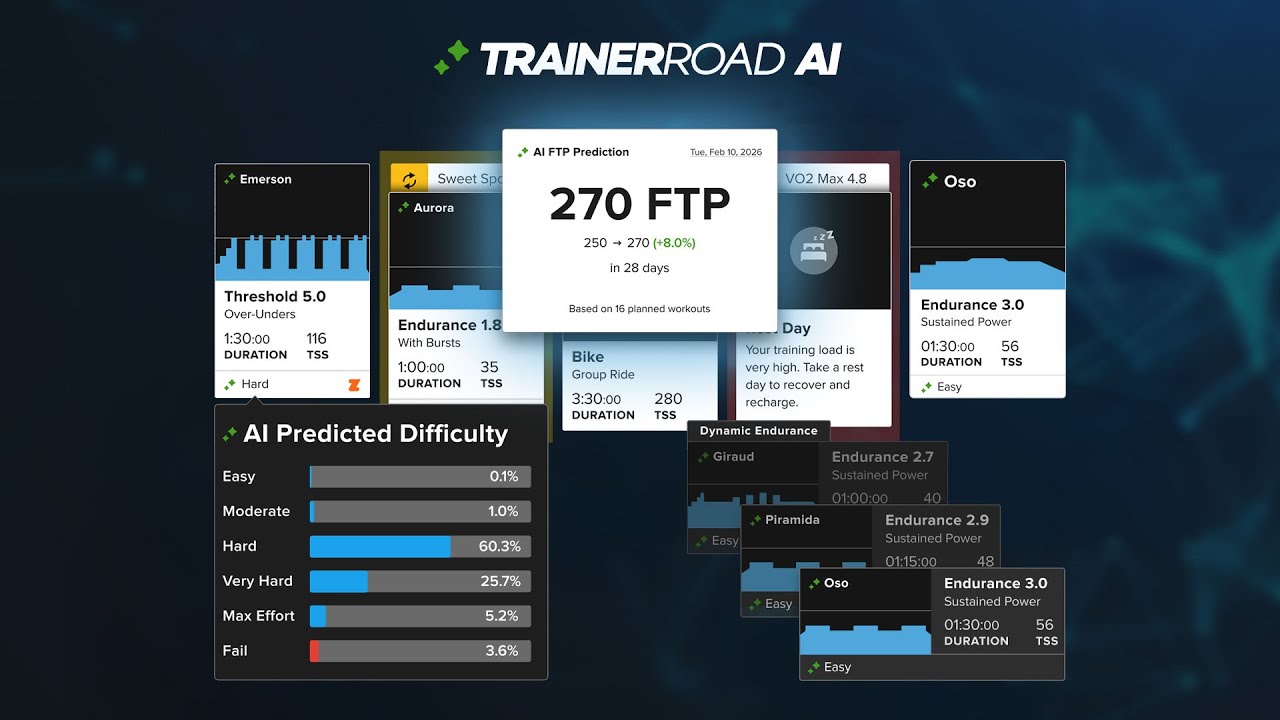
There is a new version of AIFTP and also AIFTP Prediction, that shows you the predicted outcome of the various training plans that TR considers are suited to you and your aims (it uses heart rate, watt and RPE data).

The new version of AIFTP is different. Here is TR’s Nate from the corresponding thread on the TR forum

What is the new AI FTP Detection?
The updated AI FTP Detection you’re getting puts you around a level 3 threshold level. This will be consistent between detections, and we think this is a good insert point into your overall zone progressions to get faster.

The old AI FTP Detection was predicting the result of a ramp test, then we would make adjustments to your workout levels to try to make things incremental. That means you could end up with an FTP with a threshold level of around 1-8. Although you could still get good workouts, this wasn’t a consistent way to assess FTP from one detection to the next, or to compare it with others.

You’ll see your FTP recalibrated through AI FTP detection today. This doesn’t mean that you’re stronger/weaker than before. This is kind of like buying a new bathroom scale that is more precise. Just because the number changed by +/- 5 lbs doesn’t mean your weight changed.”

Here is the full thread, with charts and supporting data

and here is the AIFTP prediction thread

@alex feel free to delete the links (or tell me to) if you prefer not to link there from here.

No, no, it’s totally fine. I appreciate it. I can give a long and drawn-out “proof” as to why machine learning of user data is not the right approach to telling an individual how they should train. I’m not saying it’s not insightful and doesn’t provide value. Just remember, TrainerRoad has been the best marketer for “how to get faster.”

Now, the one thing TR does excellent is they make people confident in what they’re doing, which has huge value. They probably get a wide range of people working harder than they normally would, that squeezes out some additional short-term and in some cases, long-term performance.

As we know, towards the lower end of the spectrum, you can do just about anything to improve; at the upper end, Improvement is so small that it likely has more to do with recovery, diet, and all kinds of factors, stress, than it does with specific “universal” training it’s ultimately all about that balance of work and recovery. And I would argue TrainerRoad does not have the data it needs to make quantified decisions that are relevant to a specific individual.

This is like the previous discussion that somebody said that the range deviation of science studies means that 5% of the people would fit the target prescription. It’s the same with machine learning. I’ve done a lot of deep analysis we have 3 million activities, and while you can find some general trends, there’s people all over the place no matter which way you try to slice the data. I’m not saying that they don’t have good scientists that are spending more time and smarter than me. It’s just that they have always been very strong at focusing on the marketing side of the story.

2 Likes

I should say I do believe that AI FTP can be great. And I wouldn’t be surprised if they’re not doing a great job of it.

Yes, I think AIFTP is a good tool and the results seem accurate enough (for me).

On how to train, TR states that it does not have a way to automatically choose the training approach with the best predicted outcome. Let alone the best actual outcome.

“At this time, we don’t have an automatic way to choose the training approach with the best predicted outcome. I recommend trying a few and seeing what it says. The whole process should take under a minute. We do plan on adding this feature.”

Oh, that’s cool. I should read more of their documentation. That’s a perfect answer. I like the people on Reddit forums, probably the same on the TR forums, that are saying their predicted FTP is going down. That seems like on the honest side, maybe a bit too honest.

I just watched the launch video during my workout. It is a step forward for TR and I think it will meet their primary objective: to attract new subscribers and retain existing ones.

The premium that TR costs over TD is, though, still massive.

Still in the middle of watching. Good video. Nice to see Nate back.

Overall, what I’m hearing them say is they are using machine learning to pick workouts which in my mind is basically like Xert does meaning trying to estimate what’s good for a user to not fail and not be too easy, and frequently picking something that’s hard or just under the edge. Which I think most people, when working out, want a certain kind of feeling. So there’s a feeling associated with productivity. So you’ve taken what people want and justified it with science theory.

So in general, I agree with you, meaning this is a good approach for their objectives. And overall, matching what people want with what they get is not such a bad strategy.

I wouldn’t say model data is overly accurate on predicting results like they’ve indicated. So you don’t really know what workout they should be doing today. You just know what’s going to produce a certain kind of feeling, heads them towards their goals, balancing what they’ve done recently with what kind of makes sense. Meaning you’ve done a bunch of hard workouts. Maybe take it easy today.

So coaches have designed training plans for a very long time that are, I would call cookie cutter, and they’ve worked. Meaning, here’s an athlete, here’s his goals, here’s a reasonable plan to get there. Buy a plan on Training Peaks, execute it, get reasonable results, take a CJ plan, execute, get reasonable results.

I would say that their vision of how to implement this is much more science-experimental than it is proven. But ultimately, if you get something that somebody adheres to, they’re likely to get reasonable results. Especially if you mix in some specificity.

I’m not sure I provided anything interesting in my opinion here. The main thing I’m pointing out is there’s a big difference between “proven” science and science theory. Nate admitting that high volume plan was a failure is good, but it points out the fact that they were doing something very experimental. I think in this industry, experimental sells if you have a good story. Everyone wants the latest and greatest.

2 Likes

It will be interesting to see how it plays out, as more and more users get further into their new “AI” plans.

One thing I took away from the video, is that TR is very keen to reduce the amount of workouts failed due to them being too hard.

One thing that I think will need a bit of thinking about (by users) is how they reflect their TR “FTP” number with the one proposed by, say, Garmin. If there is a significant mismatch in training zones between TR and Garmin, that could lead to some consternation to some people.

I’ve never used a chatgtp training plan, but when I’ve goofed around with it by far the best results are from asking it to create a plan “in the style of” and then pick a respected coach or researcher. I had it made a plan based on Jem Arnold for a 3 hour gravel race and by my assessment it was really good.

Yes, people suggesting that LLMs can’t provide good training plans, I would assume don’t know how to use them. LLMs can provide exceptional advice if you know what you’re looking for and reasonably good at articulating to the LLM (prompting). Now, I would argue that generally LLMs don’t provide the same kind of advice Coach Jack does. And so maybe they go against our belief system, but that’s our belief system. It surely doesn’t mean it’s right, especially for everybody.

Probably not the best for a beginner that doesn’t know anything that says, “Just give me a training plan.”

Someone who knows enough to coax a good plan out of an LLM probably didn’t need the LLMs help developing the plan in the first place.

Dave

4 Likes

Building a plan is a pain. Creating all the workouts, scheduling them all the days. So an LLM can turn that process from a six-hour process into a 15 to 30-minute process.

I should also say you should try creating an LLM plan directly in Claude. You know a lot about creating plans. After your feedback see if you like the plan.

Why do you use Coach Jack? You use it because it makes it easier. So it’s basically the same with an LLM, it just makes everything easier. You might know the basics, but it’ll give you some other ideas.

I think I’m mostly stirring the pot although I didn’t say anything I don’t believe to be true.

Dave

I would argue, you are saying things you know are not true :slight_smile: That you are suggesting building a training plan by hand. Go build a 16 week, CJ plan by hand and tell me how long it takes you.

An LLM is just a tool. It’s a very good tool if you know how to use it. A phone or computer is pretty useless to a caveman but not many would say they are not useful these days.

Nate’s point in that video about LLM’s is correct in my opinion. They were clear, honest and put a lot of thought into what they stated. The way Fascat is using LLM’s I disagree with. We see the power and potential but struggling to make our LLM solution provide good advice out of the box. Our schema approach for power users was reasonable but the core AI recommendations are not ideal, or not something we would suggest. New version is coming and is more hybrid and I believe should be a lot better.

So to clarify a screw driver is good for screws but fairly worthless for a nail. LLM is a tool, that is all.

16 wks is awfully complex. Long plans like that don’t seem to survive first contact for me. I made my own 4 wk plan from scratch. If it’s any good someone would have to judge for themselves.

CJ is a good option, Training Peaks coach plans, etc… if people like AI then go for that too.

I wasn’t being disingenuous.

Dave

The TR AI FTP prediction tool works on a 4 week cycle.

i.e. it gives you an AIFTP number today and the prediction is 28 days out, based on the workouts in the plan up to that date.