Oh, for sure not. I trusted your intent completely, and I appreciate the banter and the back and forth. These discussions help me clarify my thinking as well.
1 Like
Share as much as possible about their AI FTP. Someday I want to build something. One thing about TrainerRoad is they spend a lot of time thinking about things. And they see all of the stream of crazy things that happen and try to reduce the number of crazy ideas that are produced by their systems.
1 Like
I’d be doing good to follow a two-week plan these days, although I’m quite consistent at the moment. Mostly zone two, but excited for spring and more variety.
1 Like
I am curious how much TR budgeted for server use under this new system. As of now, every user can conduct as many changes to their plan as they wish - and every one comes with a total rework of the remainder of the plan and the predicted outcome.
Also, it accepts unstructured rides and revises the remainder of the plan accordingly too. That is probably the most requested thing on the TR forum, so it is good to see it delivered. It could be interesting to see how users react when they see the magnitude of the changes made as a result of their “group rides that are nearly races really” being analysed.
I think 4 wk plans or blocks are the way to go. I finished a z2 block in December and am wrapping up a sweet spot focused block now, recovery week is next week.
I find 4 wk blocks are mentally easier to deal with.
Dave
1 Like
That’s a great idea. I’m going to try that.
Depending on how this is designed, it doesn’t have to be tons of server usage. Meaning they do tons of machine learning to understand, but then ultimately they do rules and maybe run machine learning just on a month’s worth of data, the user per for each user. So it’s not like they’re running 300 million activities. They also don’t need to process stream data in real time. They can aggregate those metrics. Meaning when a user completes an activity, they can look at the stream data, but that’s it. My guess is it’s reasonably efficient. LLMs are the brutal thing.
I’d say that just means that they haven’t optimized their code/processes. Pretty amazing though. Sometimes optimization is quite scary and extremely time consuming to implement.
While I think, I know what you wanted to say, but this is wrong. Many users doesn’t know how an LLM work, and if you write something like that, they could believe this is true, and the LLM is something “super intelligent”.
An LLM knows nothing. It knows nothing about training, nothing about training cycles, nothing about physical adaptations and so on. It’s a text generator. It selects the most probable next word based on a prompt and its training data. The result sounds as if the LLM knows what it is talking about, but ultimately this is just a string of probabilities.
Thanks for sharing. They do a good job in using “AI”. Created their own model for their own specific purposes. That’s ultimately different than any other “AI Startups”. I think this can be a good way, to predict your FTP, but as @Alex said, there might be extremes which may fall out of their prediction.
Nevertheless it sounds interesting, but for me I am good to go with my own “guesstimates” for my FTP.
Yes, it can create thousand of lines of text in seconds - but how long will it take to explain in sentences what training plan you want to have and what are the conditions you have? I think this is overseen a lot. I have tested many of them, and they all suck. I don’t want to chat to a chatbot 30 minutes, and finally if I gave it all requirements for my plan, it has forgotten the first chats again. If I tell YOU, or any other trainer, or even any other member of the forum
Could you give me a 4 week cycling plan, I have 4 days a week to train, starting 6h in the first week, ending 8 hours in the last week. I really would like to do polarized training, like Seiler described. I have time for a long ride on sunday.
I think you would do a good job, to give me 3 endurance rides and one vo2max session with maybe 4x8 intervals. Would an LLM generate an usable trainings plan? Sometimes such a short message worked, but often it failed (last I tested 3 fails to 1 success). The more weeks, the worse my experience.
I’ve counted (and muted now) 8 “AI Coaching Apps” on the intervals forum. They all have the same “nice” chat box to chat to an “AI Coach”. That’s ridiculous. Users asks “the Coach” how they went with their latest workout. Just look at the f****** numbers! Why asking a chatbot, and it says something like:
You climbed more today than in most of your recent rides.
Your power output was very steady today, and your heart rate drift stayed low — great aerobic control.
Why asking a chatbot “I feel tired today what shall I do?”? Common, do people really want to give away their control over their decisions? Why?
Ok, these apps can create training plans, and this is probably still a valid problem they try to solve, to generate more or less “individual” training plans. But using LLM and the chat interface sucks, in regards of training plan creation. I don’t want to tell him every detail, and at the end, he got something wrong again. And you keep prompting and prompting. And at the end you can’t say move the workout from Wed to Thu, because the app doesn’t “support” that. Argh.
So my conclusion is - I don’t need them. I don’t see any advantage in using LLM as a coach. It’s like using a screwdriver to hammer in nails. I don’t say they are bad - but it’s the wrong tool for those tasks. With the help of AI I created my own workout generator. As @Alex said, if you prompt it correct and describe for example the architecture you want to use, you got a clean framework from AI where you could input the logic for that:
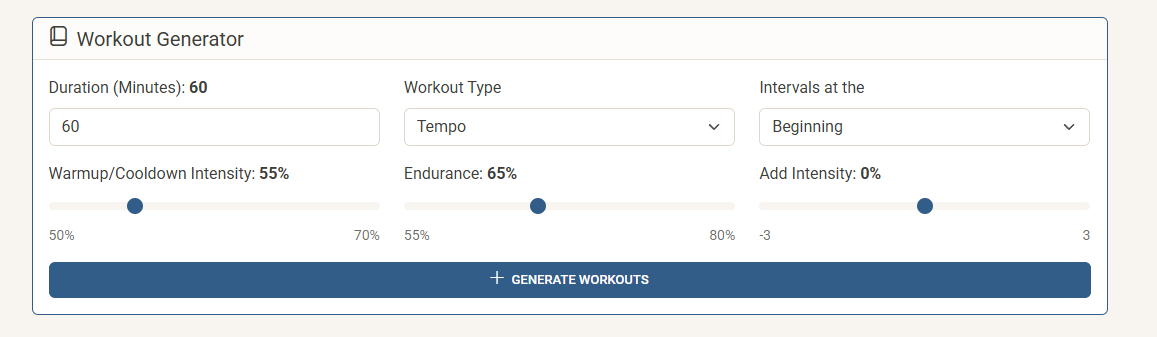
Now I can create thousands of workouts in seconds. And they make sense!  I’ve programmed the progression steps for all kind of types. , but can update these progressions for each type or new types by downloading/uploading just a json file. It uploads directly to intervals library and from there I can create my specific 4 week plan with these workouts. My library is now full of workouts with different durations and different intensities and progression levels. Creating that UI for me, was a useful task for the AI
3 Likes
Good points.
An anecdote first, then linking back to AI / ML.
Back in the day (about 25 years ago), I remember talking about training with a fairly decent local time triallist. He had recently finished 2nd in the local 25 mile championship race, his best finish ever by some margin. I think he said his previous best finish in the championships was 14th - that sort of area.
I asked him how he had made so much improvement in a year. He said that he just asked loads of riders that beat him in races how they trained, picked out the common themes from their answers and started training like that. Just one year later, his pb was over 5 minutes better.
Is that the sort of thing the TR AI / ML is doing (on a bigger and more structured scale)? Analysing what made users’ FTP improve and proposing the same sort of work to other users?
Did you ask also what’s the secret sauce of training you need for these improvements?
Absolutely, I think that’s exactly what TR does. They trained their model and checked what worked for athletes and what didn’t. How did they make progress with what kind of training? And they took your data as input and future training sessions to “estimate” progress. If done correctly, it should “calibrate” to the athlete, so after a few training cycles, it should make good suggestions for training sessions to improve. That’s a good way to use ML for training. The other thing, though, is that this ML lives in their TR bubble. That means it probably works best with TR workouts. That was also the case when I last used it with TR AIFTPv1. It was poor at analyzing outdoor rides. Maybe they’ve gotten better now. But outdoor rides are not comparable to indoor workouts, so I would guess that the training data for their ML might be worse for outdoor rides.
1 Like
The secret sauce, in that case, was repeatedly riding at target race speed for a quarter of race distance with a couple of minutes rest between those fast sections.
Today we would probably call them threshold intervals?
The new TR does analyse outdoor rides. Power, HR and time are considered. My understanding is that all workouts and rides are analysed for power and hr second by second. The launch video made quite a big thing (for TR) about the usefulness of HR data, encouraging users to provide HR data.
I do some TD HR+ rides and upload them to TR as a .fit file. Before this launch, the advice was to associate those uploads with their closest TR workout. I checked in with TR support whether that was still recommended and was advised not to do so under the new system. The uploaded workout would be fully analysed and taken into account anyway.
Still valid. “Do often what you want to get better at.”
I was referring more to the training of their model. They have a series of workouts that many users have completed. With this set, it is “easy” to say that this workout is suitable for this and that workout is suitable for that. It’s different with outdoor rides. There is no direct feedback for the training model. Even if you specify an outdoor workout, it is rarely done in the same way as an indoor workout. And the same “outdoor” workout is not done multiple times; each user does it differently due to topographical differences, traffic, etc. Every ride is different. I understand that TR takes outdoor rides into account, but my point was more that they may not be as useful for making predictions. But I could also be wrong about that.
1 Like
You are right. The variability and other differences that outdoor rides have, when compared to structured workouts on a trainer, are huge.
I was left with the impression that the way TR is handling data from outdoor rides under the new system is better than it was previously. How much better and what value it adds to the training data overall…. I have no idea.
LLM knows nothing, is a bit of a misleading statement. While technically you are right. Google knows nothing, even humans coaches know nothing because there is no proof of almost anything…. It’s always best guess. LLMs are very good at best guess when provided the right input.
But to be sure, you are right. If I say knows everything, it does but without reasoning how it puts it together can be a mess and for sure should NOT be blindly trusted. For sure you can spend 30 minutes and may not have a good suggestion. I know for me personally it has given me amazing insights into personal health ideas to explore. I recently solved a 2 year chronic cough that doctors did not fix. AI did.
Just like LLMs don’t have reasoning either does ML… so in either case if it happens to be that riders improve eating donuts, both examples will suggest eat more donuts, or riders that have 3w/kg need to eat donuts. I have done a bunch of ML, and just don’t see that as any more of a viable option other than it resonates as more logical. I am not saying it is terrible, when you put smart people with the right constraints/rules with ML it’s likely to be reasonable training suggestions. If you want to not think, and just let the system tell you what to do then TR might have the best thing going right now.
But for self-coached, we have very good historical coaching information, and ML is closer to a random number generator than the collective established training information provided by coaches. Now there are so many coaches with such varying information that everyone gets confused. Picking a single coach or a single AI solves that problem.
To defend the future of LLM use. Systems building on LLMs can provide the context that users leave out and prioritize their own biased but “smarter” training. Overall. I agree with you though. Which is current LLM implementations are far less than ideal, but that is going to change quickly. Just like for programmers, 12 months ago LLMs provided limited value, now, everything has changed.
Even think about TrainerRoad. What are they optimizing for? Meaning you take a bunch of data and feed it into ML. What are you optimizing towards? Increased FTP, meaning the user actually raised their FTP value or the system did, which in general means they did better on a ramp test or possibly change their protocol.
Like you, for your race, optimizing for Z2 would be better than optimizing for a ramp test. Obviously there’s a relation between the two. But as we know, ramp tests and FTP estimates bounce around. Even TRs current analysis changed everybody’s FTP.
I partially say this because I was trying to see if there was a correlation between HR watt efficiency at zone 2 and FTP increases. But the data at that zone two is just so messy that you can’t, it’s not linear.
I still think AI FTP can be great but again, with a much more complex FTP algorithm, now trying to determine input versus results becomes even more complex.
I hope you know the capital city of France? A LLM doesn’t know that, but it predicts it should be Paris (well, in most cases probably).
I hope you know that 4x2 = 8. LLMs get that so often wrong. They have to build rules and checks so that they do math correctly. But I was still getting 4x 2 hour workouts, and it was stating here is your 6 hour/week training program …
I agree with you. The difference is, LLMs nowadays a used for a whole bandwidth of tasks. While TR ML approach is considered to analyse “only” workouts and activities. So that’s more specific, it’s trained for this one specific task. But maybe you’re also right (I don’t use TR anymore, I can’t tell), maybe it’s really that the output of that ML is only best for “increasing” FTP, and for no other task. That may be too specific.
That’s so true. Different “influencer” stating you have to do sweetspot, half a year later it’s zone 2 only, then polarized only and so on. Don’t know what’s the current trend?
But I disagree, why AI should solve this. Users who don’t know training, can’t provide the right prompt. Users, like me, who are self-coached, and having an idea of what they want to do, getting workouts out of it, yes. But for me it was always a mess. Prompting and prompting and prompting to get a specific workout to another day, or replace the hard ones with easy ones, oh, now LLM changed also workouts which were fine …. It missed progression nearly always if it was longer than 4 weeks, and so on. Maybe it will get better. But for now:
- I hate how an LLM “talks”. I recognise that from 1000km. I just don’t like it. It’s so staged, well, so artificial. Just create workouts, don’t text me with how smart it is to do this or that. I like buttons, and sliders and so on. I hate getting answers from a chatbot. Tons of useless text around the essential information.
And
- I still get better results with my own workouts and own training plans. Creating a plan for 2 weeks is basically dragging and dropping 10 workouts into the calendar. So for me, this is way more efficient than anything other.
1 Like
I hate to say it, but I’m not sure I know the capital city of France. I would call mine a prediction as well. Trust the books I’ve read. I trust what people have told me. I accept most societal truths as being true. This gets into a long sidetrack on truth that doesn’t belong here.
Again, I did a lot of slicing and dicing and running data through ML. And running a huge number of different queries. I’m even still in the middle of this as a fun side project. While I don’t have 300 million rows like TR does, I do have currently about 3 million and access to about 5 million. Including both indoor and outdoor. It’s very clear that the lower your FTP, the more it’s going to increase from year to year. As you get to around 280 watts or 3.8w/kg, the incremental gains are extremely small on average. The outliers in that are hard or so far impossible for me to group in any logical way.
The general trend is people that do more hours have higher FTP. Or the opposite, people with a higher FTP do more hours. That seems more universally true.
And so trying to predict a 2% yearly increase with the amount of variabilities people have in their life In my guess, it’s not about the exact workouts you do. Or you sure can’t attribute it to that.
I hate how LLMs talk. They agree with you on everything and ChatGPT is the worst. Having an LLM give you daily guidance is horrible from my perspective.
I also believe that anybody putting thought into this and doing their own plan that they believe in is far better. I would like to build a plan generator that is more like your workout generator.
2 Likes