I have to admit: I tried TDs current release of AI, and I prompted just nonsense - and nevertheless it created an usable training plan out of that. So it may you’re on the right track But there are tons of other apps who are just releasing it, and it’s more like an early alpha. And they are promoting it as a coach for, like you said, daily guidance.
That’s interesting. I would love to have access to this data to do such calculations, machine learning and so on as a side project
But probably I would come to the same conclusions. Sounds logical.
Yeah, I missed that point in my arguments. TR stillt doesn’t know how was your sleep, whats your job, family, stress, social life, … That has clearly an huge impact on the outcome too.
Do you want to help me do analysis? I started using DuckDB. I had never heard of it before, but it’s amazingly fast. If you get time in your life and really want to, I’d love to have somebody to discuss this stuff with. I don’t have time right now, but it would be ideal if we both had time at the same time.
I’ve decided that the target group is the 180 watt to 280 watt group to see what affects them. I think I have about 2,000 users in that realm with good data.
Ours is for sure beta. Most of the plans are better than TRs old high volume plan. I just don’t want it giving three hard days in a row. Or 2x20s on day one.
One thing I haven’t seen answered properly yet on the TR forums, is whether this new AIFTP (that seems very different from the FTP given by other systems now) is going to make it harder to train other aspects of cycling fitness, e.g. time to exhaustion.
In the launch material, the AIFTP number aims to pitch the user at TR workout level 3 threshold workouts.
In practice, some users are saying that causes them to be served with threshold (and sweet spot) workouts where the work intervals are too short to deliver the required stimulus.
Some say that will resolve itself as the plan progresses, but not all are wholly convinced of that yet.
Yeah, I wanted to invent my own FTP too. Considering I’m not Trainer Road, I probably can’t get away with it.
This idea is an interesting/funny one to me.
“work intervals are too short to deliver the required stimulus.”
So this means users are claiming they know what the required stimulus is to cause the adaptions they are looking for. If so, why are they using TR workouts? Or adaptive training? My experience is that people just want their desired feeling of what a workout should feel like to match their mental model of what causes improvement. A Peloton class or spin class.
What they are saying, as an example, is that on Tuesday 20th Jan, the previous version of TR prescribed them a threshold workout that was 3x17’ @ 104% of AIFTP (completed properly, rated hard), and that the threshold workout on the schedule for Tuesday 27th Jan is 3x12’ @ 95-99% of NEW AIFTP (which itself is 4% lower than their previous AIFTP).
That doesn’t look like progressive overload, does it?
One of those prescriptions is wrong. Which one? Well that is a separate question!
Oh, now I understand. Yeah, that doesn’t sound too good. How is that even possible? Meaning if you’re claiming something is AI, it’s extremely smart, it knows what’s going on, and then it gives you something completely wrong. That’s basically hallucinations like an LLM. I haven’t looked at XERT lately but I believe they’re more mature with that than with just “basic” yet well established rules.
On the flip side, there are users reporting that it is serving them workouts that are a sensible progression.
A change of that magnitude was always going to cause some problems for some users. The big bang launch (i.e. it went from beta to live with no notice and no possibility to opt out) caught a few users by surprise.
It is clear that TR is working hard to resolve the issues. There are already reports from some users that the problem they first thought would cause them to ditch TR, have been fixed in one call with TR support.
Yeah, I guess it points out the donut problem. Modeling finds that a donut matches the users profile and offers a donut. This is the same issue with modeling as well as llm’s.
They need a better harness to keep things on track. It ultimately turns ai into a hybrid rules/ai. We are trying to do the same thing with LLM… Obviously not at their scale and not daily recommendations. As much as I know users want daily recommendations, I struggle with this concept, we have tried to do it like 4 times now.
Pioneering is never easy. Sometimes the prize is worth the effort.
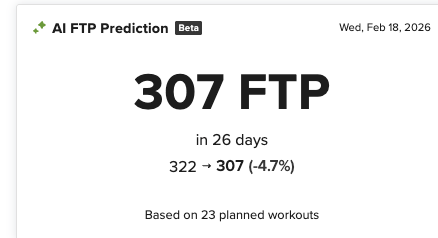
Another complaint that is surfacing on the forum is that the predicted FTP is lower, than the current FTP.
“How can 28 days following the recommended plan give me an FTP reduction?”
Which, if you had joined TR on the basis of one of the many marketing banners that say something like “I added 40 watts to my FTP and I’m feeling better than ever.” could be a fair question.
I’m not a candidate to use TR, but from what I gather at a high level:
They are moving on from traditional FTP and some users don’t like this. The new version of FTP is level 3 threshold workouts.
The system is much more of a black box in general and some users don’t like this either.
The predictions are a can of worms. Negative predictions create unhappy customers and predictions that don’t come true will be a problem in 28 days if users follow the prescription to a T.
I’m sure loyal users will love it and many others will really like it too, most of the response seems positive. Part of my issue with them is coaching, what coaches do they actually have and what is their expertise? Some of their standard base plans seem really intense and why is threshold 3 the right level? Surely, people who need TTE would be better off going longer?
I like how TrainerDay really gives the user precise control, which is important because my training response/recovery is weird. I’ve tried countless plans in the past and found out what works well with each.
Coach Jack helps generate the actual workouts for Zwift to fill an 8 week cycle, which is super tedious to do manually. I like how the shorter length and variation of intervals makes it mentally easier to finish long endurance workouts.
I use the calendar as a training journal as well, the ease of moving things around for injuries is great.
On AIFTP prediction (and FTP prediction by other platforms too), there is a risk of invoking what has become known as Goodhart’s Law: When a measure becomes a target, it ceases to be a good measure.
Already there are examples on the TR forums of users tweaking their plans in all sorts of ways to cause the predicted FTP number to go up.
How many surprises / shocks / cheers / tears will there be on 19 Feb, when the first AIFTP reassessment actually takes place!?
The CP and W’ tools on Trainerday are probably superior to whatever this AI FTP thing is.
The graphs are quite accurate (if a bit generous when it comes to W’ recovery). I can make a workout right at the limit of my current fitness, and see which workouts are even possible to complete before attempting them.
Yes, I think people likely get the best from understanding what they’re choosing and understanding how it feels. Systems just can’t quite capture that. And HRV or anything else, don’t know how you feel 20 minutes into the activity after your warm-up.
Yeah, I saw some of that on Reddit too. Totally motivating. Overall as people get to 300w FTP the model should predict a lot of people will drop. This would appear like honest modeling based on my data modeling experience as well, many will drop ftp.
 But there are tons of other apps who are just releasing it, and it’s more like an early alpha. And they are promoting it as a coach for, like you said, daily guidance.

 Just need to swap that T for an S…