I have their podcast going in the background while working on other stuff and if this works as well as they say it is a game changer.
They aren’t FTP fixated anymore, it is power and watts. It sounds like FTP is just on the front end for the athlete’s benefit. If they can progress from 200W 4x10 to 210W 4x10 then the athlete is getting better.
Maybe the AI isn’t madness and I’m a bad guy for my clickbait thread title! I still like my dead simple training though.
No, at this point in time, I think it’s fair to call it AI madness, with regards to training. Consumers think they need it. Everyone’s got a half (or less) completed product.
I feel like physiology is so complex its quite reductive to try to describe it with any single number. Training needs specificity, and a rider may be focused on a 1 minute Strava segment, another on 15k TT, long mountain climbs, Ironman Tri etc.
The VT1/2, LT1/2, VO2max, peak sprint, power curve etc. etc. varies so greatly among the above that a specific training focus is needed. Some metrics work well for one thing and are completely useless for another.
Even if AI can deliver her perfect plan, filled with miracle workouts, the user still has to throw her leg over the bike X times per week and pedal.
Better compliance to (any) plan and more consistency will be the sources of the biggest gains for a very large cohort of users of most training platforms.
There are some features of the new TR that might do that - gamification of FTP for example.
Maybe the data is too commercially sensitive to share @Alex but what sort of % of plans started on TD are actually completed and what sort of % are abandoned before reaching the halfway point?
I think the concept of perfect plan is the illusion. But if we make up some arbitrary definition like within 2% of the best you for that goal within that time, The absolute best version of you could get that 40 KM TT race in 52 minutes in the next 24 weeks and instead you get 53. I would say you achieved the best version of you in that time frame. Obviously for pros, that tolerance of the definition of a best version of them is much smaller.
Depending on how you define plan, there could be a hundred variants of that plan, or an at the micro level an infinite number of variants of that plan that gets you there. Most of them involve riding as much as possible, variety, a weekly long ride and recovering the best you possibly can and ending with lots of specificity towards your event.
I see no problem sharing data that does not uniquely identify users. I prefer to be on the more open side as you know. It’s time consuming to figure this stuff out. I know you are a big compliance fan. I am anti-compliance But probably not how that sounds. My personal anti-compliance is completely the wrong kind of “compliance.” Busy/lazy… Next time I do some deep analysis I will see if I can get a feel for this. Many of our users might do outdoor or other platforms so trying to decide if they actually completed it or not is not so easy.
I think the perfect plan is all about micro adjustments, and some times macro adjustments. So in that definition it would be closer to non-compliance. But on the other side if the non-compliance is from lack of discipline or laziness, then I agree with you that lack of compliance is one of people’s biggest issues. There is a time for hard work, and that is not the time to kill the plan and start something new.
I guess if we say do 80% of the workouts in the plan and end at approximately the last week of hardest workouts within a few weeks of the original plan end date, then I could agree that’s acceptable definition of compliance.
It’s hard to guess if we might have more compliance than TR would. Meaning I think the TR crowd is much more race type oriented or extremely driven to push hard. Ours users tend to be people that are like been there, done that and more self coached as well as many health and fitness focused. We also have hundreds to possibly thousands of racers and focused performance cyclists as well. I saw something like 3000 with 180-280w FTP and more like 1,000 with 280+
I guess our price point is more accommodating to more diversity. On the other side regarding TR the amount of burnout, or failure they create is significantly higher than CJ plans. We have a lot of people doing their own plan, and that might include lots of adjustments, including hard work. We have Tanyo with his 400w FTP doing training more like TR until he felt he got over trained.
Oh yes, I am in 200% agreement on consistency, and even consistency patterns as you are suggesting. I would say at the highest level of priority it’s consistency, then volume/recovery, then volume patterns, increasing at the right times and rest periods, then variety including decent intensity and finally the specific workouts.
For sure higher FTP is associated with more training hours, that was black and white in the data. Improvement was less clear in more hours at least in higher FTP guys. But yes I should compare number of days per week and consistency of those patterns to improvement, this is an interesting/great idea.
I saw on their forum that one guy said he as training for TTs and his goal is to train for TTE. The AI driven FTP it has given him is about a zone off from his physiological steady state, so sweet spot = threshold, threshold = VO2, VO2 = anaerobic, etc…
So if I may be blunt IMHO it boils down to do really short intervals at too high of power for the intended zone for that guy and I don’t think that approach is ever going to work. Level 3 threshold is not going to drive TTE development.
I’m biased though FWIW, my personal feelings are much more aligned with the longer interval approach rather than just pounding intensity. I sincerely hope it works for that guy if he sticks with it.
Yes, it is a great tool. I am in the early stages of learning how to use it and I may well reach out to you for help once I have got the basics clear in my mind. Thanks for the offer.
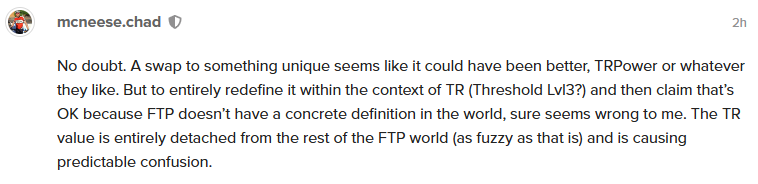
There is an increasing groundswell of opinion being voiced on the TR forum that the changes made to AIFTP are a mistake.
The previous AIFTP was well regarded for its accuracy.
The new AIFTP is, TR states, not FTP at all, but a power number calibrated so that a TR level 3 workout is the right threshold workout for the user.
But it is still called FTP.
For many users, the new AIFTP is quite a way off the FTP derived from ramp and other tests. Moreover, it is quite a way off from TP, Garmin and other systems’ estimation of FTP.
Although this was raised as a concern and extensively debated during the beta programme, with users calling for it to, at least, be called something else to avoid confusion, TR stuck to its guns and launched it live.
Here is a post summarising the situation from one of the most longstanding and respected posters on that forum.
You know it’s funny as Chad is a really good friend of mine. The person that you posted is comment there. I kept trying to convince him to switch to TrainerDay, but he said he’s got all of his notes in history in his calendar there and it’s just too much. He said he doesn’t even use trainer roads plans. Not sure if he’s using the AI plans now I haven’t talked to him lately.
I had a recovery ride today on the trainer and recalled Coggan and Allen were on with Conor Dunne of GCN discussing FTP so I watched that, I have the video queued up to their idea of the gold standard method.
I’ll save the drama:
Allen has athletes test about 6-8 wks
Coggan said he never formally tested. He thinks we make this all too complicated and instead just used benchmark workouts from his training which for him was a 2x20. He knows what his FTP is from his training. He made particular reference that he keeps this simple.
Allen said Andy has the wisdom of experience, but not everyone has that. Some people need to test. Some athletes do enough hard efforts that the testing is not needed.
AI FTP, eFTP, mFTP, ramp test, 40K TT, 60 minute “hour of power”, 20 minute test with 5 minute blow out, 20 minute test w/o 5 minute blow out, “The Grade” climb, lactate testing, blah blah blah… it sure seems we do like to make it complicated.
Usually when I talk to elite cyclists as well as according to Andrea regarding pros, they never test, unless it is in a lab for some specific reason. It’s too demanding and not worth the benefit. I know one elite guy that just uses his Garmin VO2 max and estimates FTP from that.
I watched the TR Q&A video about the new AI system.
The rationale for calibrating users so that a TR threshold level 3 workout is the right place to start from a fresh AIFTP assessment is (sort of) covered.
The summary is that TR believes that for the vast majority of its users, the number one way TR can make them faster is to raise their FTP.
All the other training metrics are less important than that, no matter what they are training for, or how they have trained before.
The best way TR can do that is to start them off at threshold level 3 and build from there.
Maybe TR is right? What do you think?
Some extracts from the transcript:
At the start of plan (i.e. not in the speciality stage, which is different), then TR’s view is that it is better to work on raising FTP, rather than working at higher percentages of FTP if “you’re not at a very, very high level”
Based on w/kg, then only if you are in the 98th or 99th percentile of trainerroad users maybe it is good for you to do some work “at a higher percentage of threshold.”
But if you are lower, you know, 3 w/kg, or something, like you got a lot of headroom, depending on your age, to uh go up and get faster.
The video is cued up to the right spot, 10’47” where this is mentioned.
I recall seeing someone comment that 4x9 at 95% with 7 minute rests was level 3. (Frisell?) If that is true I think nearly anyone could agree that is far below a quasi steady state.
I think this directly leads to the zones being messed up, sweet spot being threshold, threshold being vo2, and over unders being over overs.
 But probably not how that sounds. My personal anti-compliance is completely the wrong kind of “compliance.” Busy/lazy… Next time I do some deep analysis I will see if I can get a feel for this. Many of our users might do outdoor or other platforms so trying to decide if they actually completed it or not is not so easy.