How to test AeT efficiency

I am trying to accumulate a lot of time at and just under MAF HR

Primarily I do this via a 2 hour TD workout with HR+ set to 5bpm below my MAF HR.

Currently I am aiming for 3 of these per week. I have 2 Fatmax workouts and then either an outside endurance ride (weather permitting) or a lower endurance TR ride.

The MAF HR workouts are fatiguing for two reasons

  1. The power I produce at MAF HR has increased.
  2. The duration and frequency is designed (by me) to give a ‘worthwhile’ training load.

It doesn’t make me very / too fatigued because I am careful not to ramp up volume / load too much / too quickly.

If I swapped out those 2 hour workouts for 4 hours workouts, I would be kyboshed. Same as if someone swapped out their 1 hour workouts for 2 hour workouts.

If an athlete is currently doing 5 hours per week, then she could soon move to achieving all 5 hours at MAF HR. If she tried to go straight for 10 hours per week, she would be kyboshed.

A tip I would give to anyone considering MAF HR work is to forget power zones. Observe them in the post workout analysis if you want, but don’t even look at the power whilst you are riding.

Just set HR+ to your number and pedal.

Once you get to the point where you have very low decoupling over the duration of the workout, consider if you want to / can extend it.

You don’t have to, because as you get fitter, the power you produce at this HR will drift upwards and you will, therefore, be doing more work anyway.

More volume is the way to progress this stuff. If you have the opportunity to increase volume, do it slowly.

Presuming you are doing 3 or more rides per week of, aim to carefully extend the duration of one of them by 30 minutes. Then extend another…

Low HR rides are best enjoyed frequently!

1 Like

@Ivegotabike
Have you never taken into account to swap the 3 workouts of 2 hours each with 2 workouts of 3 hours each?
I’m not sure if this is what you mean with “If I swapped out those 2 hour workouts for 4 hours workouts, I would be kyboshed.” - but I’ve understood that the first 20-30-40 minutes of those 2 hours are “wasted” with the body trying to adapt to the workout. By keeping the same volume and reducing the workouts you pay such “tax” one time less.
I try to do 4 long workouts, instead of more frequents but shorter

1 Like

@Ivegotabike @BlackTek Great feedback as always, thanks guys.

Dave

It is a good point about the wasted element of the workout.

It is for that reason that I do a 30 minute warm up ride before the 90 minute Fatmax workouts that I am doing just now.

I am not sure I could stand a 3 hour workout on the trainer tbh. It doesn’t appeal to me when I think about it.

My outdoor rides tend to be 4 - 6 hours, but at this time of year they are quite rare things.

I have toyed with the idea of doing a double day: 2x 2 hour. I have done double days with 2x 1 hour, but 2x 2 hours hasn’t happened yet. Maybe it will, maybe it won’t.

1 Like

Have we tempted you over to the MAF side yet??!!

1 Like

at the moment I stay strictly below 139 (just yesterday a little bit above, but still below VT1) :slight_smile:

You’re tempting, but I’ll stick to the plan :):):slight_smile:

I was asking Dave!

Living a long and healthy life. I can get behind that as an objective.

Cycling as the aerobic / VO2 fitness contributor to that objective is, imo, excellent.

I don’t know which would be better, or if it really matters what one does as long as it is frequent, consistent and has a bit of variety.

A) MAF / aerobic + 1x VO2 per week

B) MAF / aerobic for 6 weeks and then two or three weeks with 2x or 3x VO2 per week, then back to MAF / aerobic.

1 Like

Yes, I full agree that HR+ low hr and one day of intensity is a perfect health first approach, and you can just watch netflix and listen to music on your maffetone days, if you read maffetone this is 100% health first approach… stress reduction.

My goal is also to be moving at 100… my grand father was great health to 93 but broke his hip and things went down hill fast so a bit more bone density should have gotten him to 100…

2 Likes

CJ plans are an excellent choice as well… Also very health focused with a bit more performance optimization. I would say if you are on you bike 45-47+ weeks a year with some level of intensity each week then. probably a base period as a bit of recovery is not a bad idea. A month of almost pure zone 2 or like base+ is a good idea for a month or so…

Ok, HR+ December then it is!

Dave

2 Likes

@dthrog00
I suggest to create a specific workout for such training and split it in several equal. Intervals of 5-10 minutes. This way you can measure decoupling better and nore precisely than intervals.icu approximations.

Eg mine Trainer Day - Workout: AeT / MAF Test 60 min @ 135 bpm + 30 min @ 120 bpm + 30 min @ 125 bpm + 30 min @ 120 bpm

Also very important to drink at the end of each interval, also if you don’t think you need drinking. When your body needs it it’s too late.

2 Likes

90 mins is a strong start.

Aiming to replace your “typical” volume / schedule with MAF HR rides is a good objective imo. Then continue at that level until decoupling is consistently under 5%

If you typically do back to back 90 minute workouts on the weekend, then do go for another if you feel ready for it.

With decoupling of 8.7%, you might find you are fatigued enough that 60 minutes is a better option than 90 for the second of back to back workouts?

Whilst the general advice I have seen on MAF suggests starting out with 60 minute workout and then, when decoupling is <5%, to extend the workouts, you know your body and training history well enough to decide.

Drink! If you need to stop to P, stop to P.

This is a long term project. Persistently and consistently completing these workouts for months is a primary objective.

1 Like

Yes I agree completely with this. This is very interesting and simple way to understand more info. This is exactly how Maffetone says to structure your maf tests… for runners every 1mile or 1km times of a 5 mile/km run.

1 Like

I agree with this too. Under hydrated skews you results, it might even add stress that lowers the efficiency of your fat burning state. Ultimately this is the metabolic goal you are trying to achieve. Greater fat burning ratio/efficiency…

1 Like

Please don’t underestimate a precise method to calculate cardiac drift. Samplings chosen by intervals.icu is far from ideal

1 Like

Intervals is very flexible and powerful on such things. Warm up / cool down exclusion, add set (or variable) duration intervals to workout data, compare previous versions of the same workout and much, much more.

It can, for example, quickly and easily apply the exact MAF test structure to analyse data and present it as tables and charts.

It is good practice to set up the workout with intervals in it to start with of course, but even compared to that, intervals is a way of digging much deeper into data if that is wanted / needed.

2 Likes

I used to do lots of in depth analysis in the past in tp wko, and they let you select a range and it will give you decoupling in that range, quick and easy. I just look around intervals but dont really do anything there. I believe I tried to do this same thing but it was not as straight forward as wko is/was. I still believe these segments is a a beneficial way to look at it as you might have some segment outliers such as bathroom break that are not as clear in simple decoupling.

1 Like

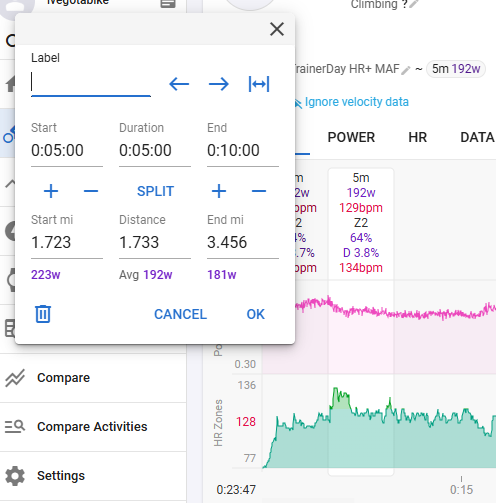
You can pick any range from any workout and it will show you, among other things, decoupling. Very quick, very easy.

Here is a screenshot of the adjustment box and a 5 minute interval from a workout of mine.

2 Likes

Ok cool, yes for some reason when I tried that I was getting confused or ran into issues, but I spent very little time trying to figure it out.

2 Likes