Perhaps this is not true “in general”, but it all depends on what is meant for fitness. If fitness is “how good I’m at supporting anaerobic work” it will be true. During pure MAF/Base work FTP / VO2 max goes down - no doubts. Therefore measuring fitness based on capacity to sustain anaerobic workout will lead to “fitness lost”
At the moment I’m following pure MAF work to avoid to make guesses in case it will not work. In the back of my mind I think that as long as aerobic and anaerobic workouts are far from each others there should not be negative effects of mixing aerobic and anaerobic. And in general I think that mixing a bit of aerobic and anaerobic is good. But Maffetone which is more expert than me, says the opposite. Therefore I trust him more than my beliefs.
Also @Ivegotabike is seeing very good aerobic improvements while also doing anaerobic workouts. The same for me in the first half of 2025.
What I’m seeing by following pure MAF training is that I’ve a better resistence to fatigue; I can train for hours (like today) without carb supplements and also after 4 hours I can still produce good power.
Eg also today after 4 hours in MTB (1000 mt uphill and 65km) I was producing 1.4 watt/hr (efficiency), which is not too far from my best 1.58 of the Aet Test
There is no universal definition of fitness, so if you use garmin as your source of truth or many other misleading metrics then yes it does equal fitness loss. I would say many people doing pure z2 might feel like they are less fit than when they do more intensity.
Most pros do a lot of or even mostly zone 2 and I would not call them unfit, any study that z2 is universally fitness loss would be bs but maybe it’s more just your interpretation of what they are saying or the specifics. FTP will go down… again not the definition of fitness.
I think that depends on where the athlete is in their MAF journey.
The MAF protocol calls for anaerobic work to be done when the gains from the aerobic work plateau (see that section in my previous post from the Mark Allen article for example).
The aerobic fitness that well executed low intensity work delivers is not won quickly. It takes, at least months and, realistically, can continue to improve for years.
Sufficient VO2 work, say to prepare for the first race of a cyclist’s season, can be done pretty effectively on top of a very strong aerobic base in a matter of weeks.
Specificity is very important to remember too. Match the training to the events being trained for. At risk of repeating one of my go to cycling training stories: Coggan often writes about training his own VO2 to the highest level it ever reached… and then getting very soundly beaten in his state’s time trial championship.
Sorry, I couldn’t find the study I referenced. Maybe it doesn’t exist!
I definitely read an article somewhere where athlete A either took an outright break or didn’t do any intensity at all and athlete B kept training with at least some intensity. By the team the racing season started athlete A was in a hole competitively to athlete B.
All that said, many people here have had great success with MAF.
This article came to mind when I read your last couple of posts. I wonder if this is the one you were referring to?
Take aways
Keen cyclists could potentially improve their upcoming season by keeping the following take-aways in mind:
1 | One high intensity interval every 7-10 days seems to maintain capacity and performance during off-season
2 | Several studies suggest that intensity work is key in preventing de-training during periods with reduced training load
3 | Riders who prevent de-training in off-season can probably start developing their endurance capacity straight off the bat come pre-season, as opposed to spending weeks and months catching up to past levels of performance
4 | There is compelling evidence that preventing de-training during off-season is vital in setting yourself up for the best possible performance next year
It refers to a paper from 2014 by Rønnestad, Askestad and Hansen
I disagree, MAF does not require no intensity, he suggests no intensity to start to kick off the process to making aerobic progress, once you are seeing progress you can start adding intensity even more and more until you stop seeing progress. In your case the progress is is not consistent or clear so you are better off going longer. You also are doing weight training which makes it so on the bike intensity is likely not a good idea for most.
The 18 year old pro kids these days are adding a weekly intensity day to their zone 2.
no, I don’t agree; this is not what the quote says. Doing more MAF doesn’t add “intensity”, only adds Volume. Here the point of the mentioned article is doing intensity (it’s not talking about generic TSS / Traning load which is also linked to volume)
So if you previously hit your life peak and are now possibly on the way down, then I agree with Friel that a small amount of intensity even during a base period for us older guys might be a good idea, use it or lose it, but I this is more of a feeling and agreeing with experts not any proof backing up any of this.
Conclusion: The present findings suggest that HIT sessions should be incorporated during the transition phase to avoid reduction in fitness and performance level and thereby increase the likelihood of improved performance from the end of one season to the beginning of the subsequent season.
Are you in the transition phase? The period between the end of one season and the start of the next.
I am not fully following but I know from Andrea the teams he works with do transition over christmas time and have the guys take 2 weeks off the bike… now for most normal people they probably get enough time off the bike that this is less critical. It’s not a bad idea if you don’t get a few weeks in a row off the bike at any other time of the year. They have a focus on weight training, cross training…
I can also say for minimalists. Andrea is a big fan of HIIT and does it personally when he is training for something…
I’m interesting in the concept of what you guys are doing.
High level you’re trying to accumulate a lot of time just below AeT/VT1/LT1 which we can assume are close enough to each other to be the same?
How do you do this without becoming very fatigued? I understand LT1 is commonly top of zone 2/low zone 3 power.
The Friel Training Peaks article references traditional zone 2, 56%-75% which does not cause high levels of fatigue if kept in the middle, but I don’t think would typically reach MAF formula level HR.
@dthrog00
I’ve measured my VT1/LT1 in lab (with mask) and this threshold during the last year test was 146 bpm (my age was 45)
Maffetone states that the training should be done below such threshold - and as this measures are not always available for all athletes he created the formula 180-age (+/- the corrections). Including the +5 corrections (two years of training without injuries) in my case now it’s 139bpm.
It’s safer to stay lower than higher, because the more you move up, the more lactate and cortisol are produced, which inhibit the usage of fats as fuel, and the methabolism shift toward glycogen usage.
When I train at 135bpm / 140bpm I’m at lower boundary of Z3 (power). Training that way will help you to also improve the resistence to the fatigue. In my case I can sustain such efforts for 3-4 hours (most of the time with just 1 minute pause for physiological needs :))
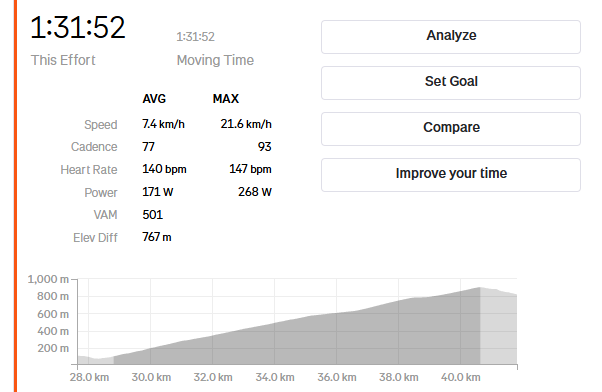
But yesterday, for example, I rode 90 minutes at 140bpm average without stops
At that moment, when started that uphill, I had already rode for about one hour and half and I had a little bit heat discomfort (I assumed to ride at about 5 degrees, but it was 10 degrees). Therefore the output of 171W was the middle of my Z2 (64% ftp)
 but maybe it’s more just your interpretation of what they are saying or the specifics. FTP will go down… again not the definition of fitness.