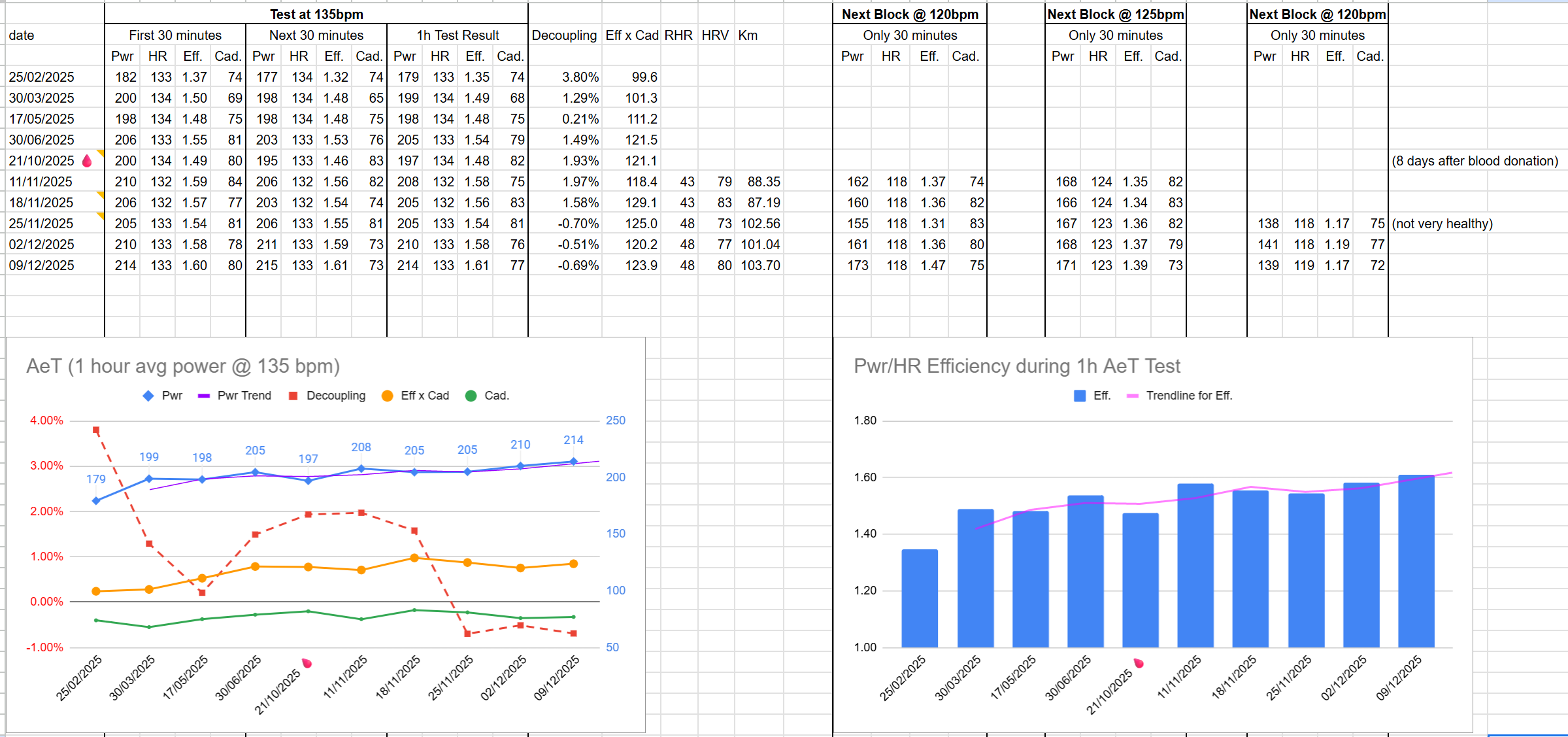
Getting depressed after reading Off-season HIT improves cycling performance next year - W/KG 
30 - 32 check you qualify for that age group… but sure these are 4mmol, 4w/kg elite cyclists… and yes, you can find studies that back up just about anything. In your case you were doing hiit and not seeing aerobic progress and now you seem to be seeing some, if it is not clear in another month I would say, doing a HIIT every 7 to 10 days in general is a good idea. Remember you are testing maffetone to see if it produces expected results give it a bit more time. Its good to do this base so it ends in about January so you can start a build period very hungry for intensity… I see you are getting there now. This is a good sign… You are getting some rest, letting your body heal for a build and peak that gives you another 20w next season.
2 Likes
Its a good study, overall there are a lot of studies supporting hiit.
1 Like
I believe in the plan, it’s worth testing it. Worst case I’ll not see big benefits and I’ll have lost some months. I’ve no races to do, and I already spent 43 years without a bike
@BlackTek I want to offer you a sincere apology, I brought this up in an academic sense only and didn’t intend to question any of your choices.
I’d like to offer this as a counterpoint, the training of Mikel Landa:
"Alright, so what does Landa’s data tell us about his lead-up to and participation in the 2015 Giro d’Italia? Here are a series of observations:
As you might expect, Landa’s day-to-day load builds in volume and intensity from day 1 of the dataset – December 8, 2014 – until the start of the Giro. More specifically, you can see he only does rides of up to four hours for the first 60 days of the study, with rather minimal focus on medium-intensity efforts and almost no high-intensity efforts at all. Classic base miles. After day 60, we start to see some medium-intensity work, and rides of up to five hours in the lead up to Catalunya. We only see the first real hints of high-intensity training (>FTP) a full 70 days into his season – in mid February."
He won two stages and finished on the GC podium in 3rd place.
@Alex I owe you an apology too, I don’t mean to agitate the forum users.
Regards
Dave
1 Like
Lost some months? you were not making progress, you lost months of more flatline aerobic…
He needs to be agitated… we are all very respectful here. I am the least respectful to him because he and I have a really good relationship. No apology required, your comments and sharing are great.
Good going to knock out back to back 90 minutes without a power drop on the second day.
You are 2 days into something that should be judged after ~84 days.
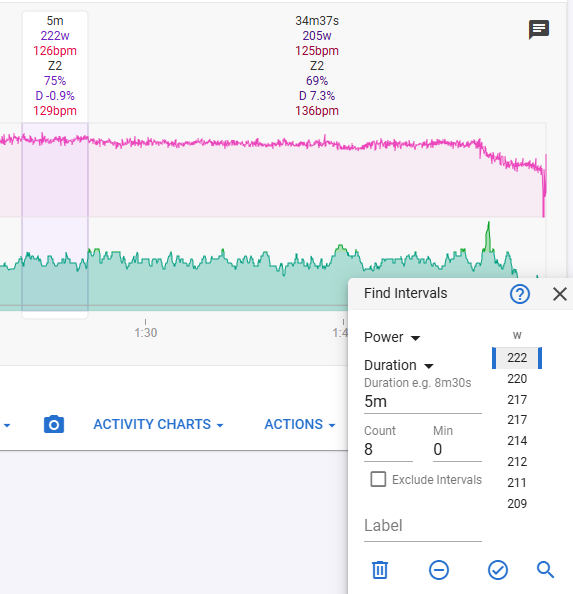
The find intervals function is interesting too. Here I used it to find the highest 5 minute power in a workout. In this case it happens to be from 1h20m44s to 1h25m44s. Decoupling and other data is right there for that interval too.
There’s something about ERG that changes decoupling versus normal HR+ driven workouts.
FTFY 
It isn’t so much that the decoupling is superior, but it shows how much improvement there is potentially available.
If, in 3 months from now, you did that same 90 minute ride and the decoupling was 50% of what it was today, how pleased would you be?
Hi guys! When I used the word “depressed” I was kidding! I like irony 
You know I like to find arguments showing that it’s better to push more.
In my training I like a lot to change stuff. Changing the training method is also good, regardless of results.
Seeing months of flat aerobic improvements is not 100% true, perhaps 80%. You can see the data shared. But good to change
1 Like
I was reading https://inscyd.com/whitepaper/fatmax2018/ and it seems that we need a test to properly find our own fat max zone. I’m travelling at the moment without much time to study it, but I’m curious. Is there another good and reliable proxy for fatmax zone? I remember that somewhere i read it was arouns lt1/vt1 (like upper limit of maf)
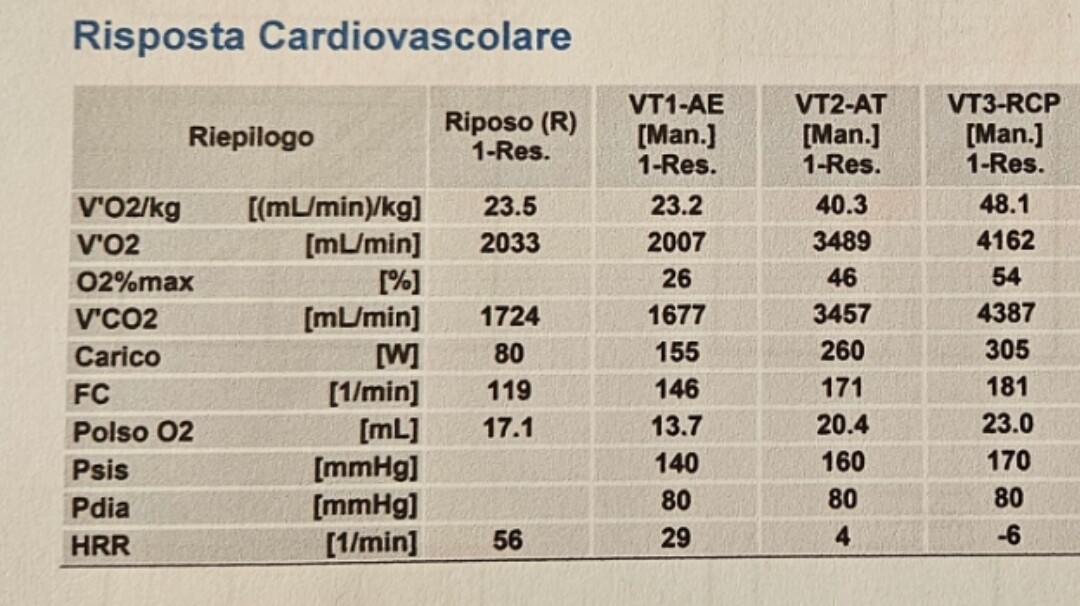
Ps from my lab test I see that my vo2max (4162 ml/min) last year was at 181 bpm, with my cfmax was 184 bpm.
They are very close, do I read the values correctly?
I’m cautious of INSCYD because they are selling a system.
See San Milan’s “Metabolic Map” slide. He uses this to establish his version of zone 2. I understand this would be done with gas mask testing in a lab.
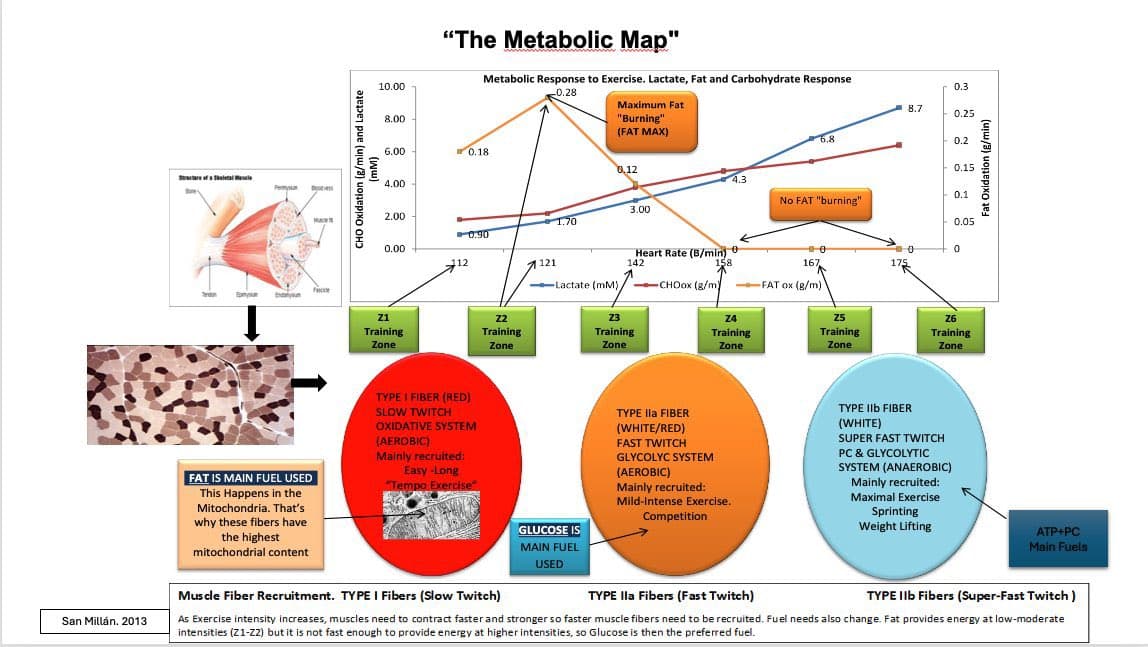
My understanding is LT1/VT1 is a good estimate of fat max.
There are counterarguments that training fatmax is not necessarily helpful. Andy Coggan is adamant about it this in particular:
"Endurance exercise training increases the absolute rate of fat oxidation at the same absolute intensity (i.e., power output or metabolic rate, i.e., VO2). It also increases the absolute, and often the relative, rate of fat oxidation at the same relative intensity, i.e., the same percentage of VO2max.
HOWEVER, these adaptations are NOT the result of oxidizing more fat during training, which is what many mistakenly assume (and then attempt to maximize). Rather, they are primarily the result of having more mitochondria, which allows you to better balance ATP demand and production, thus minimizing the activation of carbohydrate utilization. The increase in mitochondrial respiratory capacity with training is driven by these energetic perturbances, as well as calcium release from the SR.
The $64k question then becomes, how to maximize the increase in muscle mitochondrial respiratory capacity with training? That’s something that science can’t really answer, at least at the level of the individual, but 1) like all muscular adaptations, they are restricted to the muscles and even the motor units recruited during exercise, and 2) the largest increases reported have been found in individuals training very intensely (not just long).
TL,DR: Train for performance and let your physiology sort itself out."
Dave
1 Like
answering How to test AeT efficiency - #202 by Ivegotabike
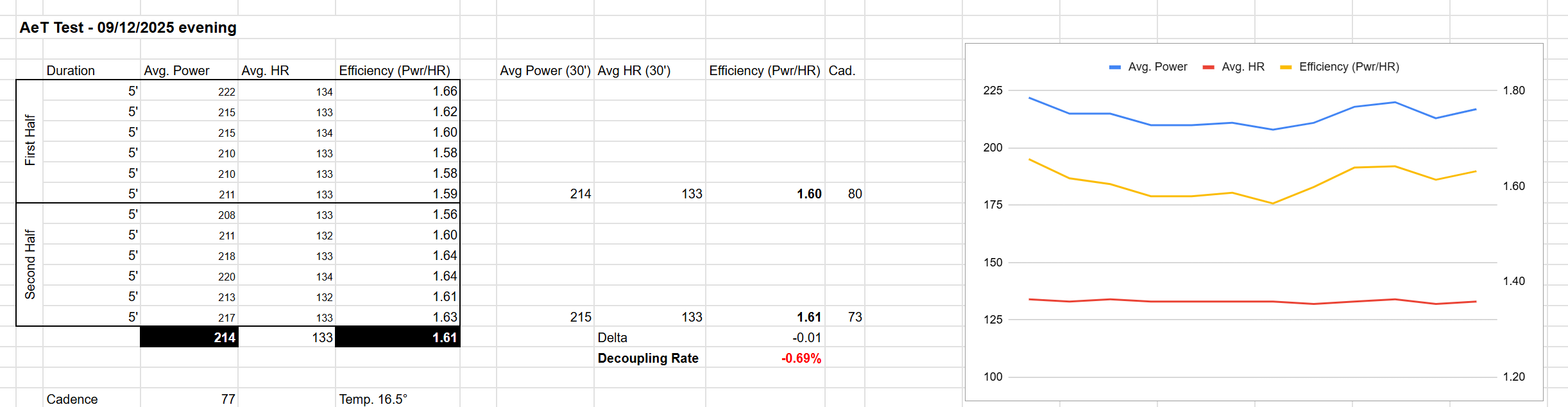
in my case, if I select the 12 x 5 minutes intervals with intervals.icu, I don’t get the decoupling I expect; eg:
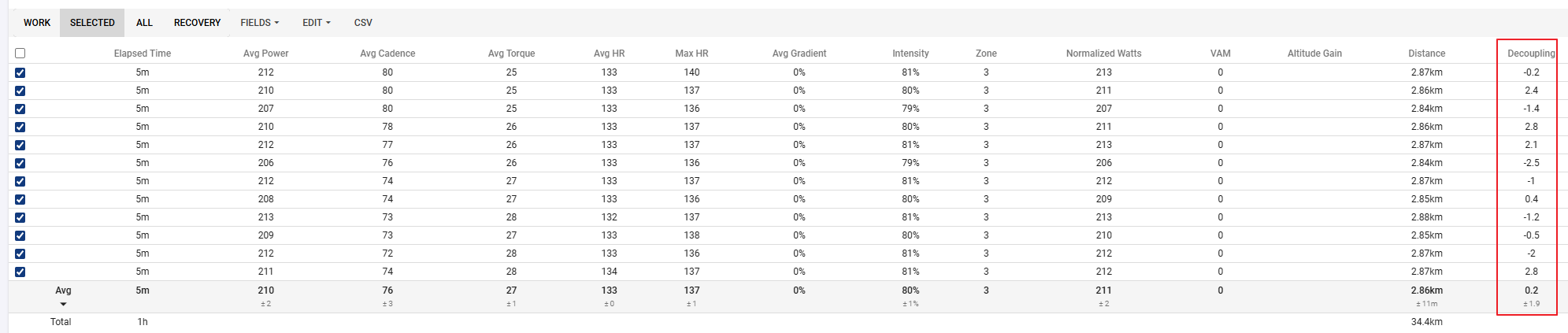
I get 0.2, while I want to measure the first 30 minutes vs the last 30 minutes (first 6 intervals vs last 6), with real decoupling being -0.01 (and not 0.2)
If I do that manually from the graphs it works better, but it’s not easy to perfectly select the start/end:

Here I read -0.7% decoupling vs the “precise” one being -0.51% (Those intervals precisely started after 20 minutes warmup and lasted 60 minutes)
The “0 fat used” at high heart rate has been proved to not be true.
eg “Myths about Fat Oxidation and Exercise (aka is it time to forget about FatMax)? - CyclingApps.net (Fastfitness Group)”
I am pretty good friends with Alex at fastfitness tips… He and I were working on some product ideas together. Funny FYI - He hates, hates, hates subscriptions and I gave him one of my seats for youtube about 4 years ago so he has free youtube premium from me…
There should be plenty of data for such tests. This doesn’t affect me in any way so I don’t care enough to dig deeper.
Dave