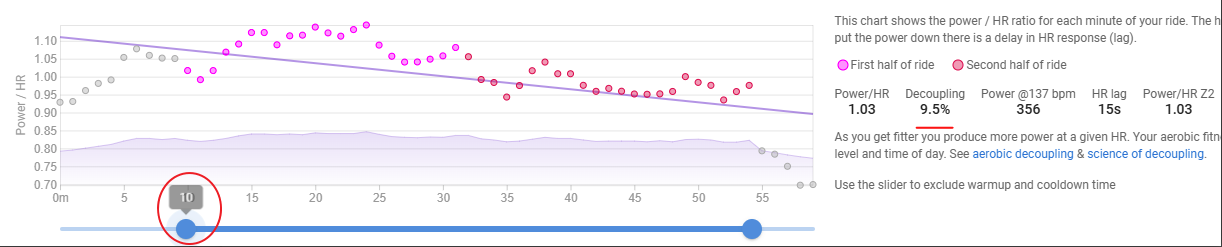
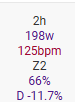
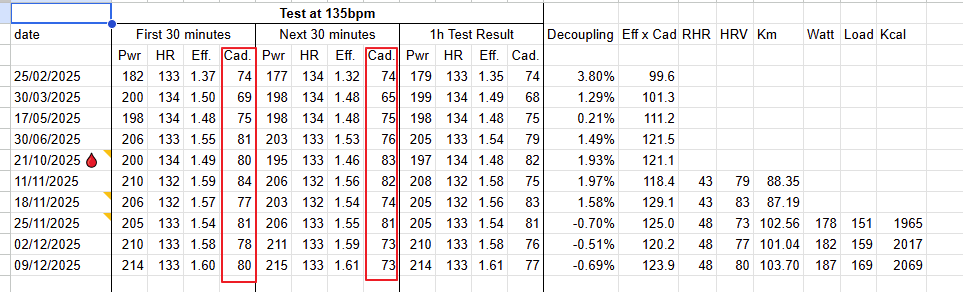
I’ve one possible explanation of my negative cardiac drift (Decoupling Rate).
We know that when the cardiac drift is > 5% it means that the target HR was too high, and above the aerobic threshold.
Looking at this, but the other way around, perhaps my aerobic threshold moves a bit more upper (toward my LT1/VT1).
I do the test at 135 bpm (180-age = 134). The LT1/VT1 measured in lab this March was 146 bpm.
Could it make sense?
In any case to make consistent test comparisons I’ll continue to do such tests/workouts with the current setup
@dthrog00
in my experience (I’m not a coach!) key points during such HR trainings are:
good ventilation/fan (like mentioned by @Ivegotabike ). I use two fans, one bigger pointing to the lower part of the body and one smaller pointing to my face:
I’m going to buy a third one also to point to a more lower part of the body (the more the better - colder is better in general, but if it’s too cold the HR will go up to keep the temperature. But it’s uneven at home).
very good hydratation! I traing by splitting the workout in 5 minutes subintervals and I ALWAYS dring at the end of each interval, regardless I feel the thirst or not (when you’re thirsty it’s too late…)
try to be stable on the bike and don’t move too much or doing things ruining your equilibrium. For me also taking the water battle and have one hand on the handles create a +3bpm HR spike that will be recovered in 30 seconds
don’t eat anything in the 2-3 hours before the HR workout; sugar in the blood will “call” insuline, which will block the fat usage as a fuel. After starting training it’s good to drink water with some carbs (during training, not before) because in that case there is no insuline peak and the sugar is also used in mitochondrias
try to be steady also with cadence. For my higher cadence = higher bpm. I usually train at a little bit higher cadence in the first 30 minutes of the test, and a little bit lower in the second 30 minutes:
be relaxed, but at the same time tuned on the workout. HR is affected a lot by what you think, how you move, your stress level etc.
rest enough before training
eat the proper way!
if decoupling / cardiac drift is > 5% you should lower the target HR. Overtime it will improve and you can increase it.
good warm-up for at least 20 minutes.
I suggest to split the test in at least two parts (first 30 minutes vs next 30 minutes), this way you can analyze the results in intervals.icu or other platforms easily and compare decoupling the proper way.
trust it will work for you it requires a lot of time and I think you can expect a small improvement in 3 months of such training (I think 10/15w?)
Good points. The only one I don’t agree with is (5)
In HR+ mode higher cadence would reduce power, not raise HR.
I also think keeping a constant cadence across the whole test is better.
Doing something that you know enables more power at the same HR in the second half of the test, i.e. reducing cadence, is a little bit cheating, isn’t it?
@Ivegotabike
yes I agree that changing the test conditions is not good, but I do those “tests” also as workouts (this is the reason I do 3h 15min). One of my goals (that I’m achieving) is to increase cadence over time.
It’s correct to say that when you increase cadence the HT will reduce the resistence, trying to keep the same power. But try to ride at 80 rpm and 150w and later 120 rpm at 150w. I can bet my right arm that your HR will skyrock
@Ivegotabike
I always did like this, if you can check my previous workouts (pasted in previous comments). I try to follow a “natural” cadence approach, pushing it a bit more when I’m fresher in the first part of the 60 minutes AeT test. My natural cadence tends to be lower when I’m more fatigued.
I do such long workouts also to test and improve my durability and resistence to fatigue. It’s nice to see that I improved my power during the second 30 minutes “block” at 120bpm starting after 90 minutes (173w yesterday vs 161w before), but not much at the forth 30 minutes “block” again at 120bpm and starting after 160 minutes (just 139w yesterday vs 141w before).
I need to work on durability, but those very long workouts on the HT are very mentally taxing
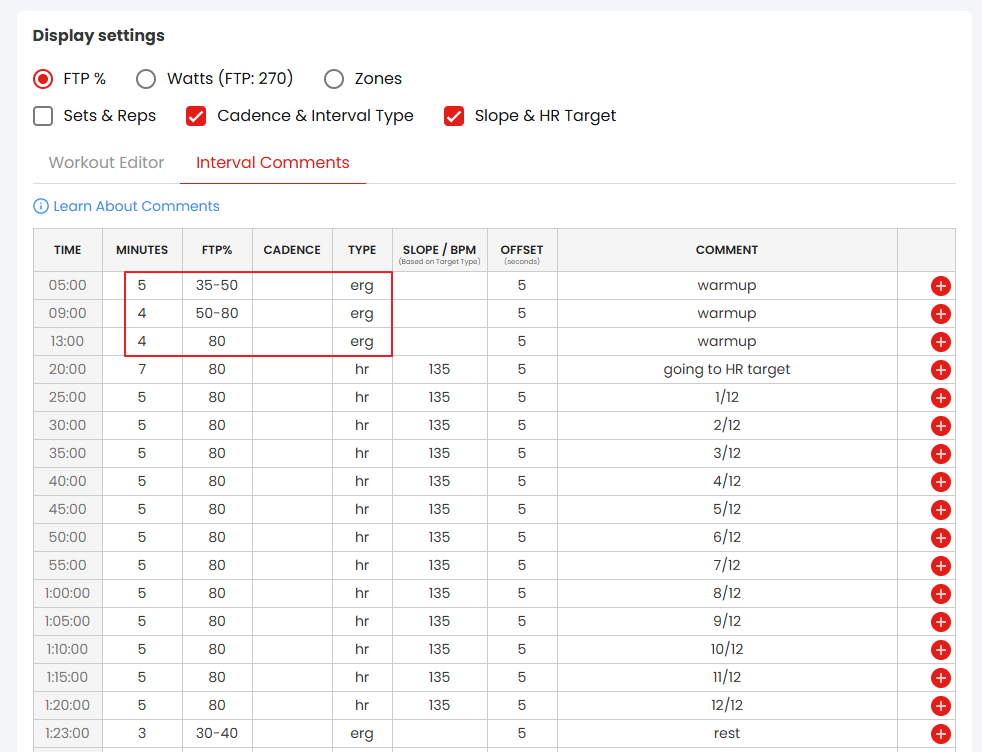
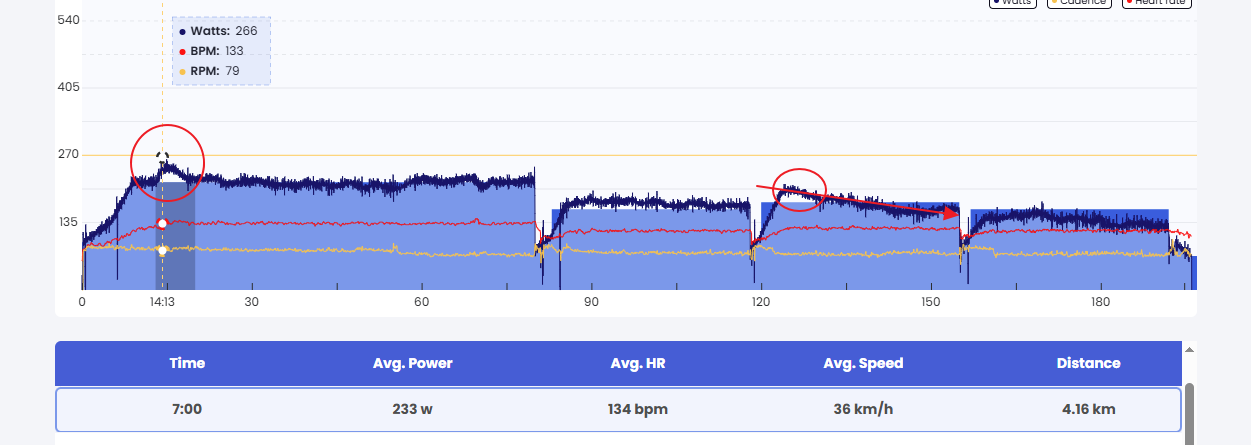
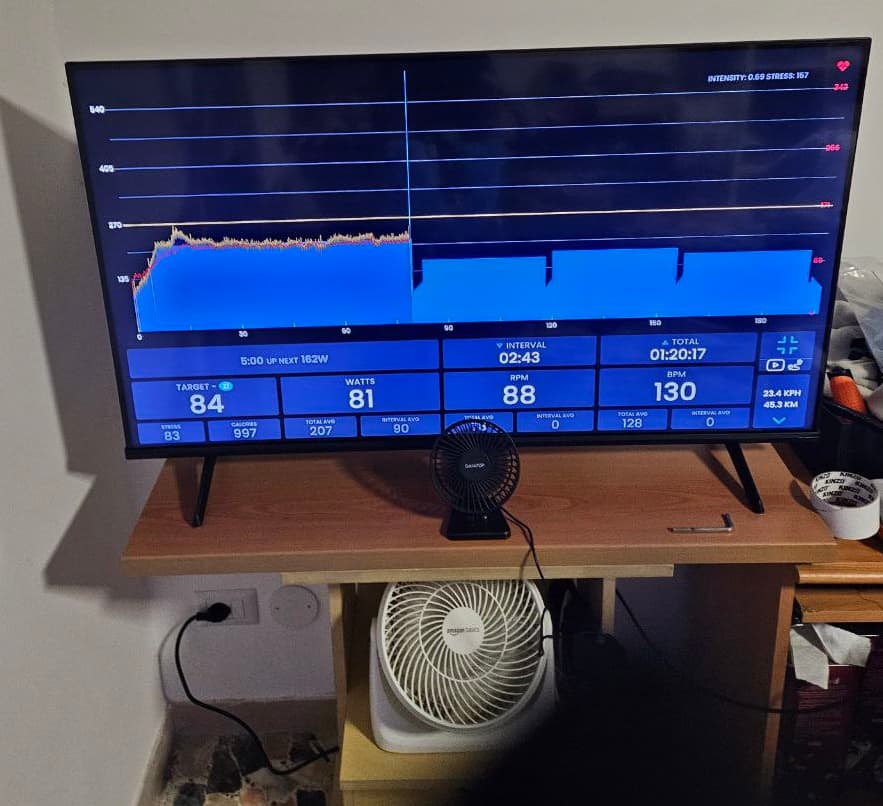
For the first 13 minutes I train using erg mode, not hr+ mode. This way I can do warm-up more gradually (without power pushed higher and higher while the HR rises but is not stable yet). The goal is to target, in erg mode, the power you’ll sustain in HR+ mode and avoid “power bumps”. Only the last 7 minutes of my warm-up is done in HR+ mode, and, when I start It, I try to stay already at my hr target. Yesterday I was a bit below (I felt a bit stronger and my HR wasn’t going up easily :)) and you can see my “bump”:
Bump will drive you in anaerobic zone (also if HR is in aerobic zone, don’t forget that there is a delay between higher efforts and consequent higher bpm).
These kind of aerobic tests should be done with lot of attention to details like these mentioned, otherwise it’s easy to get screwed results, or completely invalidate the benefits of aerobic training (if your body will produce lactate, like during anaerobic efforts, it will take 15/20 minutes to clear it, without using fats for fuel and again invalidating the goal of the workout).
Be patient and please try to care about details, it will work. But, also for me, riding “slowly” is not pleasant/funny like pushing harder in anaerobic zone.
I am only slightly in this conversation but one important thing is minimal decoupling only happens at low heart rate for most people. Do a 65% of max hr ride for 90 minutes and see.
Based on what I read there I’ve set my aerobic goal in +15w per year (and increase in efficiency (w/hr) of 0.10 per year - which is more or less 15w/135bpm). The user I quoted moved from 184w to 250w in 4 years with 20 hours of training per week.
This year I’m already around +15w, but I can expect to see diminishing returns over the next years
I suggest, like Maffetone, a longer warm-up, at least 20 minutes. The more the better. I suggest first 15 minutes in erg mode, with first 5 minutes at very low intensity <50% ftp.
Maffetone and others state that starting too fast will trigger the anaerobic methabolism, regardless of hr. And it makes sense because our brain thinks that something triggered a fight or flight scenario. Our goal, instead, is to let the brain/body think that we’re not doing anything special, our hr shouls stay low and the energy should come mostly from the (slow) fats.
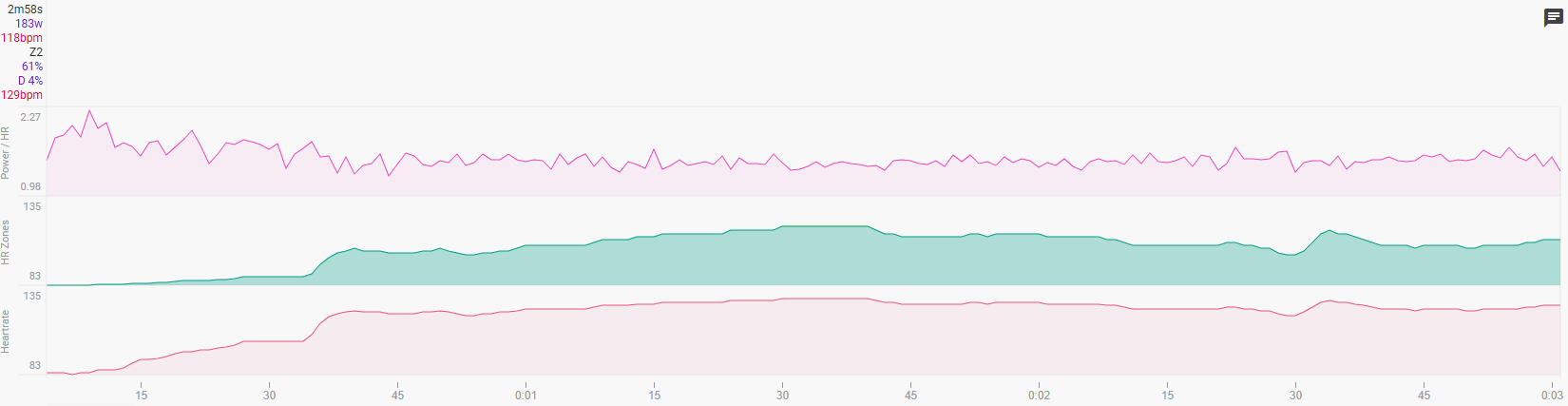
For a MAF HR+ ride, I find that my stretching / activation routine is sufficient that, with HR+ set at 128 (versus MAF limit of 132), my HR doesn’t get as high as 132 these days.
e.g. the first 3 minutes that gets me established at around the target HR, only going as high as 129
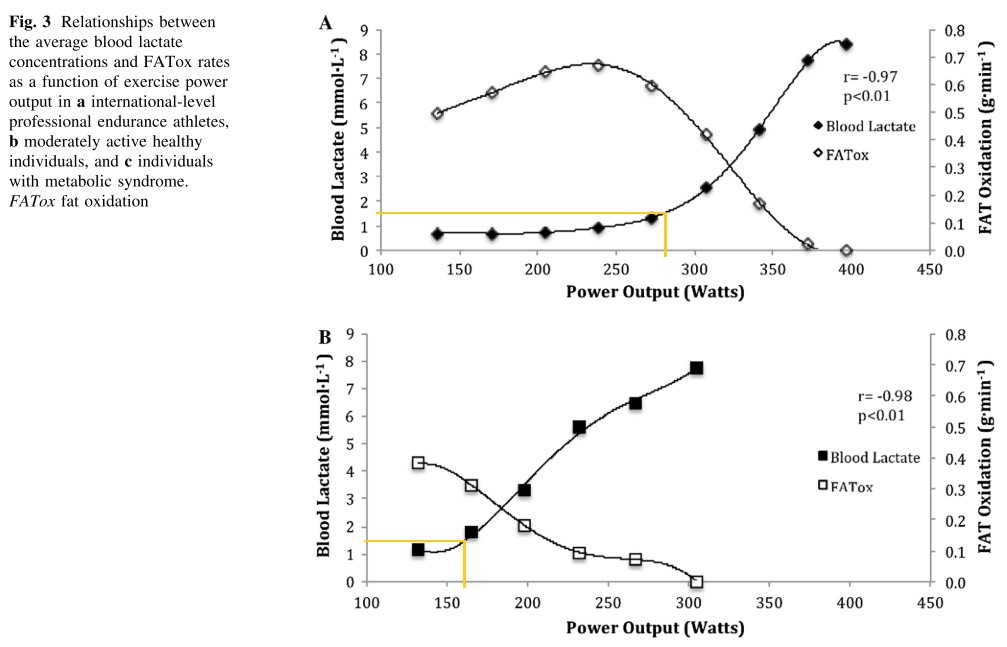
MAF / low HR training must make a decent contribution towards changing the shape of the lines on our own graph, from more like the bottom one, to more like the top one.
That being the case, then the absolute specific value of fatmax becomes less significant as an exact target to train to, because the amount of fatox that happens across a bigger power range grows substantially.
It might still be a nice to know number that could be used in training, but by changing the shape of the curve, there is room to pretty much double (and more) the fatox rate across a very wide power range.
 it requires a lot of time and I think you can expect a small improvement in 3 months of such training (I think 10/15w?)