Clearly, he has worked very hard to achieve an excellent level of fitness.
For the rest of us though unless our goals require such hard work I don’t think there’s a reason to push ourselves to that extent. For example, you only need to train to race the 200 mile Unbound race if that is your objective.
If I recall correctly Coggan estimated that the average male could get to 3.9 W/kg for FTP if they worked hard enough at it, that happens to work out to a FTP of 293 W at 75 kg weight and requires a ton of really hard work.
Maybe that fictional average male would be able to do 85% of 293 W or ~ 250 W at tempo without carrying too much fatigue. That is less than the example here so genetics certainly play a role.
The point I am making is that it is not hard work. Not hard work compared to, say a trainer road plan. Or compared to plans I have seen proposed by (quite expensive) coaches.
It is a time commitment. I recognise that I am in a very fortunate position to have a couple of hours of training time most days.
Once someone has nailed consistency, frequency and duration, the fact is that these low HR based workouts are less hard than threshold / VO2 / Sweetspot based plans.
I wouldn’t go so far as to say they are easy. It is work and it needs fuelling and recovery. But it is (ime) way more sustainable than higher intensity stuff.
Since I started to focus on this type of work, I have not increased the time I train for, nor the duration of my workouts. I have, essentially, replaced other types of workout with lower HR stuff.
I can’t see how anyone doing the same would not find the overall workload ‘easier.’ It might even be that the reduced fatigue enables you to up the frequency or duration of your workouts.
Maybe there is a minimum effective dose for this sort of work, below which more intensity is required? But, if you can cope with a month or two of ‘boring’ winter training sessions, it is well worth considering.
I agree with everything you are saying and your whole approach to this but obviously their is a strong vo2max genetic to all of this as well as training history consistency, and yes life factors, but no matter what you applied yourself the “problem” in a quality way.
You are extremely likely to be at the naturally stronger end of aerobic genetics, and some balance of that and consistent good work. But I love that you are sharing the message, you don’t have to kill yourself to get to your own personal decent level of fitness even if that is a level that most dream of.
I even wonder if there are other either genetic or learned physiological “skills.” Durability for sustained intensity… I realize this is not upper sweet spot, but obviously even just having your FTP set at a more realistic value plays a critical role in how reasonable this… If I was you, my ftp would be a short ramp test results of 400 and I would be wearing it on my jersey… joking… and doing tempo would be very hard work…
Using the time you have available to train base aerobic fitness - which is what I am doing now - can be done without absolutely destroying yourself all the time. It took me a long time to properly accept that and I wish I had accepted it sooner.
Once you can consistently fill your available time with MAF and similar riding, for a couple of months, the results will start to show.
After that point, some combination of curiosity, a plateau on your MAF test, or something else, will mean that you want to try something different.
Whatever motivates and enables you to maintain consistency is the correct choice.
Having MAF, or Zone 2, or whatever you settle on as your aerobic work, can always be your default setting, with the other stuff building on top of the increasingly effective aerobic capability you can continue to develop and maintain for many years.
Getting the best gains in VO2 does require some really, really hard sessions. That is a price worth paying: VO2 improvement / maintenance is hugely beneficial. But they don’t need to be done every day and they can be skipped altogether for significant periods of time - as long as a decent volume of good aerobic work is being maintained.
Because I am doing this aerobic development based on HR: MAF mostly, with a little 80% - 83% HRmax, then I am merely observing power and other numbers. I will keep looking at the TR AIFTP, but I don’t see the need to do a test, or even to know FTP, until (if) I decide to do some power based workouts as Spring approaches. If I ever reach the lofty heights of 400, I will be amazed.
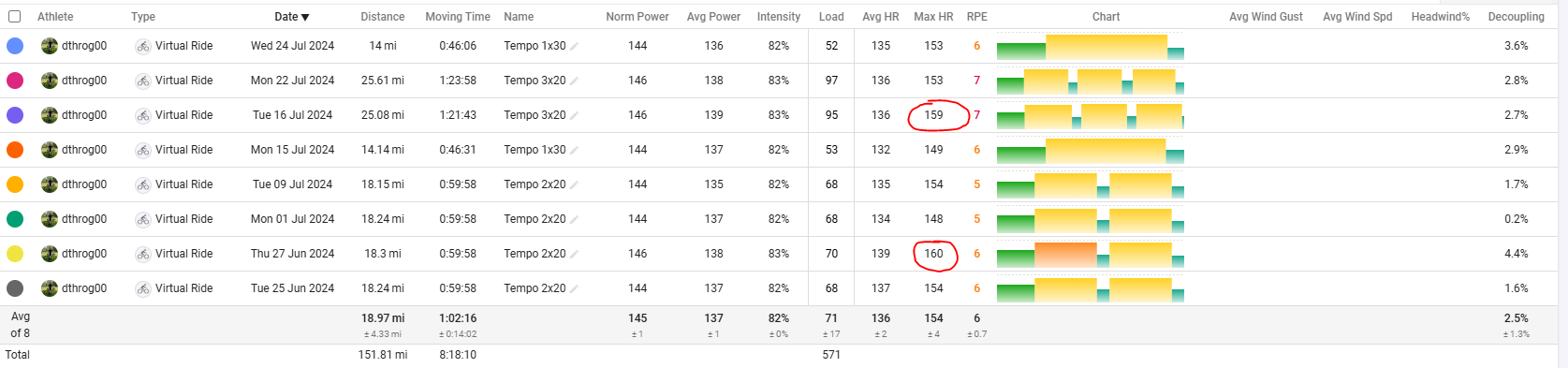
I looked at my 2024 Steve Neal inspired tempo workouts and I had previously recalled incorrectly. I didn’t bail from the tempo workouts. I actually kept doing them for a 5 week block, considered the block finished, and then started a sweet spot (actually threshold due to FTP issue) block that was a failure.
My inspiration at the time was the same batwood thread along with a Steve Neal thread on a different forum at that time.
I did the workouts by power and found decoupling was actually quite good. The worst decoupling the whole time was 4.4%. Two of the workouts in the build violated the 83% max HR governor.
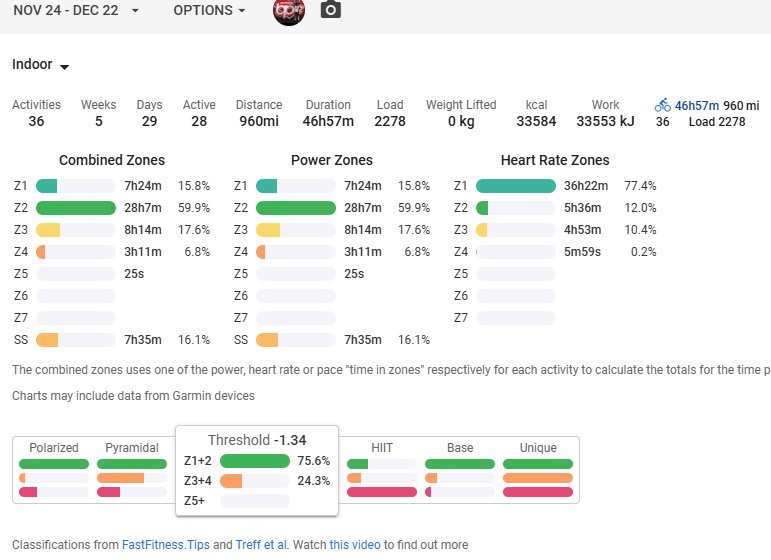
In the period, I have done MAF rides, some <60%FTP endurance rides and 2x “steve neal fatmax” rides per week. The intervals summary is below (I did just one outdoor ride in the period, a 3.5 hour steady group ride with a cafe stop). I was curious how TR’s algorithms would respond…
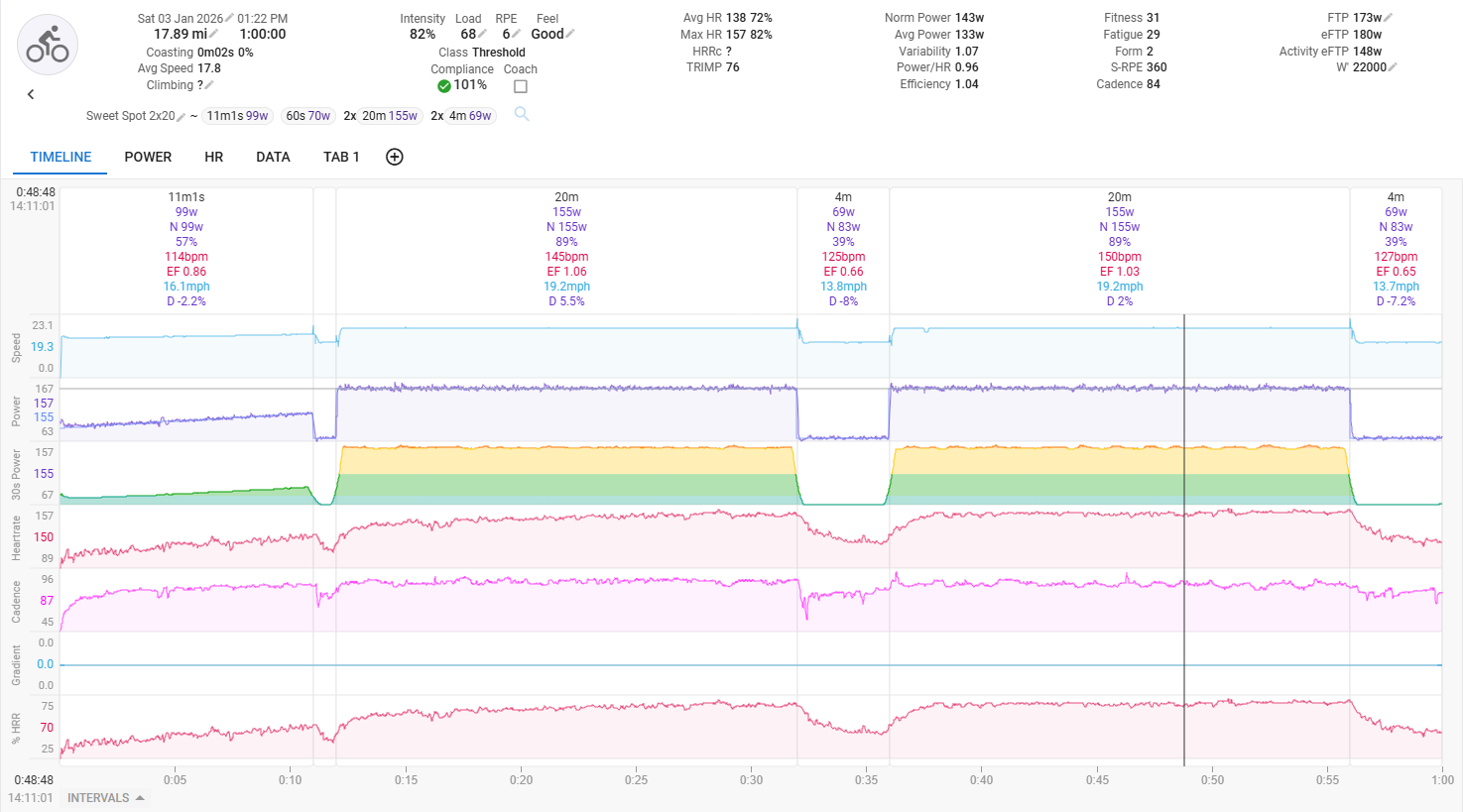
I did an accidental fat max workout today at least if you use the 83% HR governor concept. My goal was to do a 2x20 at 90% and I completed it successfully. My max HR for the workout was 157 BPM just under the governor of 158 BPM. The HR spike was a transient as I only spent 19 seconds at 156 BPM or higher.
I’ve been so afraid of intensity, but I’m not sure what exactly I’m afraid of. I feel on top of the world after today’s workout, it was competitive with my mid-2024 glory days. I only had 3.1% decoupling across the two 20-minute intervals!
I was originally going to do a polarized block, but had some doubt. I had been given some thought to trying a 4-week block of twice weekly 2x20s at 90% along with some Z2 filler and a forced recovery in week #4 and wanted to validate the concept.
Coincidently and not related to the block selection, I watched the same GCN Z2 video that you referenced. For my specific use case, a middle aged guy who only devotes 4-6 hrs a week typically to cycling, I think I have over leveraged Z2 as a strategy, particularly on the indoor trainer.
If the available levers are frequency, duration, and intensity and I can’t/won’t increase frequency or duration, particularly during the winter with freezing temperatures and only riding inside, I think some level of intensity is in order.
I plan to go fully unstructured once it is nice enough to go back outside.
Amazing, yes I think you are primed. If harder training does not negatively affect your sleep, you feel good in general, maybe monitor some hrv…. Then do it. Enjoy it.
That’s a nice workout, completed well. Good stuff.
For the rest of your 4 week block, you have a choice to make now: do you do 2x20 again (and again)? Or do you go for longer intervals? Time in Zone is an obvious way to progress this. Maybe a conservative increase to 2x22? Or to 2x25? Then 2x30 before the rest week?
The 14 minute GCN video seems to have done a good job of convincing you! As you wrote, if you are going to maintain frequency and duration, then increasing intensity is the only lever you have to work with.
Stay aware to how much load you are adding and how much fatigue that causes. “Recoverable load” is the key phrase, isn’t it?
If you go from 6 hours of Z2 per week to 6 hours of sweetspot per week, that is a significant jump up.
It is probably better to add the higher intensity workouts gradually. Make one of your weekly workouts a higher intensity one in week 1. If you feel OK in week 2, make a second workout a higher intensity one.
Maybe stick with 2 higher intensity ones for a couple of weeks before upping the intensity of a third. etc. etc.
The GCN video didn’t convince me, I’ve been thinking about this since my post in this thread 14d ago. It is an interesting data point though. Next week they’ll probably have a pro zone 2 guy on Regardless, I think my volume is far too low to be too Z2 reliant.
I did a VO2 sample workout on Tuesday and was thinking about that along with the Z2 block I did in December, and the tempo training in the past. The quote I gave about frequency, duration, intensity is a Coggan one if I recall.
My idea for the block is to keep it dead simple, do 2x20s on Tuesday/Thursday and add some zone 2 time on the weekend. Most importantly include a deload in week #4. I’ve found that when I’ve been tired, unmotivated, etc… it always follows a period of high load without recovery.
If I start crushing these workouts then maybe it is time to increase, but I would rather just focus on consistency and get through 4 weeks of this. I like the idea of finishing 4 week blocks.
Are you staying with the fat max block or did you move onto something else?
If someone tried to follow a training plan based on doing everything in GCN videos, they would only have time to get off the bike to run to the gym!
A solid 3 work/1 rest block of 4 weeks seems a good idea. Not long enough to get bored / tempted by something else, a good recovery week at the end of it and long enough to see results. There will be a definite satisfaction from finishing the blocks too.
I finished my “fat max” block on 24 Dec and then did a couple of MAF rides. This week is a recovery week - the last day of which is today.
I think I will do another month of fatmax type stuff starting next week. HR+ controlled, with the target set at about 81% to allow a bit of headroom, and with the aim to extend time in zone. Two workouts per week to get from 2x30 to 1x90 (2x30, 1x60, 1x65, 1x70, 1x75, 1x80, 1x85, 1x90) with the rest of the week MAF. Something like that.
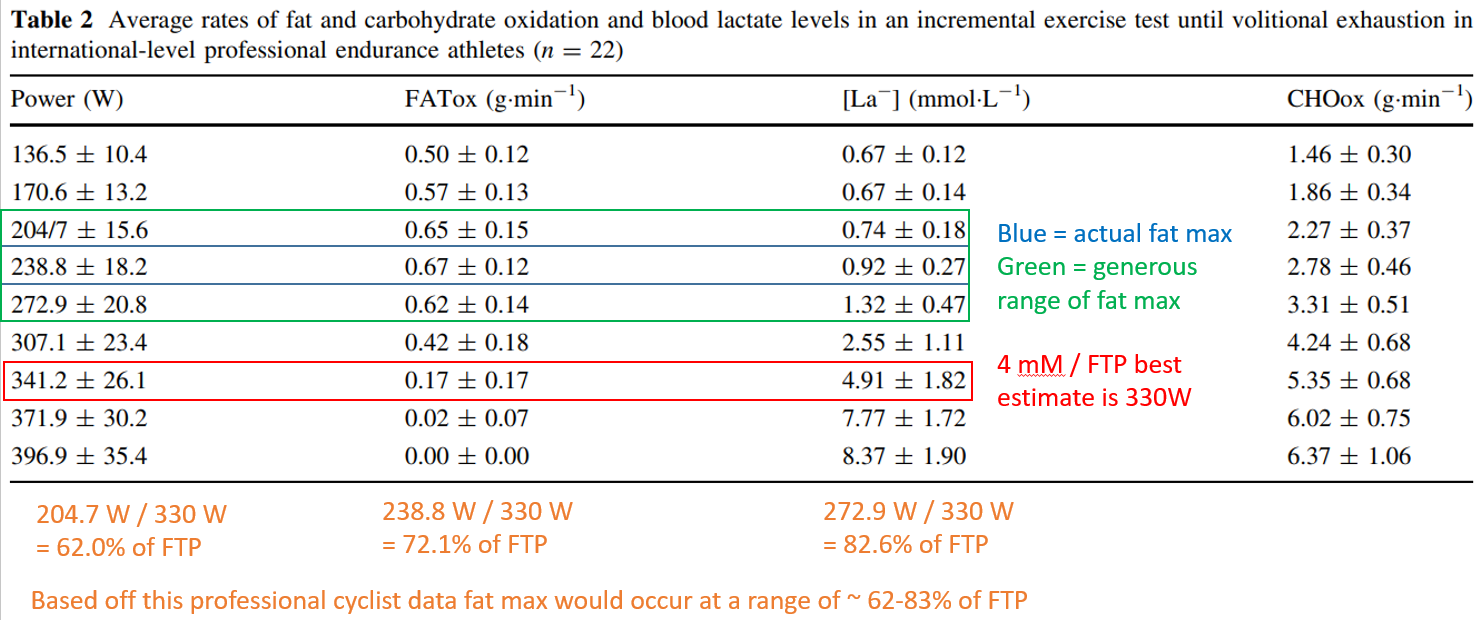
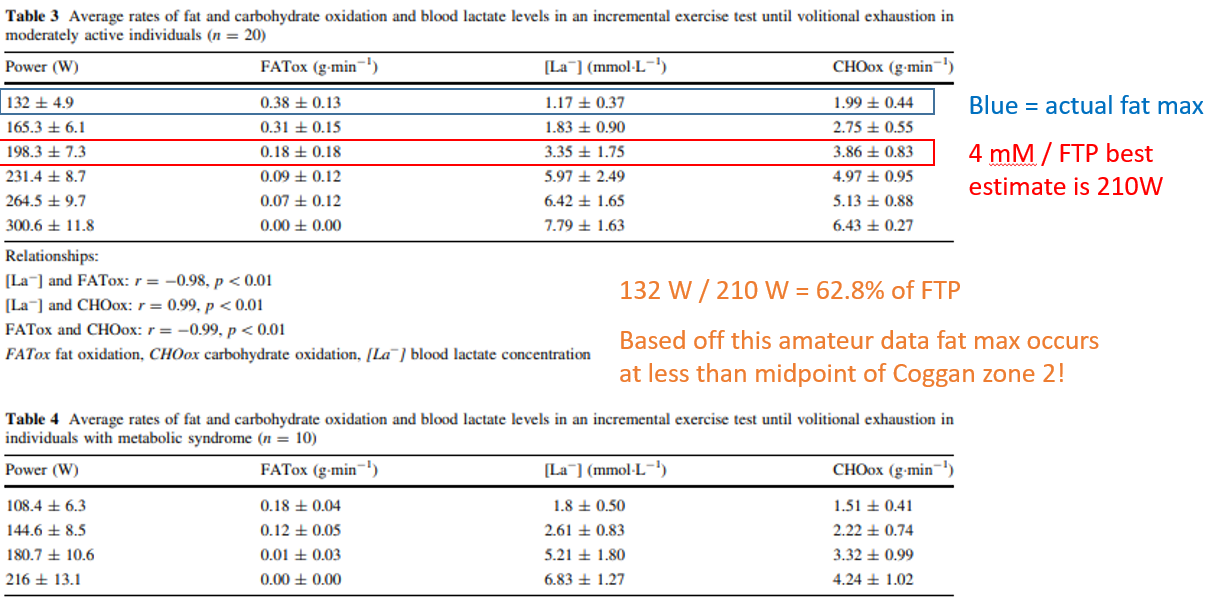
The data says to me that fat max occurs at much lower intensities than we’ve been led to believe, at least when following the dietary approach used in the study. While the Steve Neal 83% of HR max is probably a very good suggestion for quality workouts that effort level most likely does not correlate very well to fat max for most people.
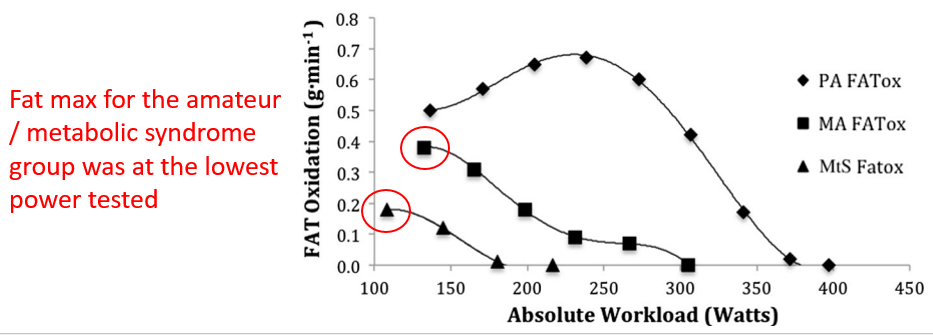
The professional group even had fat max at ~ 72% of 4 mM lactate (approximate FTP). The amateur group had fat max at ~ 63% of 4mM lactate (approximate FTP). Each the amateur and metabolic syndrome groups had fat max at the lowest power tested.
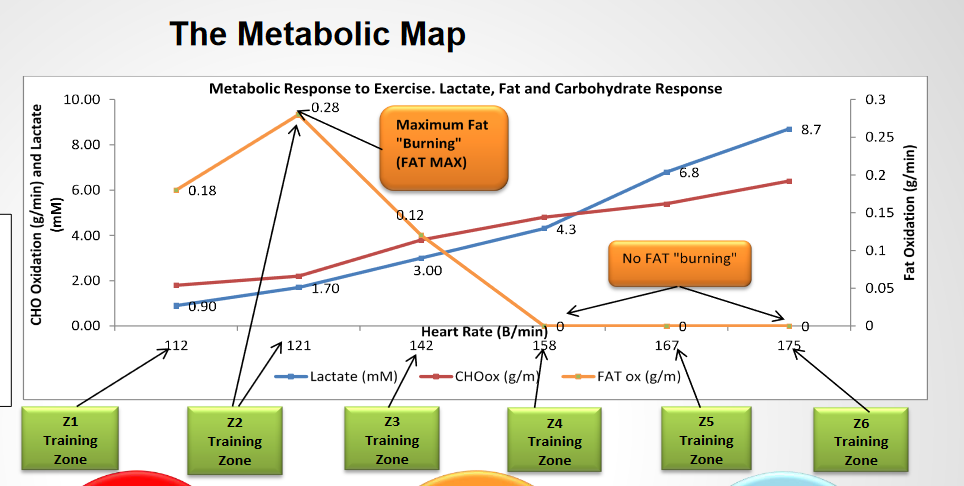
The lactate at fat max for the pro group was 0.92 mM and for the amateur group was 1.17 mM. The metabolic map that San Millan previously disclosed does not make sense when compared against his own study. San Millan’s Zone 2 is presented as occurring with 1.70 mM lactate and 0.28 g/min fat oxidation? What?! Both contradict the study’s data. The only group that possibly matches the metabolic map is the metabolic syndrome group and that couldn’t possibly be the population that he is primarily talking to on the podcast circuit.
I try to be very measured in my posts and not resort to hot takes, etc… but I can’t help myself in this instance.
San Millan zone 2, train under LT1, Attia’s exercising for longevity, etc… is collectively on very shaky ground. Coggan says train for performance and let physiology sort itself out and I think he’s probably right.
I understand nearly the entirety of the “zone 2 industry”, including test sites services such as INSYCD and notable influencers such as Attia and San Millan, that say fat max occurs at ~ LT1. Using lactate in training to control fat metabolism
San Millan’s own study discredits the idea. The data says it just isn’t true. Fat max occurs at much lower lactate levels for every group in the study.
Not to repeat myself, but the average pro in the study sees fat max at just 72% of 4 mM power and the average amateur at 63% of 4 mM power. This is not even close to what has been sold.
I’m so tired of the influencers – and not just in the cycling space either. I think there are similar issues in the health space, etc…
@Alex is the rare person in the cycling space who is in a position of power and uses it to try and help people.
Thanks Dave, I am also turned off buy many of what we call influencers these days. There are still some that seem to be fun entertainers and educators but it seems more and more people don’t stay true to themselves and just produce content that sells.
San Milan did a great job helping spread the message of Zone 2 but to me he wavers on the side of influencer…. I don’'t pay too much attention to him and for sure not GCN when it comes to training advice… I mean it’s all good if it helps motivate people. I watch GCN to some degree.
Overall any time you try to map lab tests and math to training things are going to get fuzzy…. I believe most of the benefit of any of this stuff is finding intensity levels that produce the desired effect in you. We are all over the place in what will work for us as individuals. I do zone 2 because I have to… Daily high intensity would be great if I did not fall apart.
The data looks pretty messy to me. The +/- range is pretty big on most data points.
Anyone interested in their own fatox curve is probably best advised to go and get it measured.
I have questions: if I go to the lab tomorrow and get my fatox curve after a 15 minute warm up, would it be the same 2 hours into a workout? after 2,000 kJ of work? when it is hotter / colder? is it directly correlated to just lactate? how about the effect on it of HR? cadence? etc. etc.
You mention Coggan and you may have seen his appearance on Inside Exercise from April 2023. There is a chapter in the video titled “Don’t need to burn fat during exercise to optimise fat use adaptations” and a later one “Andy questions some interpretations of San Milan”
I really like the 85% FTP (capped by 83% HR max) workouts and have had good improvements on my own power / duration curve as a result of using them. I will continue to use them.
Ohers say the intensity is too low for them to be effective. Others say the intensity is too high in terms of fatigue accumulation for the fitness yielded.
Like all training, it is there for anyone to try. If it works, great. If it doesn’t, there are plenty of other workout types to try.



 Regardless, I think my volume is far too low to be too Z2 reliant.